
“Hydrolyzed Sponge” usually refers to Hydrolyzed Sponge Collagen (or Spongin), a processed form of natural marine sponge protein, commonly used in cosmetics, pharmaceuticals, and biomedical applications.
Chemical Structure of Hydrolyzed Sponge
Hydrolyzed sponge is generally derived from marine sponges and contains a mixture of collagen-like proteins, glycosaminoglycans, and peptides. The hydrolysis process breaks down the larger sponge proteins into smaller peptides and amino acids, which are more water-soluble and biologically active.
Primary components:
- Collagen-derived peptides: Short chains of amino acids such as glycine, proline, and hydroxyproline.
- Glycosaminoglycans (GAGs): Sulfated polysaccharides that can interact with water and skin cells.
- Minor compounds: Minerals, trace elements, and other marine biomolecules.
Structural characteristics:
- Polypeptide chains are hydrophilic, enhancing solubility in aqueous solutions.
- Presence of amino acid sequences similar to human extracellular matrix proteins.
- Molecular weight: Typically 1,000–10,000 Daltons depending on the degree of hydrolysis.
Physical Properties of Hydrolyzed Sponge
| Property | Description |
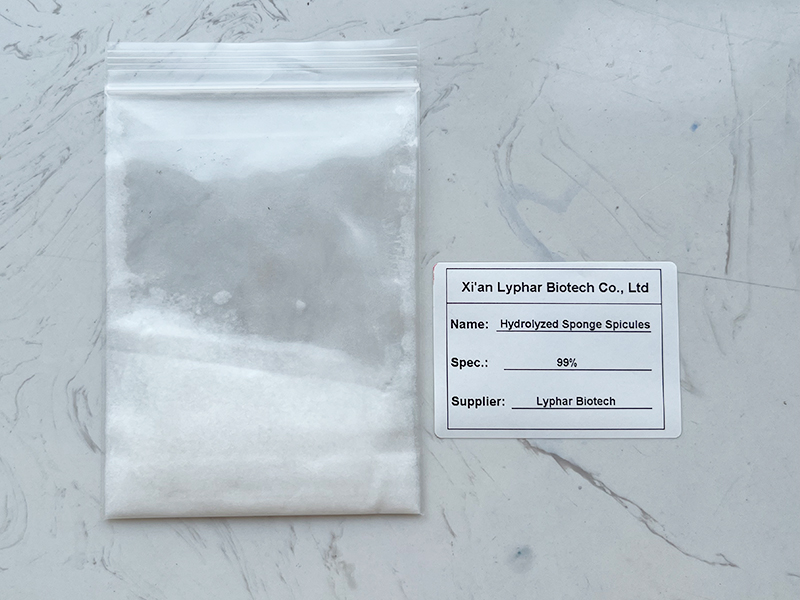
| Appearance | Light yellow to beige powder or viscous solution (depending on preparation) |
| Solubility | Highly soluble in water; insoluble in non-polar solvents like hexane |
| Odor | Slight marine or “sea-like” smell due to amino acids and peptides |
| pH | Usually slightly acidic to neutral (pH 5–7 in solution) |
| Hygroscopicity | Highly hygroscopic; absorbs moisture from air easily |
| Viscosity | Low to moderate in solution; depends on concentration and molecular weight |
| Stability | Stable at room temperature when dry; sensitive to high heat, strong acids, or oxidizing agents |
Key Notes
- Hydrolyzed sponge is biocompatible, which makes it suitable for cosmetics, skincare, and tissue engineering.
- The molecular weight distribution is crucial for its absorption and bioactivity.
- Its hydrophilic nature helps retain moisture, making it a common ingredient in hydrating formulations.