
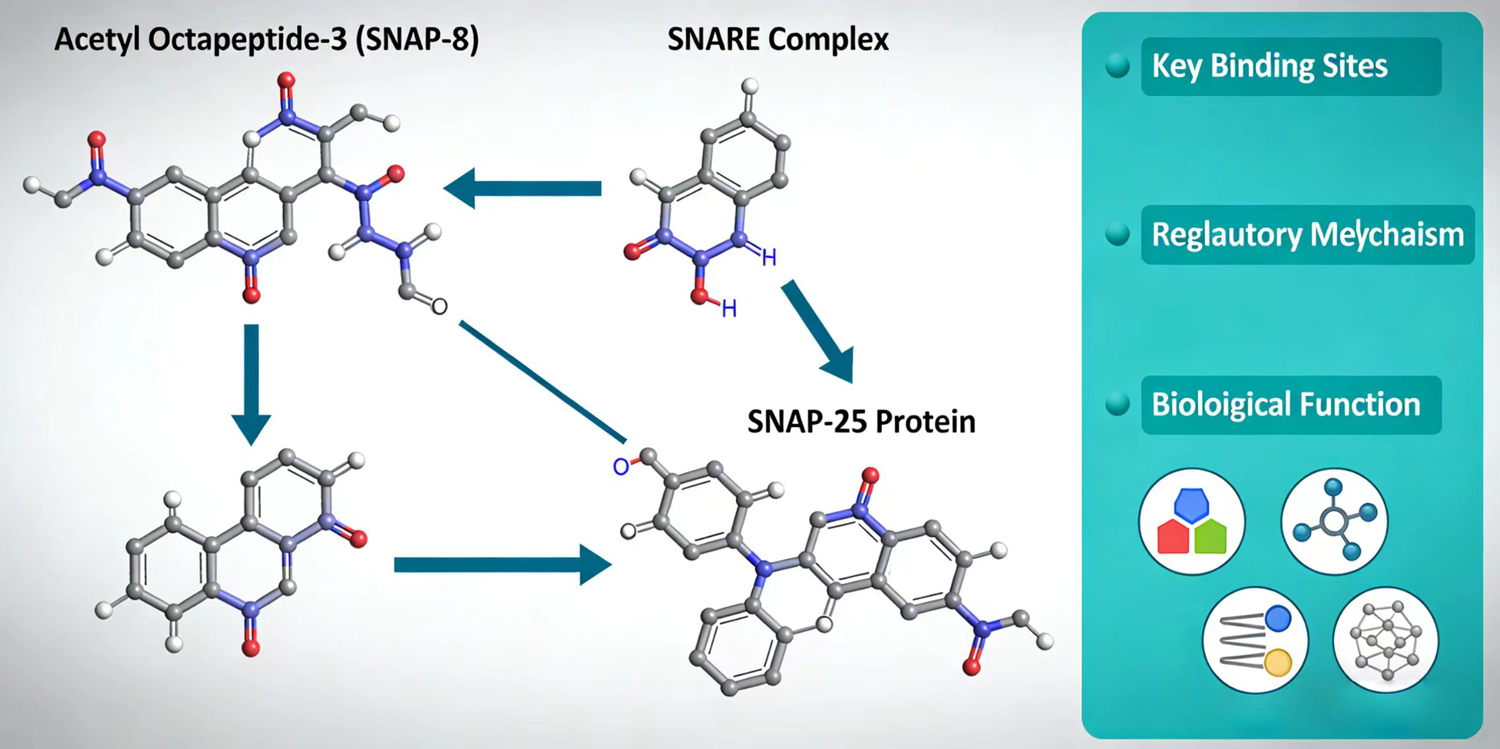
Acetyl Octapeptide-3/SNAP-8 is a synthetic peptide composed of eight amino acids designed to mimic part of the SNAP‑25 protein involved in the SNARE complex — a fundamental protein assembly that enables neurotransmitter release at neuromuscular junctions.
- Full sequence (example reported): Ac-Glu-Glu-Met-Gln-Arg-Arg-Ala-Asp-NH₂.
- Molecular weight ~1075 Da.
- Developed as an extended analog of Argireline (Acetyl Hexapeptide‑3) to improve activity and stability.
1. Mechanism of Action
Biochemical Mechanism
- Acetyl Octapeptide-3/SNAP-8 is believed to mimic the N‑terminal end of SNAP‑25, interacting with the SNARE protein complex.
- By doing so, it competitively inhibits SNARE complex formation, which reduces acetylcholine release at the neuromuscular junction, thereby decreasing muscle contraction intensity.
This mechanism is biochemical and localized — unlike botulinum toxin, which cleaves SNAP‑25 and causes prolonged paralysis. Acetyl Octapeptide-3 (SNAP-8) does not cleave proteins and does not cause lasting paralysis; rather, it is hypothesized to modulate muscle micro‑contractions relevant to expression‑line formation.

2. Research on Efficacy
Clinical Cosmetic Studies
Studies referenced in cosmetic literature report significant reductions in wrinkle depth after topical application of Acetyl Octapeptide-3/SNAP-8 formulations (often in creams or serums). Reported outcomes include:
- Up to ~63% reduction in wrinkle depth after ~28 days of twice‑daily use with a 10% formulation.
- Observable improvements in skin smoothness and expression lines (e.g., crow’s feet, brow lines).
- Some studies found improvements earlier (e.g., ~21% in the first week), with maximal effects around 4–8 weeks.
Mechanistic and Pre‑clinical Studies
- Acetyl Octapeptide-3/SNAP-8 model systems show inhibition of SNARE‑mediated exocytosis and potential changes in neuromuscular signalling at superficial tissue depths.
- Formulation science investigations have focused on enhancing transdermal penetration, improving delivery vehicles to help peptides reach their target tissues.
Comparative Research
- Compared to Argireline (Acetyl Hexapeptide‑3), Acetyl Octapeptide-3 (SNAP-8) has been reported to have approximately 30% greater activity in certain cosmetic efficacy assays, presumably due to the extended peptide sequence.
3. Safety Profile & Side Effects
General Findings
Acetyl Octapeptide-3 (SNAP-8) is widely used in cosmetic research and consumer products for topical use only; it is not FDA‑approved as a drug or injectable.
Short‑term tolerability is generally good, with most adverse effects limited to mild, local skin responses:
- Mild irritation or redness.
- Temporary sensitivity in some individuals.
Limitations of Safety Data
- Long‑term safety and systemic effects are not well documented in peer‑reviewed clinical trials.
- The majority of safety data come from cosmetic study settings or manufacturer reports, not large independent trials.
4. Limitations & Critical Considerations
Penetration & Mechanistic Uncertainty
- Peptides like Acetyl Octapeptide-3/SNAP-8 are relatively large and hydrophilic, making percutaneous (through the skin) penetration a challenge. Some research suggests only a small fraction may reach deeper tissues without enhanced delivery methods.
Study Design Limitations
- Many efficacy data come from small sample sizes, short study durations, or sponsor‑funded research designed to favor positive outcomes.
Commercial Misrepresentation Risk
- Some cosmetic marketing may overstate “Botox‑like” effects. Biochemically similar pathways do not imply clinical equivalence to neuromodulators like botulinum toxin; real clinical outcomes are generally milder and more gradual.
5. Research Gaps & Future Directions
Independent Clinical Trials
There is a need for:
- Large, double‑blind, placebo‑controlled clinical trials on Acetyl Octapeptide-3 (SNAP-8) efficacy.
- Long‑term safety studies beyond 28–60 day cosmetic evaluations.
- Mechanistic penetration studies on how much peptide actually reaches target tissues in intact skin.
Formulation Research
- Work continues on nanocarriers, microneedle delivery, and synergistic combinations with other active cosmetic ingredients to improve penetration and efficacy.
Comparative Efficacy
More comparative research is needed between Acetyl Octapeptide-3/SNAP-8, other neuropeptides, and traditional neuromodulators to establish real differences and optimize cosmetic formulation.
Summary
| Aspect | Key Points |
| Identity | Synthetic octapeptide designed to modulate facial micro‑contraction pathways. |
| Mechanism | SNARE complex modulation → reduced acetylcholine release. |
| Efficacy | Up to ~63% wrinkle depth reduction in cosmetic studies; more robust data needed. |
| Safety | Generally well‑tolerated topically; limited long‑term/scope data. |
| Limitations | Penetration challenges and small, often sponsor‑linked studies. |
| Research Needs | Independent clinical trials, enhanced delivery methods. |
If you want, I can also provide a literature table with references (authors, study design, results, exposure conditions) for all published research on Acetyl Octapeptide-3 (SNAP-8) specifically. Want that?