
Dimethylmethoxy Chromanol (DMC) is a chromanol derivative, structurally related to Vitamin E (tocopherols). Its preparation typically involves modification of the chromanol ring, introducing methoxy and methyl groups at specific positions.
General Reaction Scheme
The preparation of Dimethylmethoxy Chromanol usually involves:
1. Chromanol core synthesis
- Start from a hydroxychroman or tocopherol precursor.
2. Methylation
- Introduce methyl groups on the phenolic hydroxyls or the chromanol ring.
3. Methoxylation
- Convert a hydroxyl group (-OH) into a methoxy group (-OCH₃) using a methylating agent.
4. Purification
- Purify via column chromatography or recrystallization.
Materials and Reagents
Typical reagents include:
- Hydroxychromanol or a tocopherol derivative
- Methyl iodide (CH₃I) or dimethyl sulfate ((CH₃O)₂SO₂) as methylating agents
- Base: potassium carbonate (K₂CO₃) or sodium hydride (NaH)
- Solvents: acetone, dichloromethane (Dimethylmethoxy Chromanol), or ethanol
- Purification agents: silica gel, recrystallization solvents (hexane, ethyl acetate)
Stepwise Synthesis (Representative Method)
Step 1: Activation of Hydroxyl Group
- Dissolve the chromanol precursor in a dry solvent (e.g., acetone).
- Add a base (e.g., K₂CO₃) to deprotonate the phenolic hydroxyl.
- Stir at room temperature until the hydroxyl is fully activated.
Step 2: Methylation
- Add methyl iodide (CH₃I) dropwise under inert atmosphere (N₂).
- Stir at room temperature or slightly elevated temperature (30–50°C) for several hours.
- The phenolic OH group is converted to -OCH₃.
Step 3: Ring Methylation (if required)
- Additional methyl groups on the chromanol ring can be introduced using alkylation reactions.
- Commonly done using Friedel–Crafts alkylation with methyl halides in the presence of a Lewis acid (e.g., AlCl₃).
Step 4: Work-Up
- Quench the reaction with water.
- Extract with an organic solvent (e.g., Dimethylmethoxy Chromanol).
- Wash with brine and dry over anhydrous sodium sulfate.
Step 5: Purification
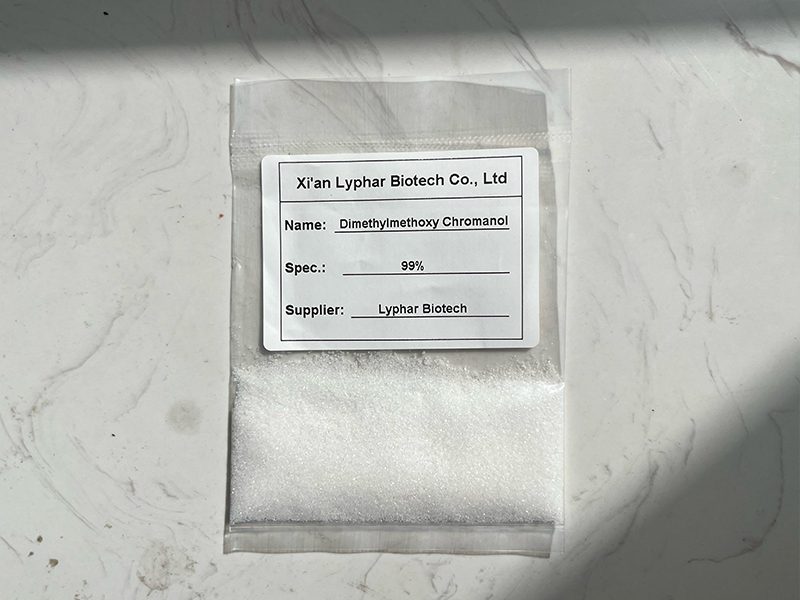
- Purify crude Dimethylmethoxy Chromanol using column chromatography (silica gel, eluent: hexane/ethyl acetate).
- Alternatively, recrystallize from suitable solvents (e.g., hexane or ethanol) to obtain pure Dimethylmethoxy Chromanol as a solid.
Notes
- Reactions must be carried out under dry conditions to avoid hydrolysis of methylating agents.
- Methoxylation efficiency depends on base strength and reaction temperature.
- Avoid excess heat during ring methylation to prevent over-alkylation or decomposition.