
Pyridoxal-5-phosphate is the biologically active coenzyme form of vitamin B6.Here’s a clean, chemistry-focused breakdown of Pyridoxal-5-Phosphate—covering both chemical structure and physical properties.
Chemical Structure of Pyridoxal-5-Phosphate
Basic identity
- Chemical name: Pyridoxal-5′-phosphate
- Molecular formula: C₈H₁₀NO₆P
- Molecular weight: ~247.14 g/mol
- Class: Phosphorylated aldehyde form of vitamin B₆ (active coenzyme form)
Structural features
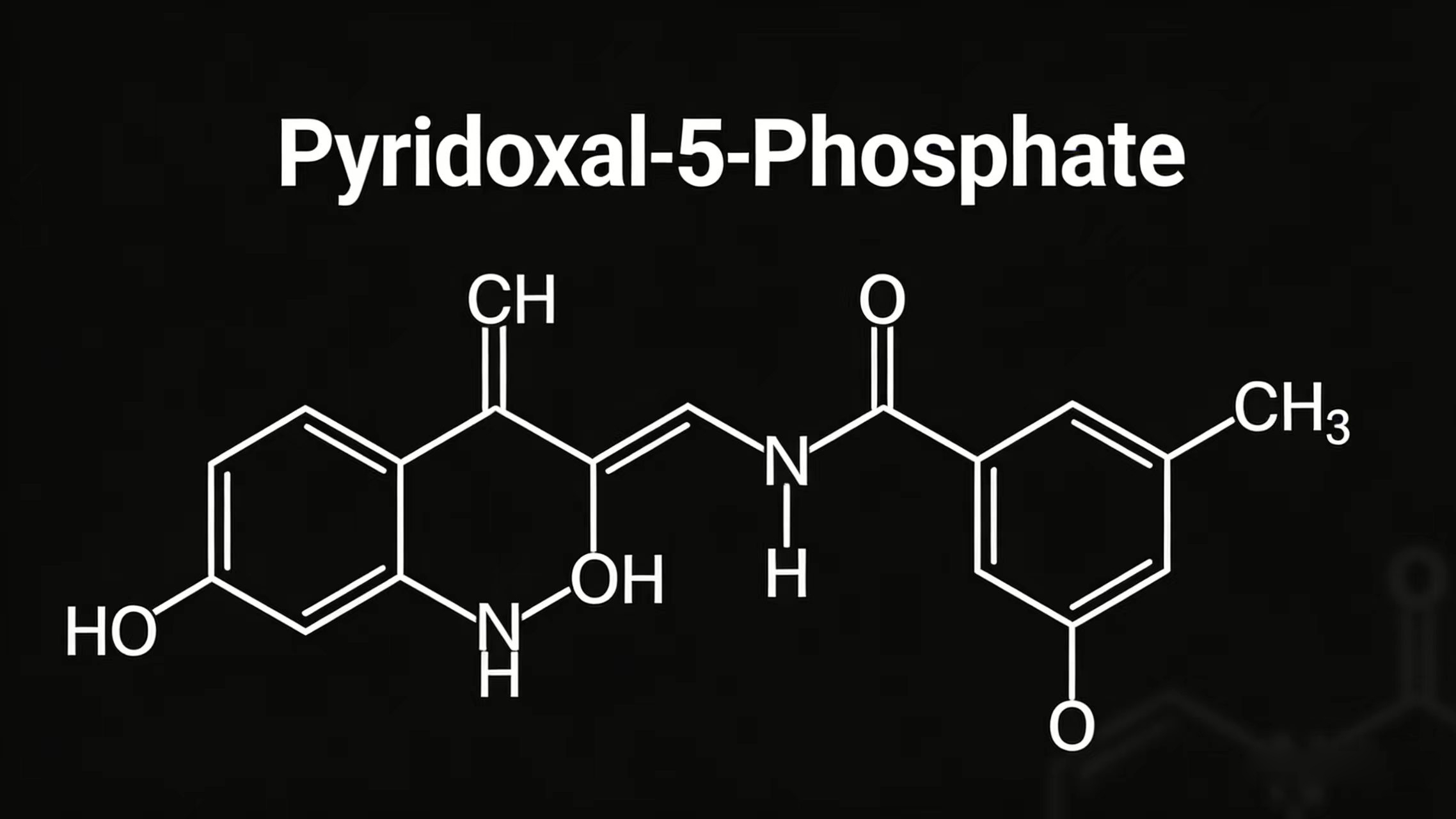
Pyridoxal-5-phosphate is built on a pyridine ring, which is central to all vitamin B₆ forms.
Key functional groups:
- Pyridine ring (heteroaromatic ring with one nitrogen atom)
- Aldehyde group (–CHO) at the 4-position
→ Enables formation of Schiff bases with amino groups
- Phosphate ester at the 5′-hydroxymethyl position
→ Critical for enzyme binding and biological activity
- Hydroxyl group (–OH) at the 3-position
- Methyl group (–CH₃) at the 2-position
Structural significance
- The aldehyde group allows Pyridoxal-5-phosphate to form reversible covalent bonds with amino acids and enzymes.
- The phosphate group anchors Pyridoxal-5-phosphate to enzyme active sites.
- The pyridine nitrogen participates in electron delocalization, stabilizing reaction intermediates.
This structure explains why Pyridoxal-5-phosphate is a universal coenzyme in amino-acid metabolism.
Physical Properties of Pyridoxal-5-Phosphate
Appearance
- Form: Crystalline powder
- Color: Yellow to yellow-orange
- Odor: Odorless or faint characteristic smell
Solubility
- Water: Highly soluble
- Alcohols: Slightly soluble
- Non-polar solvents: Practically insoluble
(High water solubility comes from the phosphate group.)
Stability
- Light sensitivity: Light-sensitive (photodegradation possible)
- Heat: Moderately heat-stable in dry form
- pH stability:
Most stable in slightly acidic to neutral conditions
Degrades more rapidly in alkaline environments
Hygroscopicity
- Hygroscopic: Yes
→ Absorbs moisture easily; needs airtight storage
Other properties
- pKa values: Multiple ionizable groups (phosphate, pyridine N, phenolic OH)
- Ionic character: Exists as a zwitterion or salt form under physiological conditions
- UV absorption: Strong absorption around 388 nm (used in analytical assays)
Structure–Property Relationship (Why This Matters)
- The phosphate group → high polarity & water solubility
- The aldehyde group → high chemical reactivity with amino acids
- The aromatic ring system → photochemical sensitivity
- Multiple ionizable groups → strong pH-dependent behavior
These properties directly explain Pyridoxal-5-phosphate is high enzymatic activity but limited formulation stability in supplements and pharmaceuticals.
If you want, I can also:
- Compare Pyridoxal-5-phosphate is structure with pyridoxine or pyridoxamine
- Explain how the Schiff base mechanism works (with reaction steps)
- Provide a structure diagram description suitable for textbooks or product dossiers
Just tell me