
Tetraacetylphytosphingosine (TAPS) and Phytosphingosine (PHS) are closely related sphingoid compounds used in cosmetic skin-care formulations. Both are associated with skin-barrier support, moisturizing, and skin-conditioning functions, but they differ significantly in chemical structure, stability, skin compatibility, and biological activity.
The most important distinction is that Tetraacetylphytosphingosine is an acetylated derivative of phytosphingosine, designed to modify its physicochemical properties, whereas phytosphingosine is the naturally occurring, biologically active sphingoid base.
1. Basic comparison
| Feature | Tetraacetylphytosphingosine | Phytosphingosine |
| Chemical nature | Acetylated derivative | Sphingoid base |
| Origin | Chemically modified phytosphingosine | Naturally present in skin |
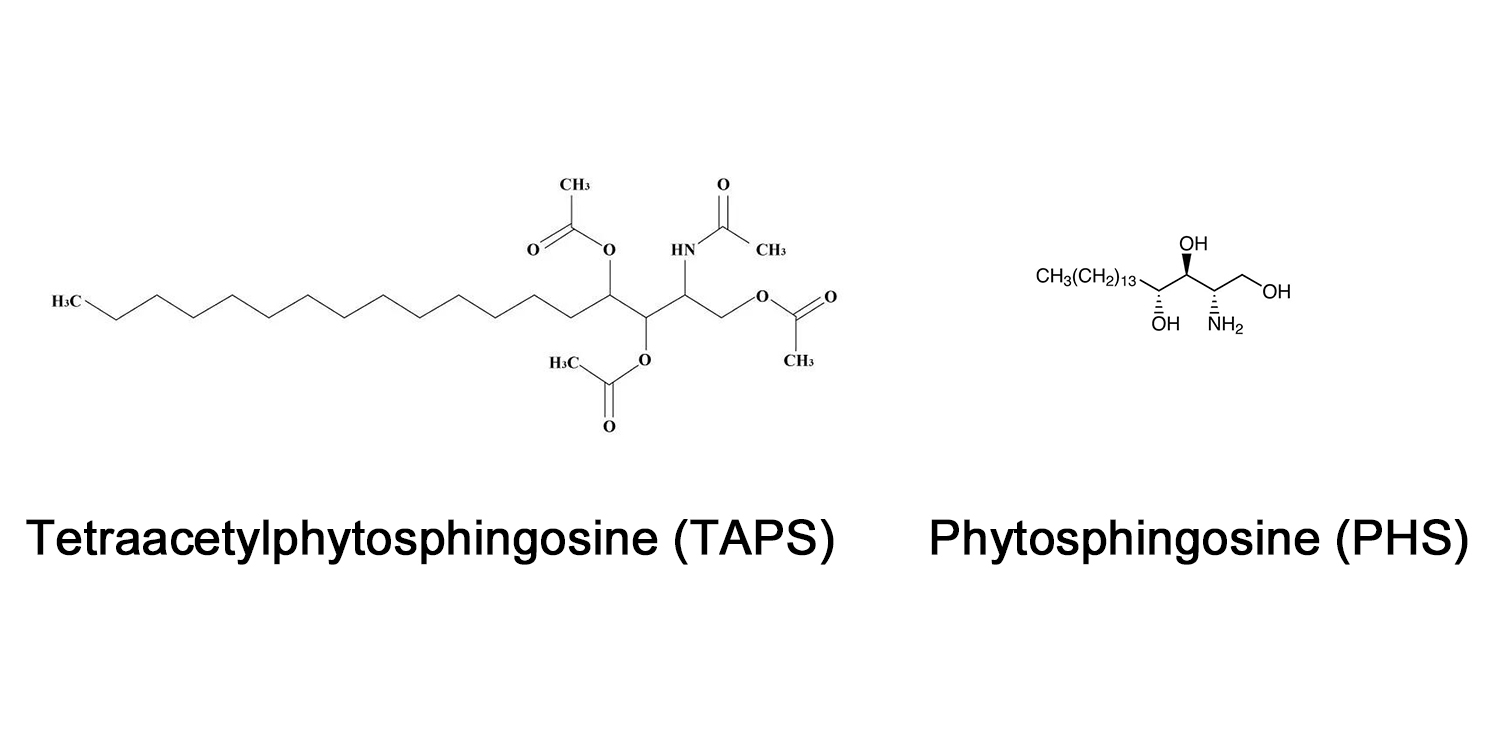
| Structure | Four hydroxyl groups acetylated | Three hydroxyl groups and one amino group |
| Molecular formula | C₂₆H₄₉NO₇ | C₁₈H₃₉NO₃ |
| Molecular weight | Approximately 487.68 g/mol | Approximately 317.51 g/mol |
| Polarity | Lower | Higher |
| Lipophilicity | Relatively higher | Relatively lower |
| Skin role | Potential precursor or delivery-oriented derivative | Direct participant in skin lipid metabolism |
| Cosmetic focus | Barrier care and skin conditioning | Barrier support, soothing and skin conditioning |
2. Chemical structure and properties
The two compounds share the same 18-carbon sphingoid backbone and stereochemical configuration, but differ in the functional groups attached to that backbone.
Phytosphingosine
- Molecular formula: C₁₈H₃₉NO₃
- Molecular weight: 317.51 g/mol
- Chemical name: (2S,3S,4R)-2-aminooctadecane-1,3,4-triol
- Contains three hydroxyl groups (-OH) and one primary amino group (-NH₂).
- Has relatively high hydrogen-bonding capacity.
- Molecular formula: C₂₆H₄₇NO₇
- Molecular weight: 485.65 g/mol
- CAS number: 13018-48-9
- Contains three O-acetyl groups and one N-acetyl group.
- Has fewer hydrogen-bond donors and greater calculated lipophilicity.
The four acetyl groups modify the original hydroxyl and amino functionalities, changing the molecule’s polarity, hydrogen bonding, and physicochemical behavior.
3. Mechanism of action
Phytosphingosine
Phytosphingosine has several biologically relevant functions:
- Ceramide metabolism: It can serve as a structural backbone for phytosphingosine-containing ceramides.
- Skin-barrier support: Its relationship with ceramide metabolism contributes to the organization of stratum corneum lipids.
- Antimicrobial activity: Phytosphingosine has demonstrated antimicrobial activity in experimental settings.
- Skin conditioning: It is used in cosmetic formulations intended to support skin comfort and barrier function.
Research on skin-lipid models has demonstrated that the balance between sphingosine- and phytosphingosine-containing ceramides can influence lipid organization and barrier properties.
Its mechanism is less well characterized in topical cosmetic applications.
Potential mechanisms include:
- Modified lipid compatibility: Acetylation changes the polarity and lipophilicity of the parent molecule.
- Potential precursor function: Enzymatic deacetylation could theoretically generate less-acetylated intermediates and ultimately phytosphingosine.
- Skin conditioning: It is recognized as a skin-conditioning and hair-conditioning cosmetic ingredient.
- Potential barrier support: Its potential contribution to skin-barrier function is related to its phytosphingosine-derived structure, but direct clinical evidence remains limited.
Importantly, it has not been established that topical Tetraacetylphytosphingosine consistently converts into free phytosphingosine in human skin or produces superior barrier repair.
4. Comparison of cosmetic benefits
| Cosmetic benefit | Tetraacetylphytosphingosine | Phytosphingosine |
| Skin moisturization | Potential supportive role | Supports lipid-barrier function |
| Skin-barrier repair | Potential benefit | Better-established biological rationale |
| Ceramide-related activity | Indirect or precursor hypothesis | Direct metabolic relationship |
| Skin soothing | Potential benefit | Cosmetic and experimental support |
| Antimicrobial activity | Insufficient direct evidence | Demonstrated in experimental studies |
| Anti-aging | Limited evidence | Indirect support through barrier maintenance |
| Skin conditioning | Recognized use | Recognized use |
| Hair conditioning | Recognized use | Possible formulation use |
A critical distinction: neither ingredient should automatically be considered a complete substitute for a ceramide-based lipid-replenishing system. Their effects depend on formulation, concentration, delivery, and the overall lipid composition.
5. Advantages and disadvantages
| Category | Tetraacetylphytosphingosine | Phytosphingosine |
| Advantages | Modified chemical properties; potentially useful for specialized formulations | Naturally occurring skin lipid component; established biological relevance |
| Disadvantages | Limited topical clinical research; conversion in skin is uncertain | Formulation challenges related to solubility and compatibility |
| Formulation consideration | Requires suitable oil-phase or solubilization strategy | Requires careful control of pH and formulation compatibility |
| Research maturity | Relatively limited | More extensive biological and lipid research |
6. Future research and development prospects
Several areas deserve further investigation:
- Skin penetration: Whether acetylation improves delivery into specific skin layers.
- Enzymatic conversion: Whether skin enzymes can efficiently convert Tetraacetylphytosphingosine into biologically active phytosphingosine.
- Barrier repair: Whether Tetraacetylphytosphingosine can improve ceramide synthesis or barrier recovery in human skin.
- Stability: How acetylation influences stability during storage and in cosmetic formulations.
- Synergistic formulations: Potential combinations with ceramides, cholesterol, fatty acids, niacinamide, and panthenol.
These are research opportunities rather than established clinical advantages.
7. Final comparison and conclusion
| Evaluation | Preferred ingredient |
| Natural skin lipid biology | Phytosphingosine |
| Established ceramide relationship | Phytosphingosine |
| Experimental antimicrobial activity | Phytosphingosine |
| Modified molecular properties | Tetraacetylphytosphingosine |
| Direct evidence for skin-barrier benefits | Phytosphingosine |
| Specialized derivative research | Tetraacetylphytosphingosine |
| Overall biological research foundation | Phytosphingosine |
Overall conclusion: Phytosphingosine is the better-characterized ingredient for supporting skin-barrier biology because it is a naturally occurring sphingoid base involved in ceramide metabolism. Tetraacetylphytosphingosine is an interesting chemically modified derivative with different physicochemical properties, but its proposed advantages in topical delivery and skin repair require more direct evidence.