
SLU-PP-332 is a synthetic agonist of the estrogen-related receptors (ERRs), especially ERRα. These are nuclear receptors that regulate genes involved in mitochondrial energy production, fatty-acid oxidation, oxidative phosphorylation, and exercise adaptation. Importantly, despite the name, ERRs are not classical estrogen receptors and do not mediate ordinary estrogen signaling.
1. It activates ERRα, ERRβ and ERRγ
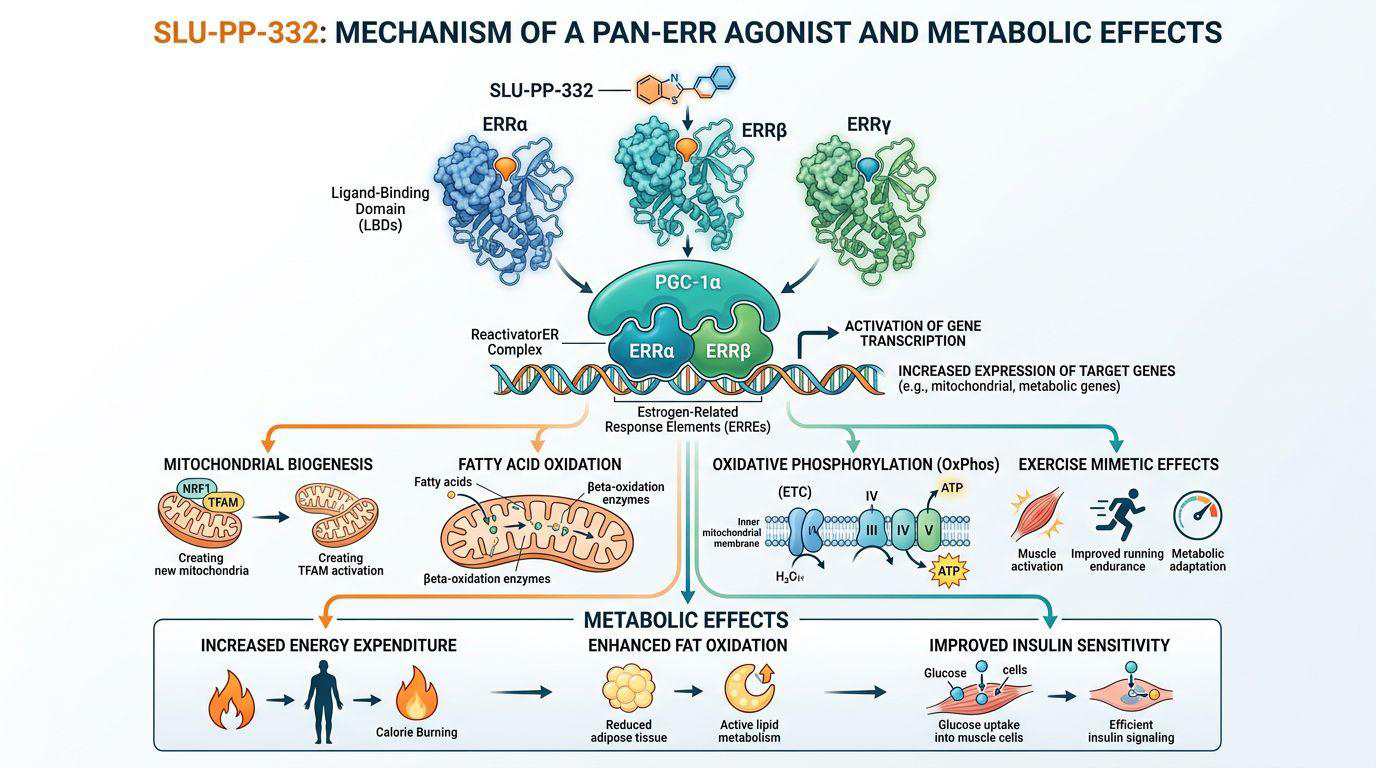
SLU-PP-332 acts as a pan-ERR agonist, activating all three major ERR isoforms:
- ERRα — strongest activity
- ERRβ
- ERRγ
ERRα appears particularly important for the exercise-like response produced by SLU-PP-332. In mouse studies, disrupting ERRα eliminated much of the compound’s ability to improve endurance.
2. ERR activation changes gene transcription
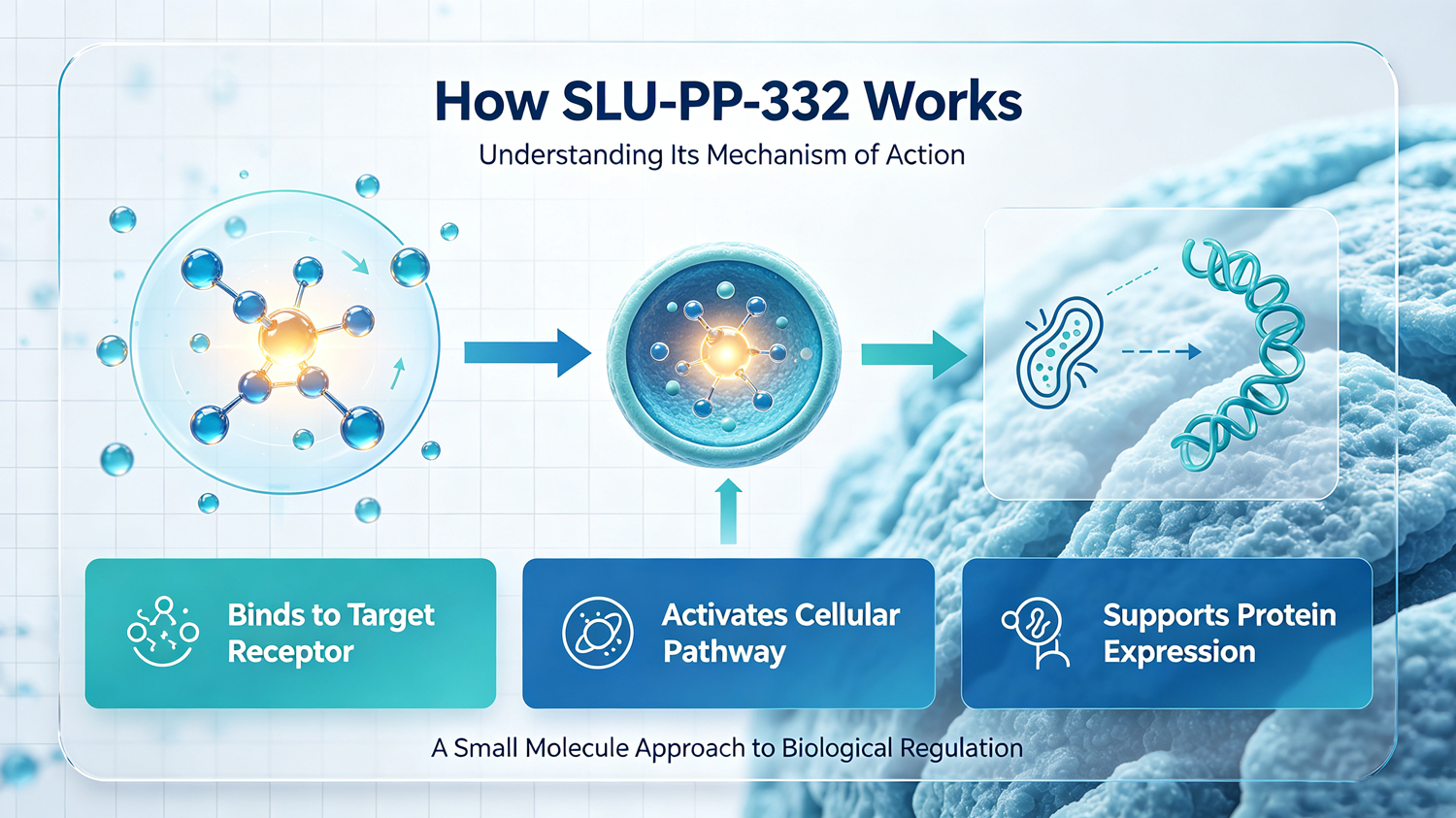
ERRs are nuclear transcription factors. Once activated, they interact with transcriptional coactivators such as PGC-1α and PGC-1β and increase expression of metabolic genes.
A simplified pathway is:
SLU-PP-332 → ERRα/β/γ activation → transcription of metabolic genes → increased mitochondrial oxidative metabolism
ERRα is closely linked to PGC-1α-driven mitochondrial biogenesis and expression of oxidative-phosphorylation genes.
One demonstrated downstream target is PDK4 (pyruvate dehydrogenase kinase 4), whose expression increases after SLU-PP-332 treatment in skeletal-muscle cells.
3. It pushes muscle toward oxidative metabolism
The result is a metabolic shift toward using mitochondria more extensively.
SLU-PP-332 increases pathways associated with:
- mitochondrial respiration
- oxidative phosphorylation
- TCA-cycle activity
- fatty-acid β-oxidation
- mitochondrial biogenesis
- oxidative skeletal-muscle fibers
In C2C12 skeletal-muscle cells, treatment increased maximum mitochondrial respiration. In mice, it increased type IIa oxidative muscle fibers and improved exercise endurance.
4. It increases fatty-acid utilization
One important consequence is increased fat oxidation.
The pathway can be simplified as:
Fatty acids → mitochondrial entry → β-oxidation → acetyl-CoA → TCA cycle → electron transport chain → ATP
ERR activation increases expression of genes involved in this mitochondrial metabolic machinery. In obese mice, SLU-PP-332 increased fatty-acid oxidation and energy expenditure and reduced fat-mass accumulation.
5. It produces an “exercise-like” metabolic program
This is why SLU-PP-332 is often called an exercise mimetic.
It doesn’t literally reproduce every effect of physical exercise. Rather, it pharmacologically activates an important transcriptional network that normally participates in exercise adaptation.
In mice, this produced:
ERR activation → oxidative muscle program → greater mitochondrial capacity → increased endurance
The original studies specifically found an ERRα-dependent acute aerobic-exercise genetic program.
6. Effects on glucose metabolism
SLU-PP-332 does not primarily work like insulin or a GLP-1 receptor agonist. Its effects on glucose metabolism are more indirect.
By increasing mitochondrial oxidative capacity and fatty-acid utilization, it can improve metabolic flexibility and insulin sensitivity.
In mouse models of obesity/metabolic syndrome, SLU-PP-332:
- increased energy expenditure
- increased fatty-acid oxidation
- reduced obesity/fat accumulation
- improved insulin sensitivity
So the conceptual difference is:
Insulin/GLP-1 pathway: primarily regulates glucose intake, secretion, appetite and glucose handling.
SLU-PP-332: primarily activates an ERR-driven mitochondrial oxidative-metabolism program.
7. It may affect organs beyond skeletal muscle
ERRs are expressed in multiple metabolically active tissues. Experimental studies have therefore investigated SLU-PP-332 in tissues such as the kidney.
For example, in aged mice, ERR activation with SLU-PP-332 improved several measures of mitochondrial function and reduced inflammatory signaling, including effects involving the cGAS-STING/STAT3 pathway.
However, these findings are preclinical and should not be interpreted as evidence of established therapeutic efficacy in humans.
Important limitation
SLU-PP-332 is an experimental research compound, not an approved human exercise or weight-loss drug. The strongest evidence comes from cell and mouse studies. Moreover, recent pharmacology reviews note that the original SLU-PP-332 has poor oral bioavailability and metabolic-stability limitations, which are important obstacles to treating it as a conventional drug candidate.
Interestingly, 2026 research has begun systematically optimizing the SLU-PP-332 chemical scaffold to improve properties such as solubility and metabolic stability, while retaining ERR activation.
In one sentence: SLU-PP-332 works by pharmacologically turning on the ERRα/β/γ transcriptional network, particularly ERRα, thereby promoting a mitochondrial, fat-oxidizing, oxidative-muscle program that partially resembles the metabolic adaptations produced by aerobic exercise.