
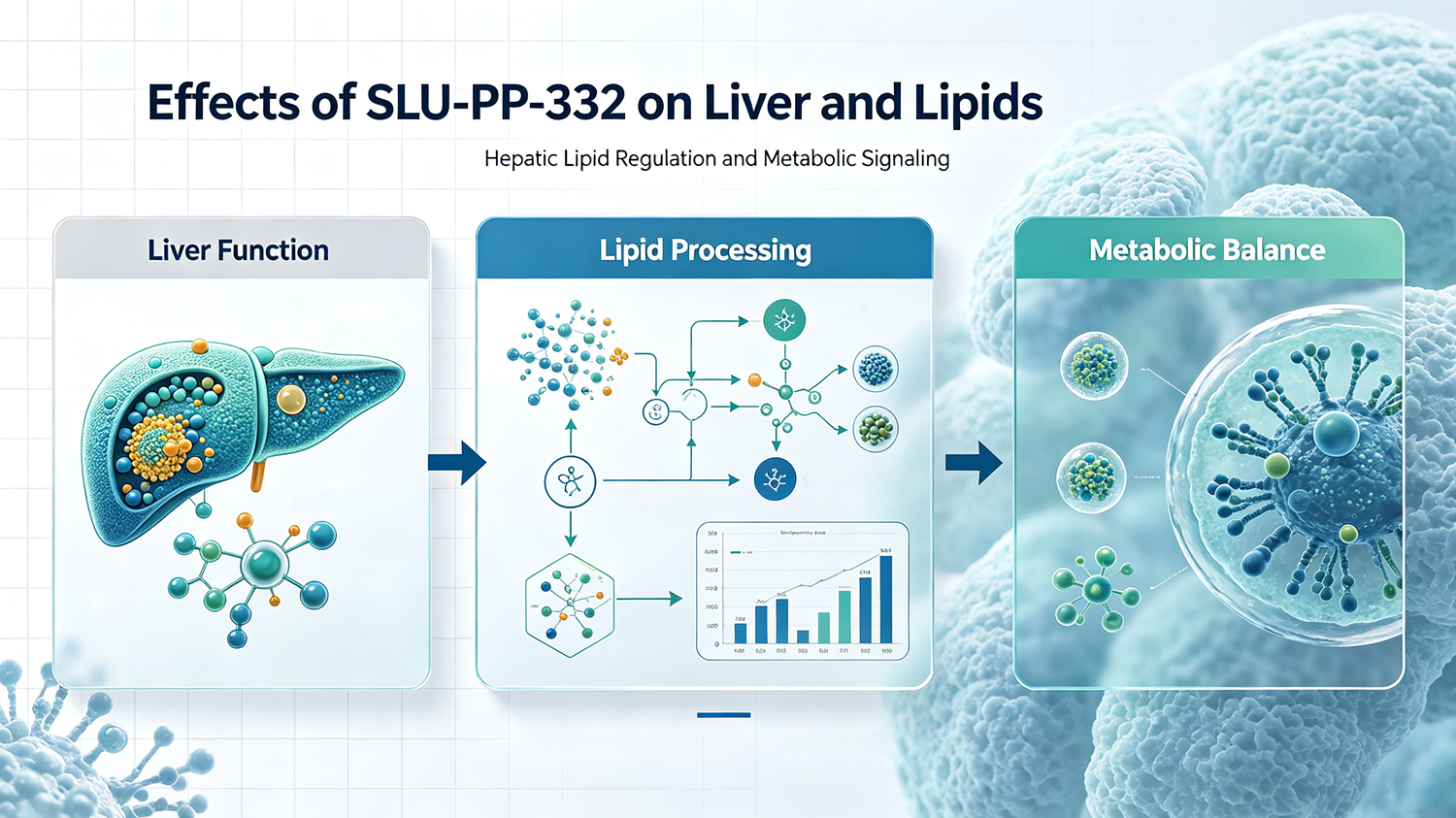
SLU-PP-332 appears to have potentially favorable effects on liver fat and systemic lipid metabolism in mice, but the evidence is still preclinical. Importantly, SLU-PP-332 is an ERRα/β/γ agonist, not a PPAR agonist, so PPAR findings should be treated as mechanistic context rather than direct evidence for SLU-PP-332.
1. Effects on liver fat
In a mouse model of diet-induced obesity, 28 days of SLU-PP-332 treatment produced:
- Reduced hepatic lipid accumulation
- Less lipid staining in liver tissue
- Lower liver triglyceride content
- Increased whole-body fatty-acid oxidation
Reduced fat-mass accumulation
The investigators specifically assessed liver Oil Red O staining and hepatic triglycerides and reported improvements with SLU-PP-332. Similar liver histology was evaluated in obese ob/ob mice.
This suggests that SLU-PP-332 may help counter hepatic steatosis (fatty liver) by shifting metabolism toward greater fatty-acid utilization rather than storage.
2. Effects on blood lipids
The same study measured total cholesterol, HDL, LDL and triglycerides. SLU-PP-332 altered the lipid profile in mice, although the magnitude and direction differed depending on whether animals were on normal chow or a high-fat diet. The important overall finding was improved metabolic handling of fatty acids rather than simply a conventional “cholesterol-lowering” effect.
Its metabolic action can be summarized as:
SLU-PP-332 → ERR activation → mitochondrial oxidative program ↑ → fatty-acid oxidation ↑ → lipid storage ↓ → adiposity/liver fat ↓
3. Why might it reduce liver fat?
ERRs cooperate with PGC-1 coactivators to regulate mitochondrial oxidative metabolism. SLU-PP-332 activates this transcriptional program and increases energy expenditure and fatty-acid oxidation. In obese mice, this was associated with improved insulin sensitivity and reduced adiposity.
There is also supporting evidence from the broader nuclear-receptor literature that increasing fatty-acid oxidation and suppressing hepatic lipogenesis can reduce steatosis. For example, PPARδ activation can inhibit SREBP-1-driven lipogenesis and improve hepatic steatosis, although this is not the same mechanism as SLU-PP-332.
4. Does it protect the liver?
Possibly, but this is not established.
The available animal study included measurements of liver enzymes and liver histology and did not present SLU-PP-332 as causing an obvious liver-toxicity signal under the tested conditions. However, that should not be interpreted as proof that it is hepatoprotective or safe for human use.
As of 2026, the evidence base remains preclinical, with no established human pharmacokinetic, efficacy, or safety dataset.
5. Potential implications
| Parameter | Observed/expected effect | Evidence |
| Liver triglycerides | ↓ | Mouse studies |
| Hepatic lipid accumulation | ↓ | Mouse histology |
| Fatty-acid oxidation | ↑ | Strong mouse evidence |
| Whole-body energy expenditure | ↑ | Mouse evidence |
| Fat mass | ↓ | Mouse evidence |
| Insulin sensitivity | ↑ | Obese mouse models |
| Blood triglycerides | Potentially ↓/modified | Mouse evidence |
| Cholesterol | Modified, context-dependent | Mouse evidence |
| Human liver fat | Unknown | No clinical evidence |
| Human liver safety | Unknown | No clinical safety data |
Bottom line: SLU-PP-332 currently looks more like a metabolic/lipid-oxidation research compound than an established liver treatment. The most interesting liver effect is its ability to increase fatty-acid oxidation and reduce hepatic lipid accumulation in obese mice. Whether this translates into meaningful treatment of human MASLD/NAFLD—or whether long-term ERR activation could produce unexpected hepatic effects—remains unknown.