
SLU-PP-332 is a synthetic small-molecule agonist of the estrogen-related receptors (ERRs)—a family of orphan nuclear receptors involved in regulating mitochondrial activity, oxidative metabolism, fatty-acid utilization, and exercise-responsive gene expression.
It is particularly notable because it activates ERRα, ERRβ, and ERRγ, with its strongest activity reported toward ERRα. Because activation of ERR signaling can reproduce some molecular and metabolic adaptations associated with aerobic exercise, SLU-PP-332 is commonly described in research as an “exercise mimetic.”
Importantly, it is not an approved exercise-enhancing drug or established human medicine. The evidence base remains predominantly preclinical, involving cell and animal studies.
Origin of SLU-PP-332
The name SLU-PP-332 is associated with research originating from the Saint Louis University (SLU) research program involving the laboratory of Thomas P. Burris, with collaborators including researchers at Washington University in St. Louis and other institutions.
The compound was reported in detail in a 2023 ACS Chemical Biology study by Billon and colleagues. The researchers were attempting to overcome an important problem in ERR pharmacology: although ERRβ/γ agonists had been developed, obtaining potent synthetic compounds capable of activating ERRα and being used effectively in vivo had been difficult.
The research program subsequently investigated SLU-PP-332 in metabolic disease and exercise-mimetic models. A 2024 study reported effects on energy expenditure, fatty-acid oxidation, adiposity, and insulin sensitivity in mouse models of obesity/metabolic syndrome.
More recently, 2026 research has performed detailed structure–activity relationship (SAR) studies of SLU-PP-332 and related analogues, helping define structural features that influence ERR potency, selectivity, solubility, and metabolic stability.
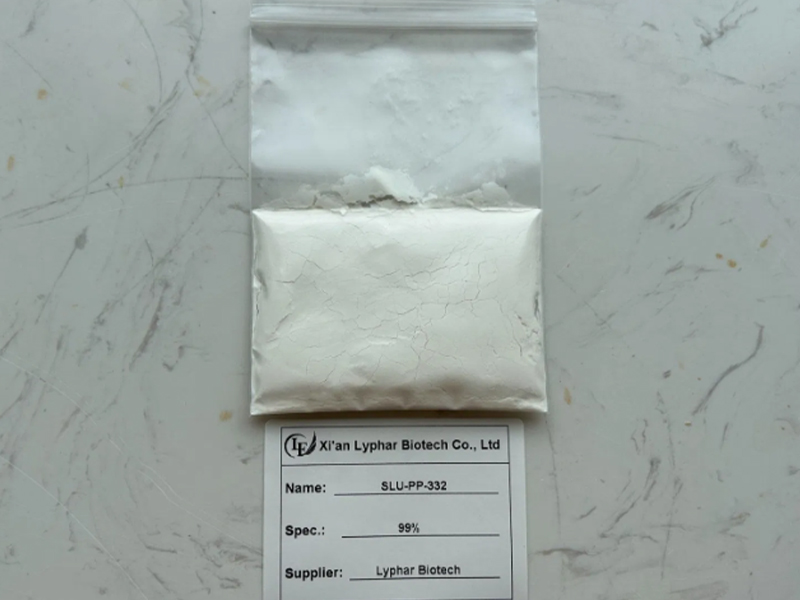
Chemical nature of SLU-PP-332
SLU-PP-332 is:
| Characteristic | Description |
| Type | Synthetic small molecule |
| Chemical class | Nuclear-receptor agonist |
| Primary targets | ERRα, ERRβ, ERRγ |
| Target preference | ERRα > ERRβ/ERRγ in overall activity |
| Peptide? | No |
| Protein? | No |
| Hormone? | No |
| “Exercise mimetic”? | Yes, in a preclinical pharmacological sense |
| Primary research area | Metabolism, mitochondrial biology, exercise physiology |
| Development status | Experimental/preclinical |
The compound is therefore fundamentally different from peptide-based compounds such as semaglutide or tirzepatide. It is a low-molecular-weight synthetic chemical probe designed to modulate nuclear-receptor signaling.
Molecular target: estrogen-related receptors
ERRs are nuclear receptors consisting principally of three subtypes:
- ERRα (NR3B1)
- ERRβ (NR3B2)
- ERRγ (NR3B3)
Despite their name, ERRs are not simply alternative estrogen receptors. They are a distinct nuclear-receptor family and are strongly associated with regulation of energy metabolism and mitochondrial function.
ERRα in particular has an important role in coordinating transcriptional programs involved in:
mitochondrial biogenesis → oxidative phosphorylation → fatty-acid oxidation → aerobic energy production
SLU-PP-332 activates these receptors and thereby stimulates transcriptional programs associated with oxidative metabolism.
Why is it called an “exercise mimetic”?
Normal endurance exercise produces a broad physiological response involving skeletal muscle, mitochondria, cardiovascular adaptations, energy metabolism, and numerous signaling pathways.
SLU-PP-332 does not literally reproduce all of these effects.
Instead, it activates an important molecular pathway associated with exercise—particularly the ERR signaling network.
In animal experiments, SLU-PP-332 was reported to:
- increase mitochondrial function;
- increase cellular respiration;
- promote more oxidative type IIa skeletal-muscle fibers;
- activate exercise-associated gene-expression programs;
- increase exercise endurance in mice.
This is why it is often referred to as a pharmacological exercise mimetic.
Biological significance
The importance of SLU-PP-332 comes from the central role of ERRs in metabolic regulation.
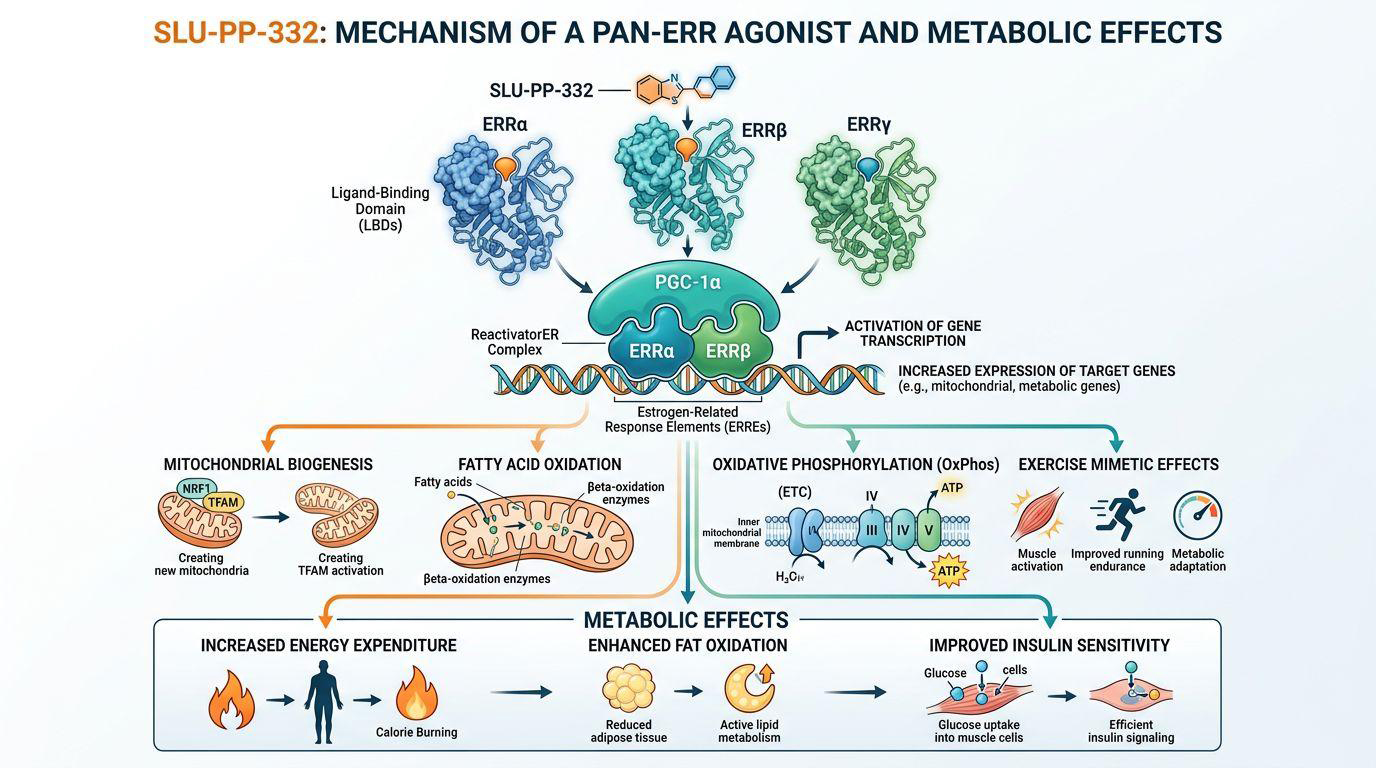
A simplified pathway is:
↓
ERRα/β/γ activation
↓
transcription of oxidative-metabolism genes
↓
mitochondrial activity ↑
↓
fatty-acid oxidation ↑
↓
oxidative skeletal-muscle capacity ↑
↓
exercise-like metabolic phenotype
Animal research has also reported increased energy expenditure, increased fatty-acid oxidation, reduced fat accumulation, and improved insulin sensitivity in obesity/metabolic-syndrome models.
Current scientific position
SLU-PP-332 should be viewed primarily as a research compound and pharmacological tool, rather than a clinically established therapeutic.
The major research interest is whether selective activation of ERR signaling could eventually contribute to treatments for conditions involving impaired mitochondrial or metabolic function, such as:
- obesity and metabolic syndrome;
- insulin resistance;
- metabolic dysfunction;
- reduced skeletal-muscle oxidative capacity;
- mitochondrial dysfunction;
- age-associated loss of muscle function.
However, promising results in mice cannot be assumed to translate into equivalent benefits in humans. Human efficacy, optimal dosing, long-term safety, and clinical risk–benefit remain unresolved.
Bottom line
SLU-PP-332 is a synthetic ERRα/β/γ agonist developed as a research tool to activate exercise-related metabolic signaling. Its distinctive feature is strong ERRα activity, which can stimulate mitochondrial and oxidative metabolic programs. Early mouse studies produced an “exercise-mimetic” phenotype, including improved endurance and metabolic parameters, making SLU-PP-332 an important experimental compound in research on mitochondrial metabolism, obesity, metabolic disease, and exercise biology.
If useful, I can next provide a comprehensive study of SLU-PP-332 covering chemical structure, mechanism of action, synthesis, benefits, applications, pharmacokinetics, side effects, safety, and SLU-PP-332 vs. exercise.