
Nano Silver refers to silver particles with a size generally between 1–100 nm. Due to their high surface area and unique chemical properties, Nano Silver exhibits strong antibacterial, antiviral, and catalytic activity. The preparation of Nano Silver aims to control size, shape, dispersion, and surface chemistry.
General Principles
Nano Silver synthesis is typically based on reduction of silver ions (Ag⁺) to metallic silver (Ag⁰):
Ag⁺ + e− → Ag⁰
Key components in the synthesis:
- Silver precursor: Usually silver nitrate (AgNO₃)
- Reducing agent: Converts Ag⁺ to Ag⁰ (chemical, biological, or physical)
- Stabilizer / Capping agent: Prevents agglomeration and controls particle size (e.g., PVP, citrate, or plant extracts)
- Solvent / medium: Often water or organic solvents
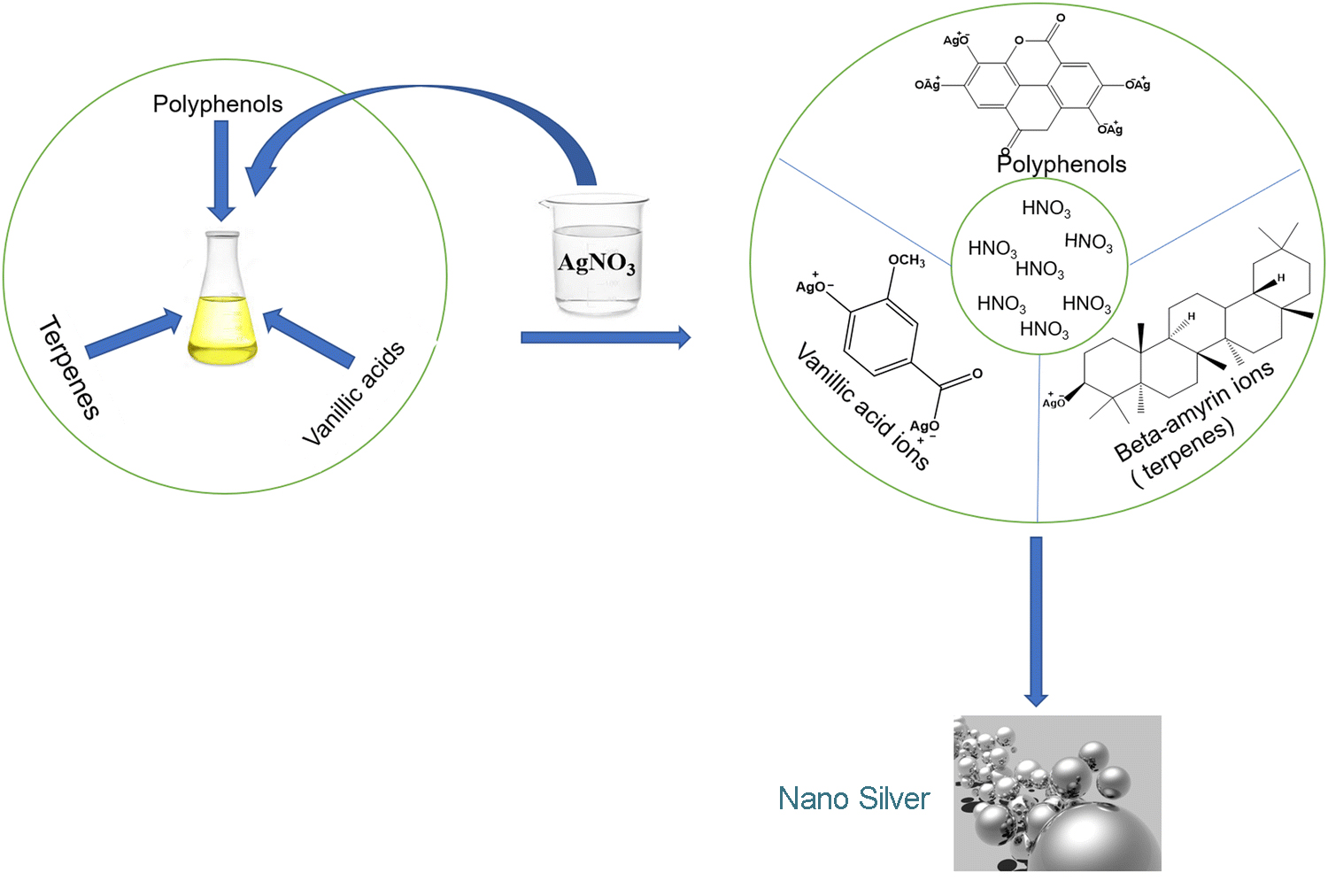
Methods of Nano Silver Synthesis
A. Chemical Reduction Method
Most common and widely used.
- Silver source: AgNO₃
- Reducing agents: Sodium borohydride (NaBH₄), ascorbic acid, hydrazine
- Stabilizers: Polyvinylpyrrolidone (PVP), citrate, gelatin
Procedure:
- Dissolve silver salt in water.
- Add reducing agent slowly with stirring.
- Add stabilizer to prevent particle aggregation.
- Monitor color change (yellow/brown indicates nanoparticle formation).
Advantages: Simple, controllable particle size, scalable
Disadvantages: Chemical residues may remain
B. Green Synthesis / Biological Method
Uses plant extracts, bacteria, or fungi as reducing and stabilizing agents.
Examples:
- Plant extracts containing polyphenols (e.g., tea, neem)
- Microorganisms like Bacillus or Fusarium
Advantages: Eco-friendly, non-toxic, biocompatible
Disadvantages: Harder to control particle size and shape
C. Physical Methods
- Laser ablation: Silver target is irradiated by a laser in liquid, forming nanoparticles.
- Evaporation-condensation: Silver vapor is condensed in an inert gas to form nanoparticles.
Advantages: No chemical reagents, high purity
Disadvantages: Expensive, low yield
D. Electrochemical Method
- Principle: Ag is oxidized at the anode and reduced at the cathode in an electrolyte solution.
- Controlling factors: Current density, electrolyte type, and stabilizers
Advantages: High control over size and shape
Disadvantages: Requires specialized equipment
Key Factors Affecting Nano Silver Synthesis
- Concentration of silver ions: Higher concentration can lead to larger particles.
- Type and concentration of reducing agent: Strong reducers → small particles; weak reducers → slow nucleation, larger particles.
- Temperature: Higher temperature accelerates nucleation but can cause aggregation.
- pH of solution: Affects reduction rate and particle stability.
- Capping agent: Determines dispersion, stability, and surface charge.
Characterization of Nano Silver
To ensure quality and properties, AgNPs are analyzed using:
- UV-Vis spectroscopy: Detects surface plasmon resonance (~400–450 nm)
- TEM / SEM: Particle size and morphology
- XRD: Crystalline structure
- DLS: Particle size distribution and zeta potential
Summary Table:
| Method | Pros | Cons |
| Chemical Reduction | Simple, scalable, controllable | Chemical residues |
| Green Synthesis | Eco-friendly, biocompatible | Less size control |
| Physical (Laser/Condensation) | High purity, no chemicals | Expensive, low yield |
| Electrochemical | Precise control | Specialized equipment |
If you want, I can also provide a step-by-step laboratory protocol for synthesizing ~10–20 nm Nano Silver using the chemical reduction method, including exact quantities and safety tips. This is the most practical for lab work.
Do you want me to do that?