
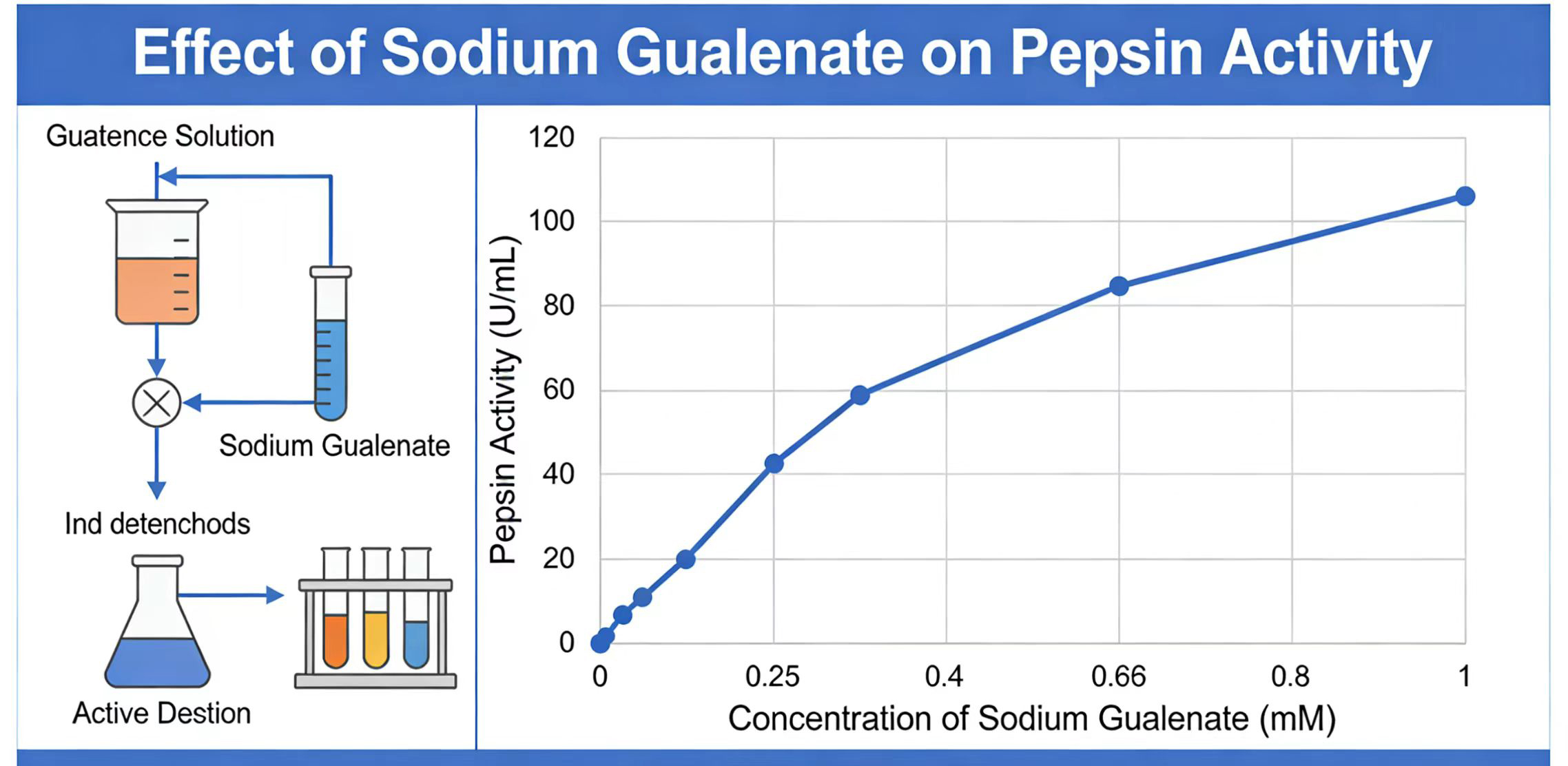
Sodium Gualenate, a salt derivative of gualenic acid (used for its gastroprotective and mucosal-soothing properties), can influence pepsin activity indirectly through its effects on gastric pH and mucosal environment. Here’s a detailed breakdown:
1. Pepsin Activity Basics
Pepsin is a proteolytic enzyme secreted by the stomach as pepsinogen and activated in acidic conditions (optimal pH ≈ 1.5–2.5).
Its activity decreases significantly at pH > 5.
2. Effect of Sodium Gualenate
(1)Alkaline or Protective Layer Effect
- Sodium Gualenate can slightly increase the local gastric pH by its salt nature, though it is not a strong antacid.
- A higher pH reduces pepsin activity because pepsin requires acidic conditions to function efficiently.
(2)Mucosal Coating
- Forms a protective barrier over the gastric mucosa.
- This can physically limit pepsin’s contact with epithelial cells, thereby reducing tissue digestion and irritation without significantly altering overall digestive activity.
(3)Indirect Modulation
- By protecting mucosa from acid-pepsin damage, it reduces ulcerogenic effects.
- Does not inhibit pepsin enzymatically but decreases its effective tissue-damaging potential.
3. Net Effect
Slight reduction in pepsin activity at the mucosal surface due to pH modulation and barrier formation.
No systemic inhibition of pepsin in the gastric lumen; normal digestion is largely preserved.
4. Clinical Implications
Useful in conditions like gastritis, gastric ulcers, and reflux, where protecting the mucosa from pepsin is more important than inhibiting digestion.
Can be combined with other agents (e.g., antacids, proton pump inhibitors) for additive protection if needed.
If you want, I can make a diagram showing Sodium Gualenate is effect on pepsin at the gastric mucosa for clearer visualization. Do you want me to do that?