
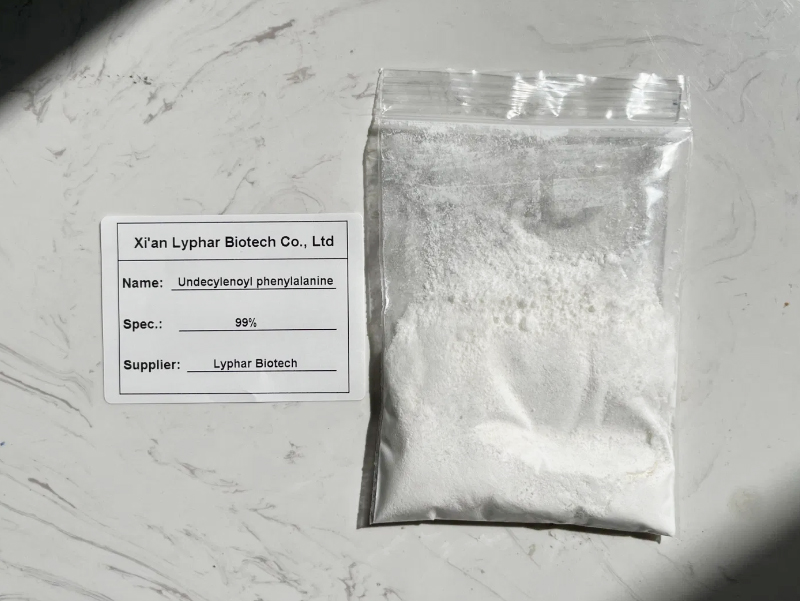
Sepiwhite MSH is a cosmetic skin-brightening active ingredient developed by Seppic. Its INCI name is Undecylenoyl Phenylalanine, a lipid-modified derivative of the amino acid L-phenylalanine. It is primarily used in formulations designed to reduce the appearance of hyperpigmentation and promote a more even, radiant complexion.
1. Basic profile
| Property | Information |
| Trade name | Sepiwhite MSH |
| INCI name | Undecylenoyl Phenylalanine |
| Chemical type | Lipoamino acid |
| CAS No. | 175357-18-3 |
| Molecular formula | C₂₀H₂₉NO₃ |
| Molecular weight | ~331.4 g/mol |
| Primary cosmetic function | Skin brightening / pigmentation control |
| Main biological target | α-MSH signaling pathway |
| Key downstream target | Tyrosinase and melanin production |
| Typical Seppic recommended level | 2% for Sepiwhite MSH |
| Main application | Facial skincare |
The chemical identity is independently listed by PubChem and the U.S. FDA Substance Registration System.
2. What does “MSH” mean?
MSH refers to melanocyte-stimulating hormone, particularly α-melanocyte-stimulating hormone (α-MSH). α-MSH is an important signaling molecule involved in melanocyte activation and melanin synthesis.
Sepiwhite MSH is designed to modulate this pigmentation signaling pathway rather than simply removing existing pigment. Seppic describes it as an α-MSH pathway modulator/antagonist that reduces metabolic activation of tyrosinase.
3. How it works
The simplified pathway is:
α-MSH signaling → melanocyte activation → tyrosinase activation/expression → melanin synthesis → pigmentation
Sepiwhite MSH acts upstream in this pathway:
Sepiwhite MSH → modulation/antagonism of α-MSH signaling → reduced tyrosinase activation → reduced melanin production → brighter, more even-looking skin
This distinguishes it from ingredients that primarily act by directly inhibiting tyrosinase.
4. Main cosmetic benefits
Sepiwhite MSH is principally used to:
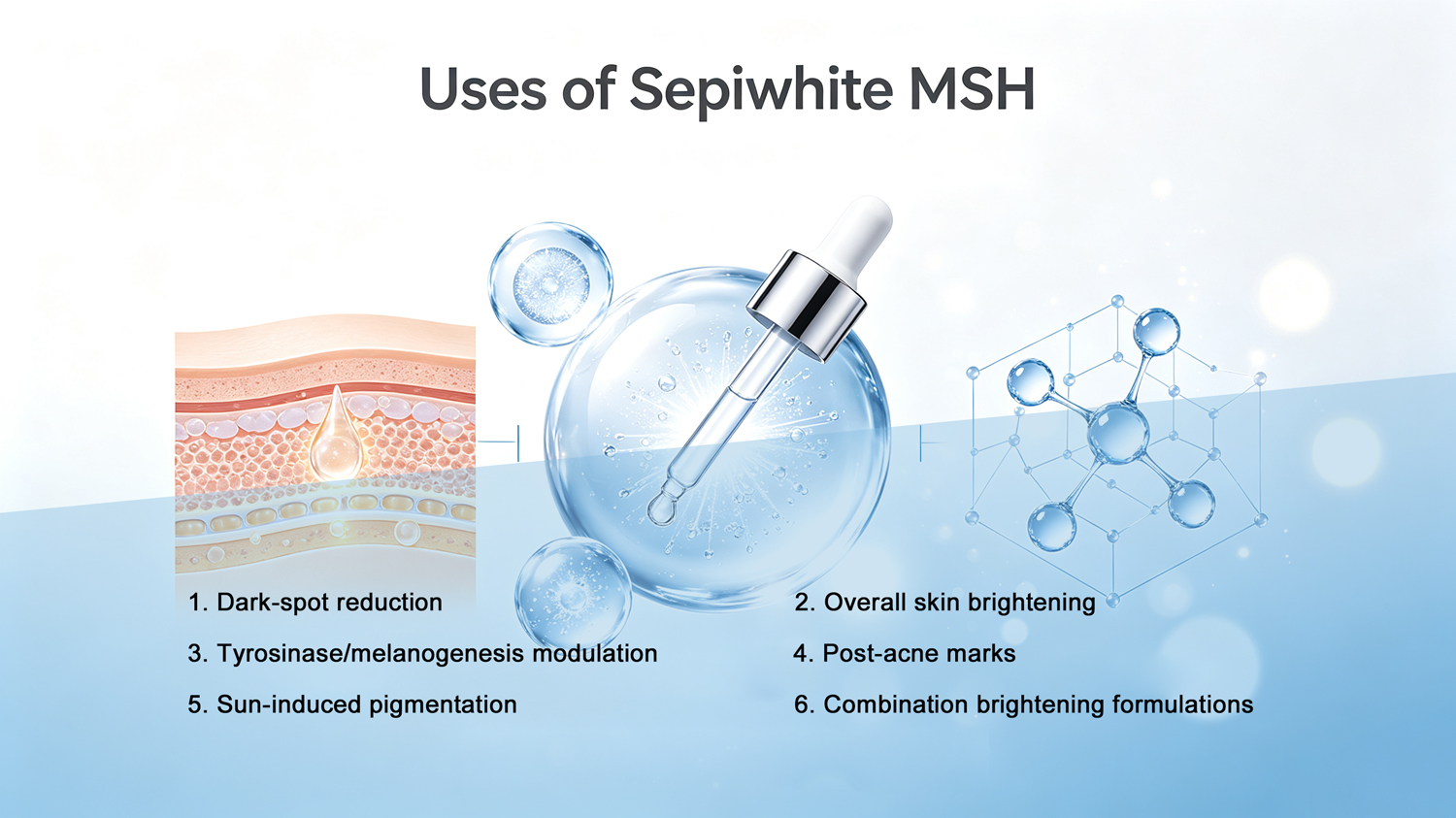
- Reduce the appearance of dark spots
- Improve uneven skin tone
- Brighten a dull complexion
- Reduce the visible appearance of hyperpigmentation
- Support formulations targeting age-related pigmentation
- Promote a more uniform and radiant complexion
Seppic reports clinical efficacy across several skin tones and phototypes and reports both short-term brightening and longer-term complexion-unifying effects. These are supplier claims based on its testing rather than a guarantee of the same result in every finished product.
5. Chemical nature
Chemically, Undecylenoyl Phenylalanine is an N-acylated amino acid: phenylalanine is linked to an undecylenoyl fatty-acid-derived group.
Its molecular formula is C₂₀H₂₉NO₃, with a molecular mass of approximately 331.4 g/mol. PubChem gives the systematic name as (2S)-3-phenyl-2-(undec-10-enoylamino)propanoic acid.
The lipid portion gives the molecule a more amphiphilic/lipophilic character than ordinary phenylalanine, which is relevant to its formulation behavior.
6. Where it is used
Sepiwhite MSH is particularly suitable for:
- Brightening serums
- Dark-spot treatments
- Facial creams and lotions
- Tone-correcting products
- Anti-aging/brightening formulations
- Products designed for uneven pigmentation
Seppic specifically lists face care as an application.
7. Recommended concentration
For the original Sepiwhite™ MSH material, Seppic currently lists a 2% recommended use level.
It is important to distinguish this from Sepiwhite™ MSH QD, a related commercial grade for which Seppic lists a 0.2% recommended use level. These should not automatically be treated as interchangeable formulations.
8. Important distinction
Sepiwhite MSH is not the same thing as hydroquinone, kojic acid, arbutin, niacinamide, or a conventional exfoliating acid. Its distinguishing feature is that it targets pigmentation signaling upstream through the α-MSH pathway.
That makes it particularly interesting for formulation strategies that combine different mechanisms—for example, an α-MSH pathway modulator with ingredients acting on tyrosinase, melanosome transfer, exfoliation, or antioxidant protection.
In short: Sepiwhite MSH is a specialized phenylalanine-derived lipoamino-acid brightening active whose main purpose is to modulate α-MSH-driven melanogenesis, helping reduce the appearance of pigmentation and create a more even complexion.