
Nano Silver, which refers to silver particles at the nanometer scale, has unique properties—especially antimicrobial activity, high surface area, and chemical reactivity—that make it useful in a variety of applications.Here’s a detailed explanation of the chemical structure and physical properties of Nano Silver (silver nanoparticles):
Chemical Structure of Nano Silver
Composition: Nano Silver consists of elemental silver (Ag) in the form of particles typically ranging from 1–100 nanometers in size.
Crystallinity: Most Nano Silver particles have a face-centered cubic (FCC) crystal structure, which is the same as bulk silver.
Surface Chemistry:
- The surface of silver nanoparticles is highly reactive due to a large surface-to-volume ratio.
- They may be coated or stabilized with capping agents (e.g., citrate, PVP, PEG) to prevent aggregation.
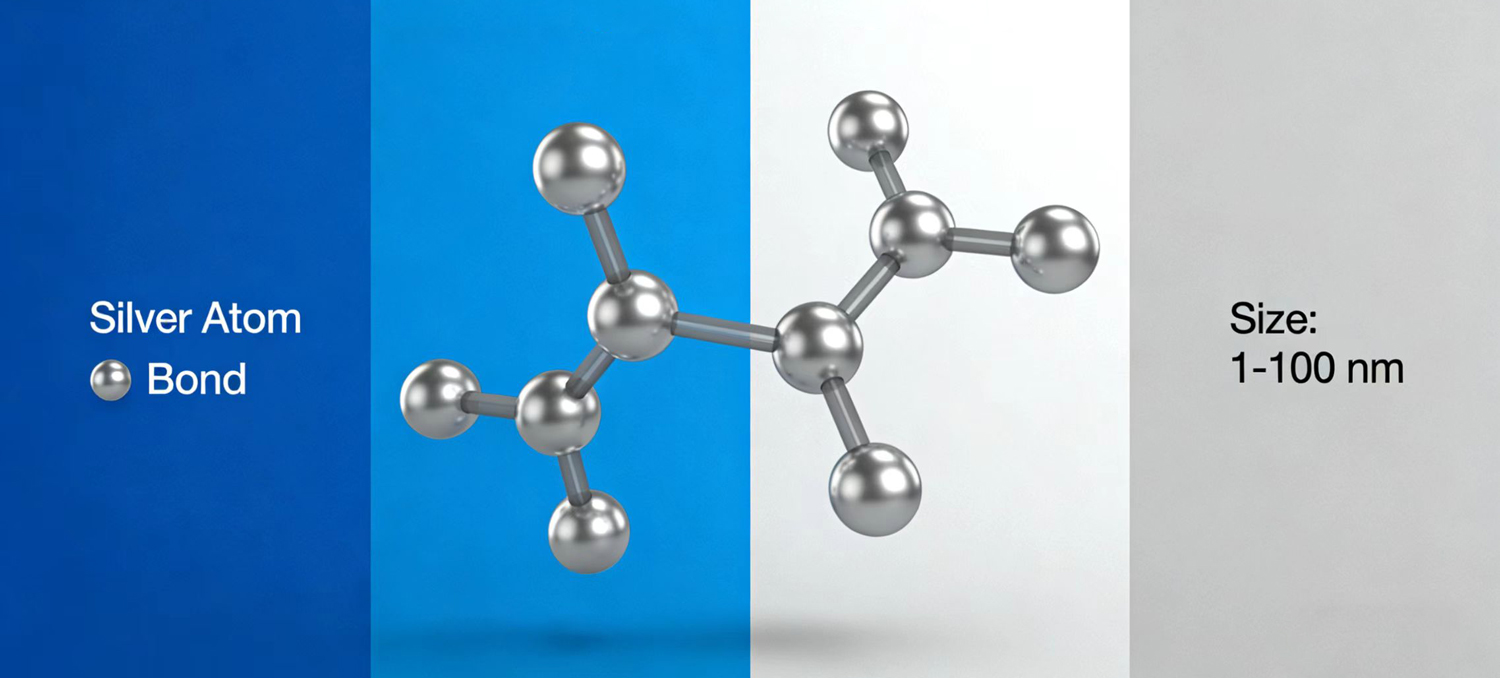
Forms: Nano Silver can exist as:
- Spherical nanoparticles – most common.
- Nanowires, nanorods, or triangular plates – shape influences properties.
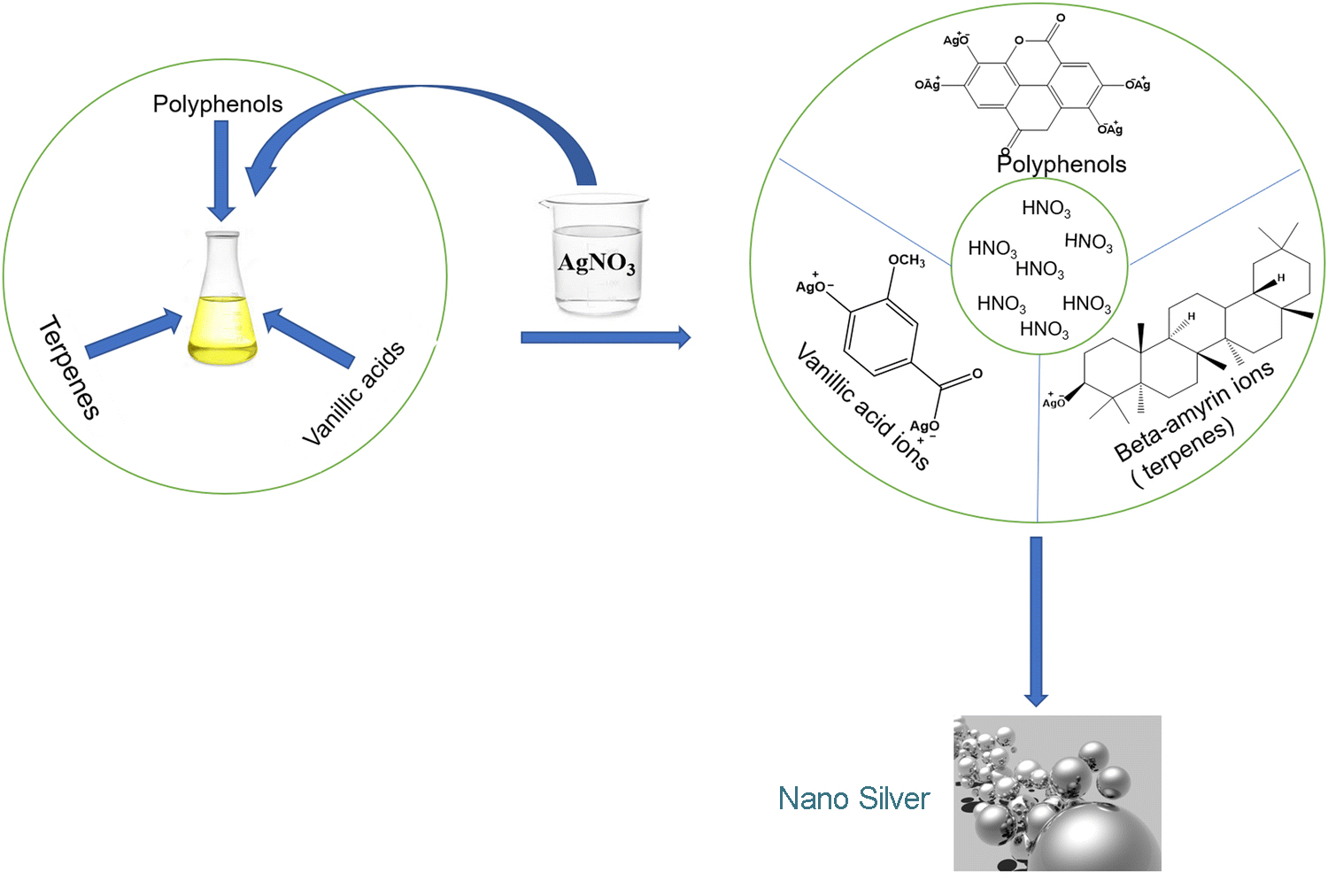
Ionic Interaction: Nano Silver can release Ag⁺ ions, which are mainly responsible for its antimicrobial activity.
Physical Properties of Nano Silver
| Property | Description |
| Size | Typically 1–100 nm; smaller particles (<10 nm) have higher surface reactivity. |
| Color | Yellow to brown in colloidal form; color depends on particle size due to surface plasmon resonance (SPR). |
| Density | Close to bulk silver: ~10.49 g/cm³, but apparent density depends on aggregation. |
| Melting Point | Slightly lower than bulk silver due to nanoscale effects; bulk silver: 961.8°C. |
| Electrical Conductivity | High conductivity, though smaller particles may exhibit slightly reduced conductivity due to electron scattering at surfaces. |
| Optical Properties | Strong SPR effect: absorbs visible light, giving characteristic colors in colloids. |
| Solubility | Insoluble in water; stable suspensions require stabilizers. |
| Magnetic Properties | Generally diamagnetic; may exhibit weak paramagnetism in very small clusters. |
Key Notes
- The size and shape of Nano Silver particles strongly influence their optical, chemical, and antimicrobial properties.
- Nano Silver is large surface area relative to its volume makes it much more chemically reactive than bulk silver.
- Often used in colloidal solutions, coatings, or embedded in polymers for biomedical, textile, or electronic applications.
If you want, I can also make a schematic diagram showing the structure of a typical Nano Silver particle and its surface properties, which makes it easier to visualize how Ag⁰ and Ag⁺ coexist at the nanoscale.
Do you want me to create that diagram?