
Sialic acid is a family of nine-carbon acidic monosaccharides. The most common form in humans is N-acetylneuraminic acid (Neu5Ac).
1. Chemical structure
| Property | Description |
| Common name | Sialic acid |
| Specific compound | N-Acetylneuraminic acid (Neu5Ac) |
| Molecular formula | C₁₁H₁₉NO₉ |
| Molecular weight | 309.27 g/mol |
| CAS number | 131-48-6 |
| IUPAC name | 5-Acetamido-3,5-dideoxy-D-glycero-D-galacto-non-2-ulosonic acid |
| Carbon atoms | 11 |
| Functional groups | Carboxylic acid, hydroxyl groups, acetamido group, ketone/hemiacetal functionality |
| Stereochemistry | Multiple stereocenters; naturally occurring Neu5Ac has defined D-configuration |
| Acidic group | One carboxylic acid group |
| Amino-derived group | N-acetylamino group |
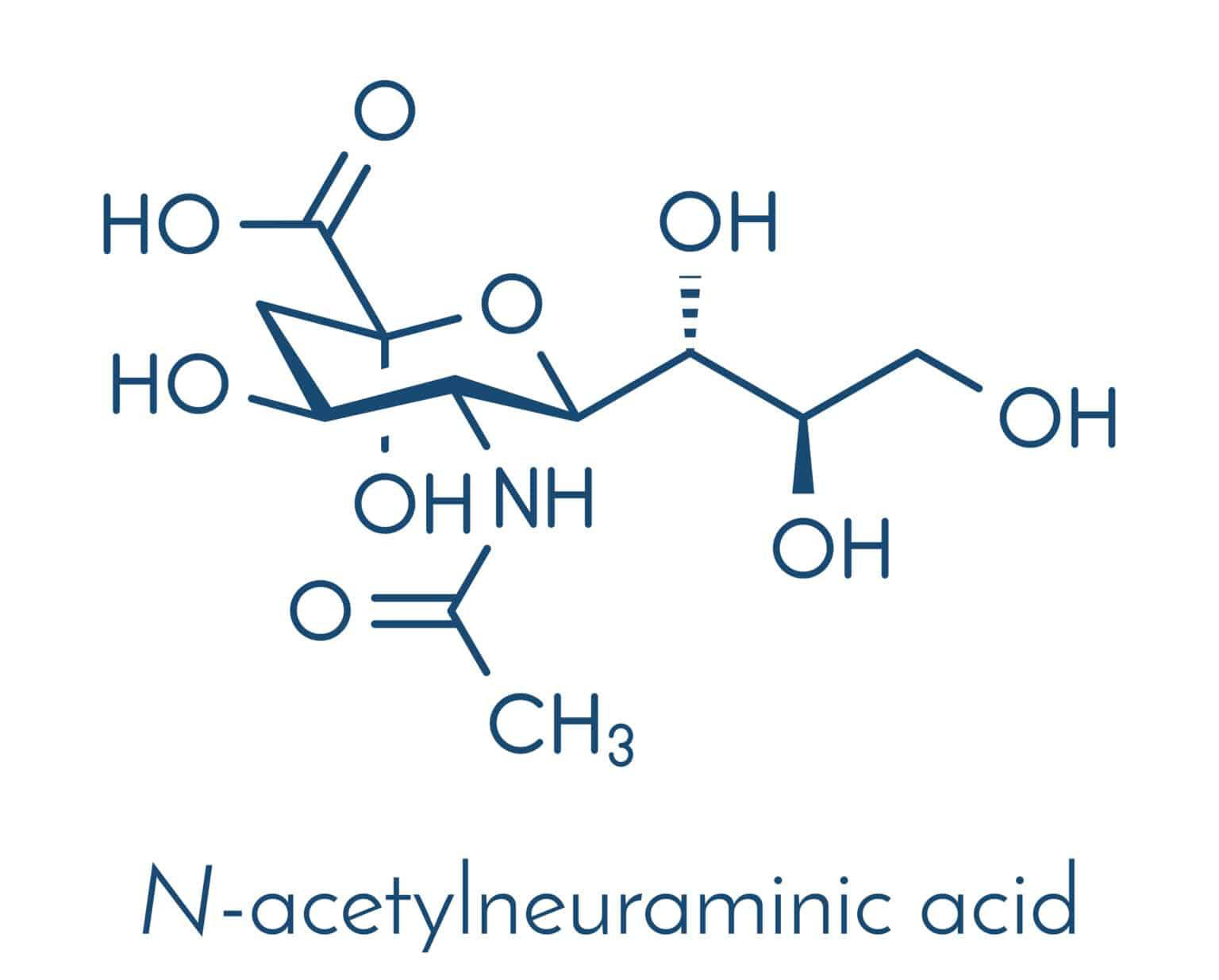
Neu5Ac is structurally derived from neuraminic acid, with an acetyl group attached to the nitrogen atom. Its nine-carbon backbone makes it chemically distinct from most common six-carbon monosaccharides such as glucose and galactose.
2. Important structural features
Carboxyl group (–COOH):
This is responsible for the acidic character of Neu5Ac. At physiological pH, it is predominantly present as the negatively charged carboxylate (–COO⁻).
Multiple hydroxyl groups (–OH):
Neu5Ac contains several hydroxyl groups, giving it high polarity and strong hydrogen-bonding capacity.
N-acetyl group (–NHCOCH₃):
The N-acetyl substituent distinguishes N-acetylneuraminic acid from other neuraminic-acid derivatives and contributes to its biological specificity.
Nine-carbon backbone:
Sialic acids are unusual monosaccharides because their core structure contains nine carbon atoms. In biological systems, Neu5Ac is commonly found at the terminal positions of glycoconjugates.
3. Physical properties
| Physical property | Typical description |
| Appearance | White to off-white crystalline powder |
| Odor | Generally odorless |
| Taste | Acidic/sour character |
| Solubility in water | Soluble; solubility is affected by temperature and pH |
| Polarity | Highly polar |
| Charge | Negatively charged at physiological pH |
| Hygroscopicity | Can absorb moisture under some storage conditions |
| Melting/decomposition behavior | Decomposes upon strong heating rather than behaving like a simple low-molecular-weight organic compound |
| Stability | Sensitive to strongly acidic or alkaline conditions and prolonged heat |
| pKa of carboxyl group | Approximately 2.6 |
4. Solubility and ionization
The carboxyl group makes Neu5Ac an acidic molecule. Because its pKa is around 2.6, most of the carboxyl groups are deprotonated at neutral physiological pH, giving the molecule a negative charge.
This negative charge is particularly important biologically because terminal sialic acid residues contribute to the surface charge of glycoproteins and glycolipids.
5. Structural representation
A simplified representation of the molecule is:
HOOC–[C₉ sugar framework containing –OH and –NHCOCH₃ groups]
More accurately, Neu5Ac exists in equilibrium between open-chain and cyclic forms, with the cyclic form being important under many conditions. Its stereochemistry is essential for recognition by enzymes, lectins, receptors, and antibodies.
6. Key chemical characteristics
- Acidic monosaccharide
- Highly hydrophilic
- Contains several hydroxyl groups
- Contains a carboxylic acid group
- Contains an N-acetylamino group
- Forms glycosidic linkages with underlying sugars
- Usually occurs at the terminal ends of glycans
- Can participate in hydrogen bonding and electrostatic interactions
- Its structure is susceptible to degradation under harsh chemical conditions
7. Biological structural significance
In humans, Neu5Ac is the predominant sialic acid and commonly occurs as the terminal sugar of glycoproteins, glycolipids, and other glycoconjugates. Its negatively charged carboxylate group influences molecular interactions, cell-surface charge, protein stability, and recognition between cells and biological molecules.
In summary: N-acetylneuraminic acid (Neu5Ac) is a nine-carbon, acidic, highly polar monosaccharide with molecular formula C₁₁H₁₉NO₉ and molecular weight 309.27 g/mol. Its carboxyl, hydroxyl, and N-acetyl groups give it distinctive physicochemical properties and make it an important terminal component of biological glycans.