
D-Chiro-Inositol (DCI) absorption and metabolism follow the typical pattern of inositols but with unique features related to its physiological role in insulin signaling. Here is a clear, step-by-step explanation:
Absorption of D-Chiro-Inositol
1. Site of absorption: small intestine
D-Chiro-Inositol is mainly absorbed in the small intestine, similar to myo-inositol.
Absorption occurs through sodium-dependent inositol transporters, primarily:
- SMIT1 (Sodium-myo-inositol transporter 1)
- SMIT2 (Sodium-myo-inositol transporter 2)
These transporters recognize multiple inositol isomers, including D-Chiro-Inositol.
2. Absorption mechanism
- Active transport (via SMIT1/2) is the main route.
- At high doses, passive diffusion can also contribute.
3. Factors that affect absorption
| Factor | Effect |
| Co-ingestion with carbohydrates | May enhance insulin response, indirectly boosting tissue uptake. |
| Competing inositols (e.g., myo-inositol) | Very high doses of myo-inositol can out-compete D-Chiro-Inositol for transporters. |
| Gut health / microbiota | Minor influence; the majority is absorbed intact. |
Distribution After Absorption
Once absorbed, D-Chiro-Inositol enters the bloodstream, remains largely unchanged, and is distributed to tissues sensitive to insulin, especially:
- Liver
- Skeletal muscle
- Fat (adipose tissue)
- Ovaries (important in PCOS physiology)
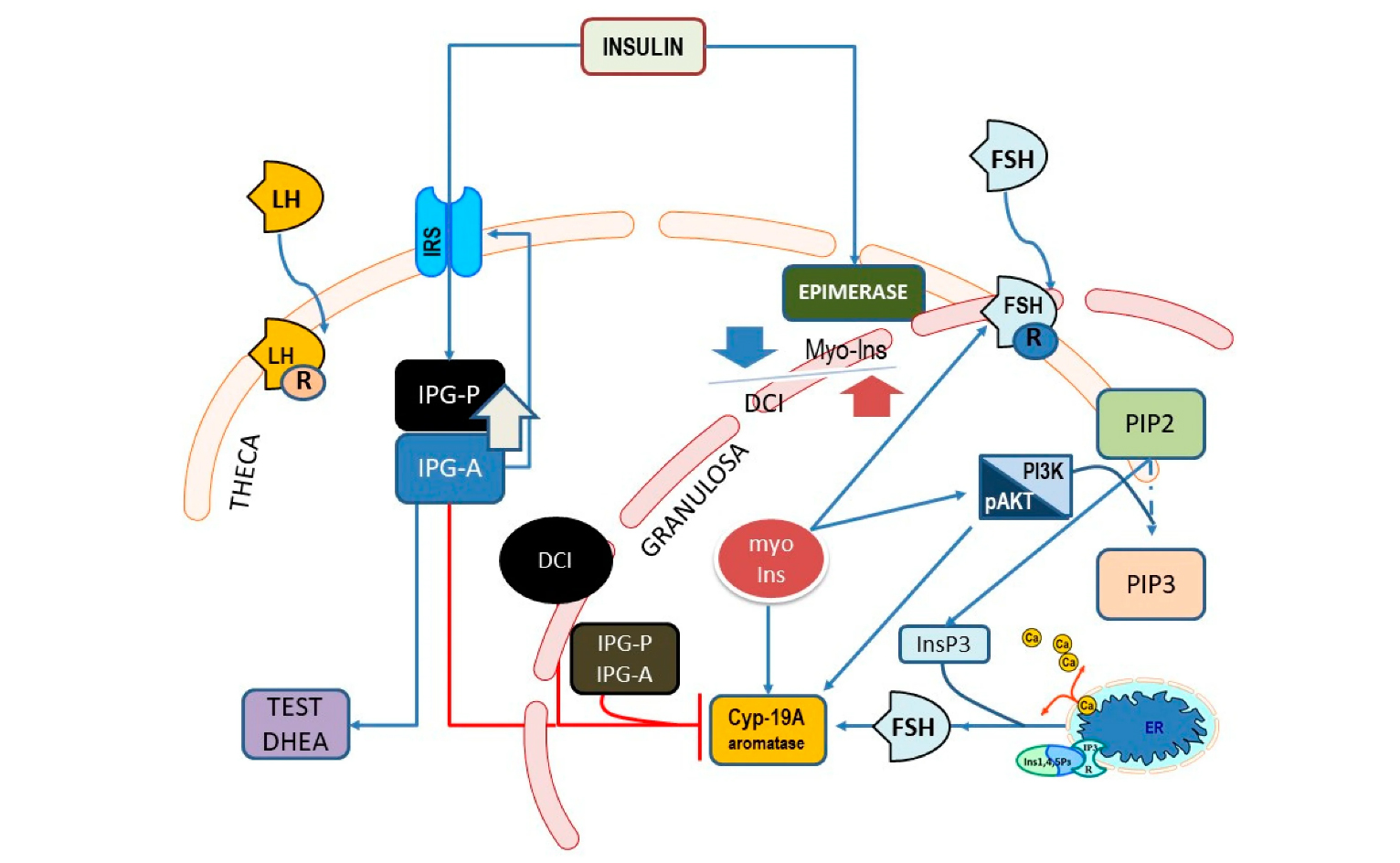
D-Chiro-Inositol is used as part of the inositol phosphoglycan (IPG) system that regulates insulin signaling.
Metabolism of D-Chiro-Inositol
1. Conversion from Myo-Inositol
The human body can synthesize D-Chiro-Inositol from myo-inositol via an epimerase enzyme, which is insulin-dependent.
- High insulin → ↑ epimerase activity → ↑ DCI production
- Insulin resistance → impaired conversion → lower DCI levels in tissues
This is why DCI is often lowered in insulin-resistant individuals.
2. Role in insulin signaling
D-Chiro-Inositol becomes part of specific inositol phosphoglycans (IPGs) that act as:
- Secondary messengers
- Regulators of glycogen synthesis, glucose uptake, and lipid metabolism
These IPG-DCI molecules help mediate insulin’s metabolic effects.
3. Utilization and Breakdown
Most D-Chiro-Inositol is incorporated into cellular pathways.
Excess D-Chiro-Inositol circulates and is eventually cleared.
4. Excretion
D-Chiro-Inositol is excreted unchanged in urine.
Kidneys regulate its reabsorption; some is reabsorbed through the same SMIT transporters.
Summary Table
| Stage | Description |
| Absorption | Small intestine via SMIT transporters; some passive diffusion. |
| Distribution | Delivered through blood to liver, muscle, fat, and ovaries. |
| Metabolism | Converted from myo-inositol by insulin-dependent epimerase. |
| Function | Forms IPG-DCI needed for insulin signaling and glucose metabolism. |
| Excretion | Eliminated in urine largely unchanged. |
Key Takeaways
- D-Chiro-Inositol is efficiently absorbed and used directly or produced from myo-inositol.
- Its metabolism is tightly linked to insulin function.
- People with insulin resistance often have low D-Chiro-Inositol levels due to impaired conversion.
- Supplementing D-Chiro-Inositol can help restore normal insulin-mediated signaling in tissues.