
Saccharide Isomerate is generally prepared by enzymatic rearrangement (isomerization) of a mixture of simple sugars, followed by purification and stabilization. It is not a single pure chemical compound; rather, it is a mixture of low-molecular-weight carbohydrates, commonly supplied as an aqueous cosmetic ingredient.
1. Starting materials
The process typically begins with carbohydrate sources such as:
- Glucose
- Fructose
- Other monosaccharides derived from starch or sucrose hydrolysis
- Water as the processing medium
The exact sugar composition depends on the manufacturing process and the desired Saccharide Isomerate profile.
2. Sugar isomerization
The key manufacturing step is enzymatic conversion of the starting sugars into structurally rearranged sugars.
A simplified representation is:
Starting monosaccharides → enzymatic isomerization → mixture of isomerized monosaccharides
Enzymes are used because they can rearrange the molecular configuration of sugars under relatively mild conditions while minimizing unwanted degradation.
The resulting carbohydrate mixture contains sugars with configurations that give the finished material its characteristic humectant and skin-conditioning properties.
3. Removal of unwanted materials
After the enzymatic reaction, the mixture is processed to remove:
- Residual proteins or enzymes
- Unreacted starting materials
- Salts and inorganic impurities
- Colored compounds
- Higher-molecular-weight carbohydrate fractions, where appropriate
Typical industrial purification operations may include filtration, clarification, demineralization, ion exchange, and/or membrane separation.
4. Concentration
The purified carbohydrate solution is concentrated, generally under controlled temperature and vacuum conditions to minimize:
- Sugar degradation
- Maillard reactions
- Color formation
- Excessive caramelization
Because Saccharide Isomerate is highly water-soluble, it is commonly maintained as an aqueous concentrate rather than isolated as a dry crystalline compound.
5. Standardization
The concentrate is then standardized to meet specifications for parameters such as:
- Total solids
- Carbohydrate composition
- pH
- Color
- Microbiological quality
- Density
- Preservative content, if applicable
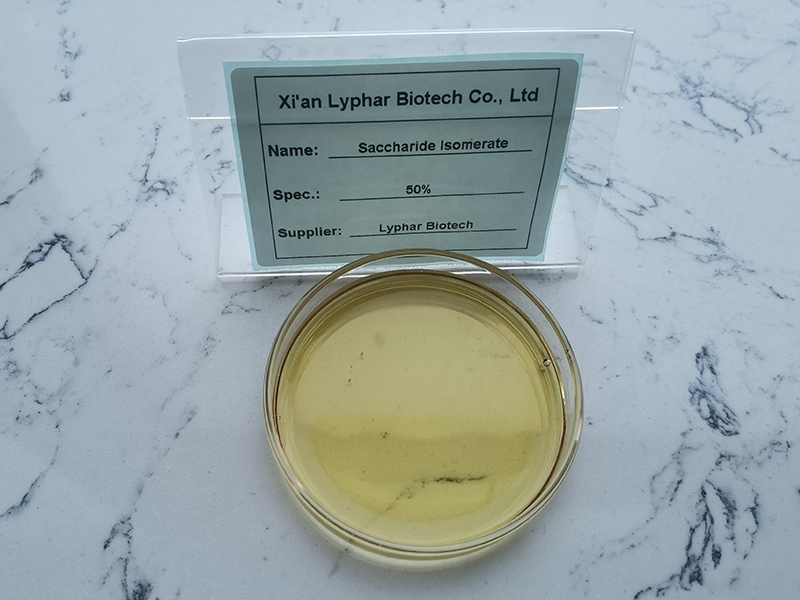
Commercial Saccharide Isomerate may therefore contain not only the carbohydrate complex but also water and formulation/stabilization components.
Simplified manufacturing flow
Sugar source
↓
Hydrolysis / preparation of monosaccharides
↓
Enzymatic isomerization
↓
Clarification and filtration
↓
Purification / demineralization
↓
Concentration
↓
Standardization
↓
Preservation and quality control
↓
Finished Saccharide Isomerate solution
Important distinction
Saccharide Isomerate should not be thought of as a conventional synthetic molecule produced through a single chemical reaction. Its commercial preparation is better described as biocatalytic carbohydrate conversion followed by purification and formulation. This is also why different suppliers can provide Saccharide Isomerate products with somewhat different carbohydrate profiles and specifications.
For cosmetic use, the final ingredient is usually incorporated into moisturizers, serums, cleansers, shampoos, conditioners, and other leave-on or rinse-off formulations as a water-soluble humectant/skin-conditioning ingredient.