
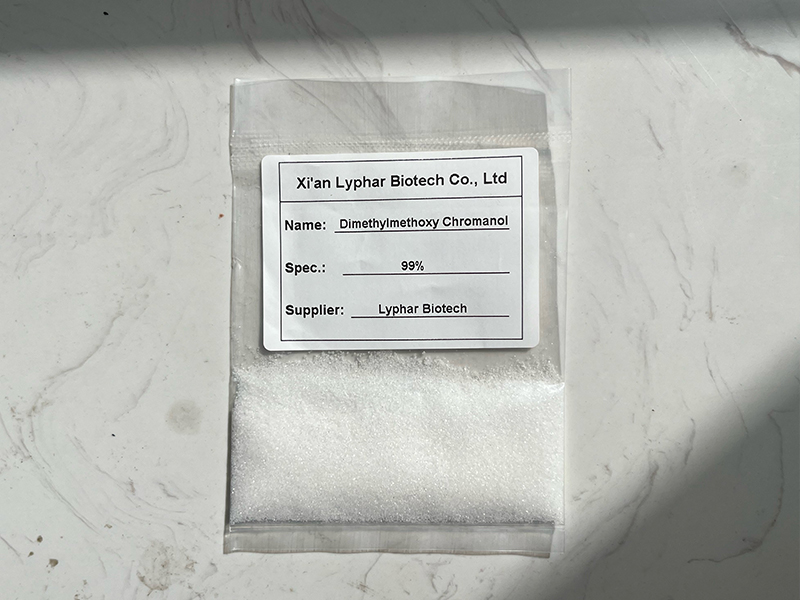
Dimethylmethoxy Chromanol is a chromanol derivative, structurally related to vitamin E analogs, with antioxidant properties. The synthesis generally involves forming the chromanol core and introducing specific methyl and methoxy substituents.
1. Chemical Structure Recap
Dimethylmethoxy Chromanol is a chromanol derivative, structurally similar to tocopherols (vitamin E analogs). Its core structure is a chromanol ring (benzopyran-6-ol) with:
- A methoxy group (-OCH₃) at position 5 of the chromanol ring.
- Two methyl groups (-CH₃) on the chromanol ring (positions 2 and 7 in the chromanol numbering).
Understanding the functional groups is critical because these dictate the synthetic steps.
2. General Synthetic Strategy
Dimethylmethoxy Chromanol synthesis usually involves three main steps:
1. Construction of the chroman ring (chromanol skeleton)
2. Methylation at the hydroxyl groups (to introduce methoxy groups)
3. Introduction of alkyl substituents (dimethyl groups) at proper positions.
The two common strategies are:
a) Formation of the Chromanol Ring
- Phenolic precursor: Start with a hydroxy-substituted aromatic compound (e.g., 2,5-dihydroxyphenol derivative).
- Cyclization reaction: Condense with an aldehyde or ketone under acidic conditions to form the chromanol core.
- Catalysts: Typically, acids like HCl, H2SO4, or Lewis acids are used to promote ring closure.
b) Methylation of Hydroxyl Groups
- Dimethylation: Introduce methyl groups at hydroxyl positions to get the “dimethyl” part of Dimethylmethoxy Chromanol.
- Reagents: Usually methyl iodide (CH3I) or dimethyl sulfate ((CH3O)2SO2) in the presence of a base (e.g., K2CO3 or NaH).
- This step selectively methylates phenolic hydroxyl groups.
c) Methoxylation
- The remaining hydroxyl or reactive site is converted into a methoxy group (–OCH3).
- Reagents: Methanol in acidic conditions or other methylating agents as above.
- Ensures the compound now has a methoxy group at the desired position, completing the Dimethylmethoxy Chromanol structure.
3. Purification
- Typical methods include column chromatography using silica gel.
- Crystallization from suitable solvents (e.g., ethanol or ethyl acetate) can also be used to obtain a pure product.
4. Characterization
After synthesis, the compound is characterized to confirm its structure:
- NMR (¹H and ¹³C): Confirms methyl and methoxy substitutions.
- Mass spectrometry (MS): Confirms molecular weight.
- IR spectroscopy: Detects functional groups like –OH and –OCH3.
Notes:
- The exact positions of methyl and methoxy substitutions depend on the starting chromanol derivative.
- The synthesis is generally considered moderate in complexity but requires careful control to avoid over-methylation.