
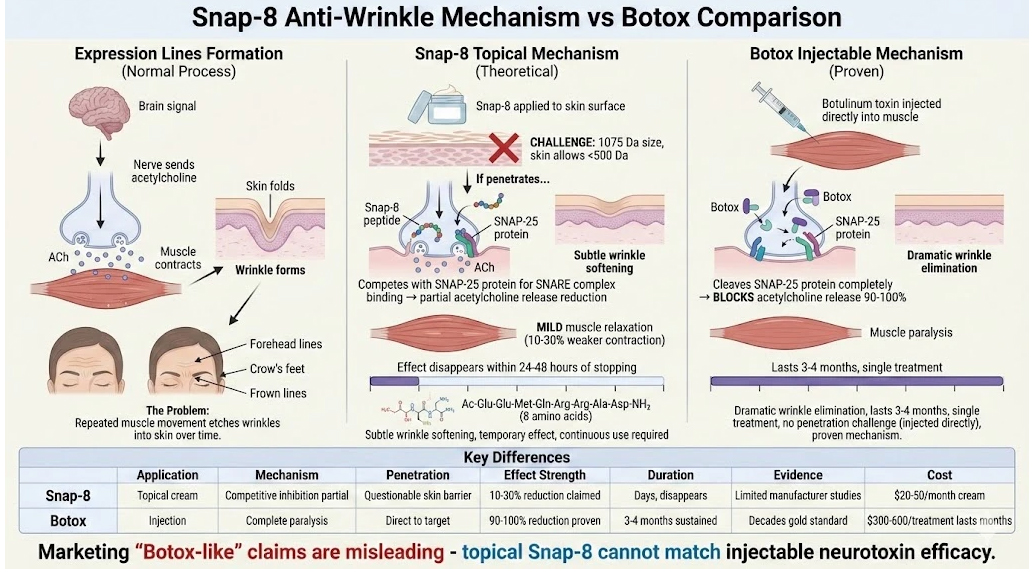
Acetyl Octapeptide-3 (SNAP-8) is a synthetic peptide used in cosmetic formulations as an anti-wrinkle ingredient. It is typically produced through solid-phase peptide synthesis (SPPS) and must undergo strict quality control to ensure purity, stability, and safety for cosmetic applications.
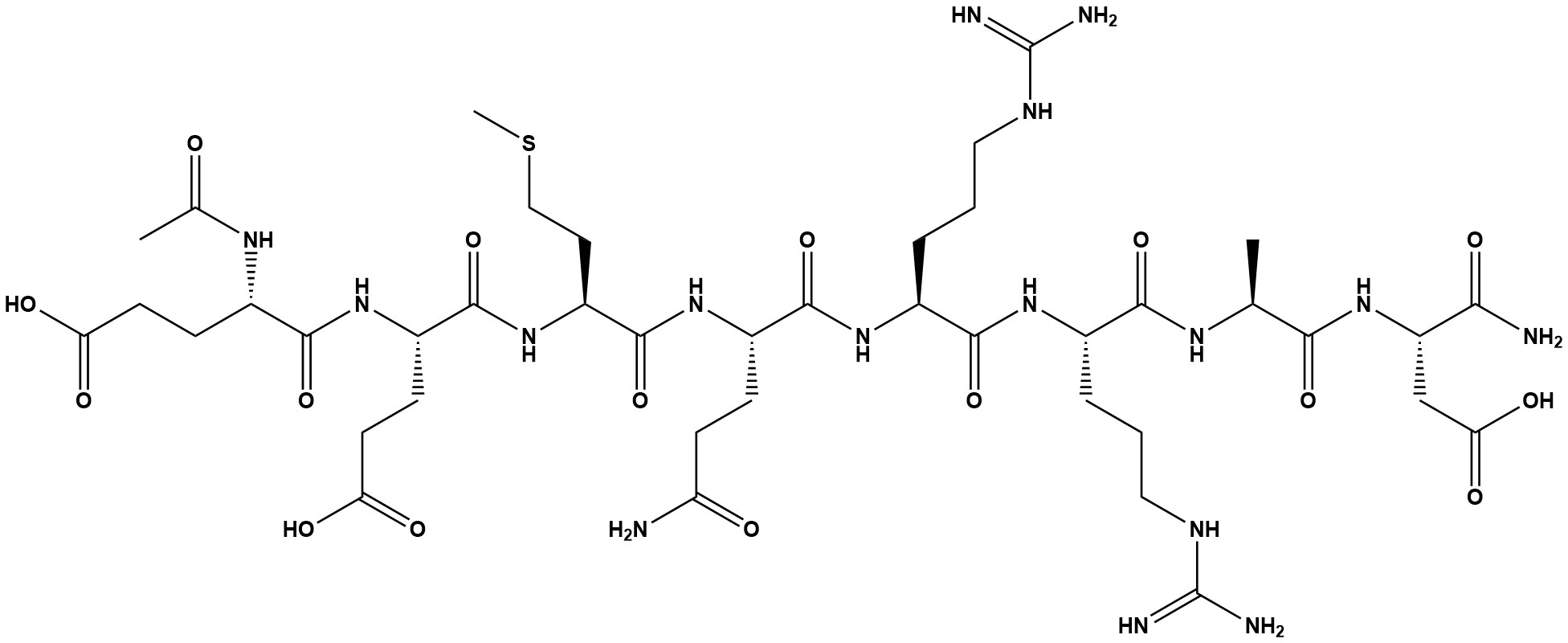
- Molecular formula: C₄₁H₇₀N₁₆O₁₆S
- Molecular weight: ~1075.16 g/mol
- CAS number: 868844-74-0
- Peptide sequence: Ac-Glu-Glu-Met-Gln-Arg-Arg-Ala-Asp-NH₂
The compound is normally supplied as a white to off-white lyophilized powder that is water-soluble and suitable for cosmetic formulations.
Production of Acetyl Octapeptide-3 (SNAP-8)
1. Raw Materials
Production begins with amino acids and reagents commonly used in peptide synthesis:
- Protected amino acids (Fmoc-Glu, Fmoc-Met, etc.)
- Solid resin (e.g., Wang or Rink amide resin)
- Coupling reagents (HBTU, HATU, or DIC)
- Deprotection reagents (piperidine)
- Solvents (DMF, DCM)
These materials must meet pharmaceutical or cosmetic-grade purity standards.
2. Synthesis Process
The peptide is produced through solid-phase peptide synthesis (SPPS).
Step 1: Resin Loading
- The first amino acid is attached to a solid resin support.
Step 2: Deprotection
- The Fmoc protecting group is removed using piperidine.
Step 3: Coupling Reaction
- The next amino acid is coupled using an activating reagent such as HBTU or HATU.
Step 4: Chain Elongation
- The cycle of deprotection → coupling → washing continues until the full octapeptide chain is formed.
Step 5: Acetylation
- The N-terminal is acetylated to produce Acetyl Octapeptide-3 (SNAP-8).
Step 6: Cleavage
- The peptide is cleaved from the resin using TFA cleavage solution.
Step 7: Purification
- The crude peptide is purified by reverse-phase high-performance liquid chromatography (RP-HPLC).
Step 8: Lyophilization
- The purified peptide solution is freeze-dried (lyophilized) to obtain stable powder.
Quality Control of Acetyl Octapeptide-3 (SNAP-8)
Quality control ensures batch consistency and safety.
1. Purity Analysis
- HPLC (High-Performance Liquid Chromatography)
- Purity requirement typically ≥98–99%.
2. Identity Confirmation
- Mass spectrometry (MS) verifies molecular weight.
- LC-MS/MS methods can quantify Acetyl Octapeptide-3 (SNAP-8) with high accuracy and repeatability.
3. Physicochemical Tests
Common parameters include:
- Appearance (white powder)
- Solubility in water
- pH stability (typically stable between pH 3–8)
- Peptide sequence verification
4. Microbiological Tests
For cosmetic ingredients:
- Total microbial count
- Endotoxin screening
- Sterility tests
Many manufacturers also perform sterile filtration before lyophilization.
Production Specifications
Typical industrial specifications include:
| Parameter | Specification |
| Appearance | White or off-white powder |
| Purity | ≥98–99% (HPLC) |
| Molecular Weight | ~1075 Da |
| Solubility | Water soluble |
| Storage | −20 °C or 2–8 °C |
| Shelf life | ~24 months |
Acetyl Octapeptide-3 (SNAP-8) is commonly stored in sealed, light-protected containers to maintain stability.
Formulation and Manufacturing Considerations
When incorporated into cosmetic products:
- Added during the cooling phase (<40 °C) to prevent degradation.
- Typical concentration in formulations: 3–10% peptide solution.
- Compatible with other peptides and skincare actives.
Quality Documentation
Reputable suppliers provide:
- Certificate of Analysis (COA)
- MSDS (Material Safety Data Sheet)
- HPLC chromatogram
- Mass spectrum data
These documents confirm batch purity, identity, and safety compliance.
Summary
The quality and production of Acetyl Octapeptide-3 (SNAP-8) rely on:
- Solid-phase peptide synthesis (SPPS) for precise peptide formation.
- HPLC purification to achieve ≥99% purity.
- Analytical verification using HPLC, LC-MS/MS, and other techniques.
- Strict manufacturing standards such as GMP and sterile processing.
- Proper storage and formulation conditions to maintain stability.
If you want, I can also explain:
- Industrial-scale manufacturing process of Acetyl Octapeptide-3 (SNAP-8) (factory production flow chart)
- Quality standards used by cosmetic peptide suppliers (USP / ISO / GMP)
- Analytical methods used in peptide QC (HPLC, MALDI-TOF, LC-MS)
These are usually required when writing a research paper or cosmetic ingredient monograph on Acetyl Octapeptide-3 (SNAP-8).