
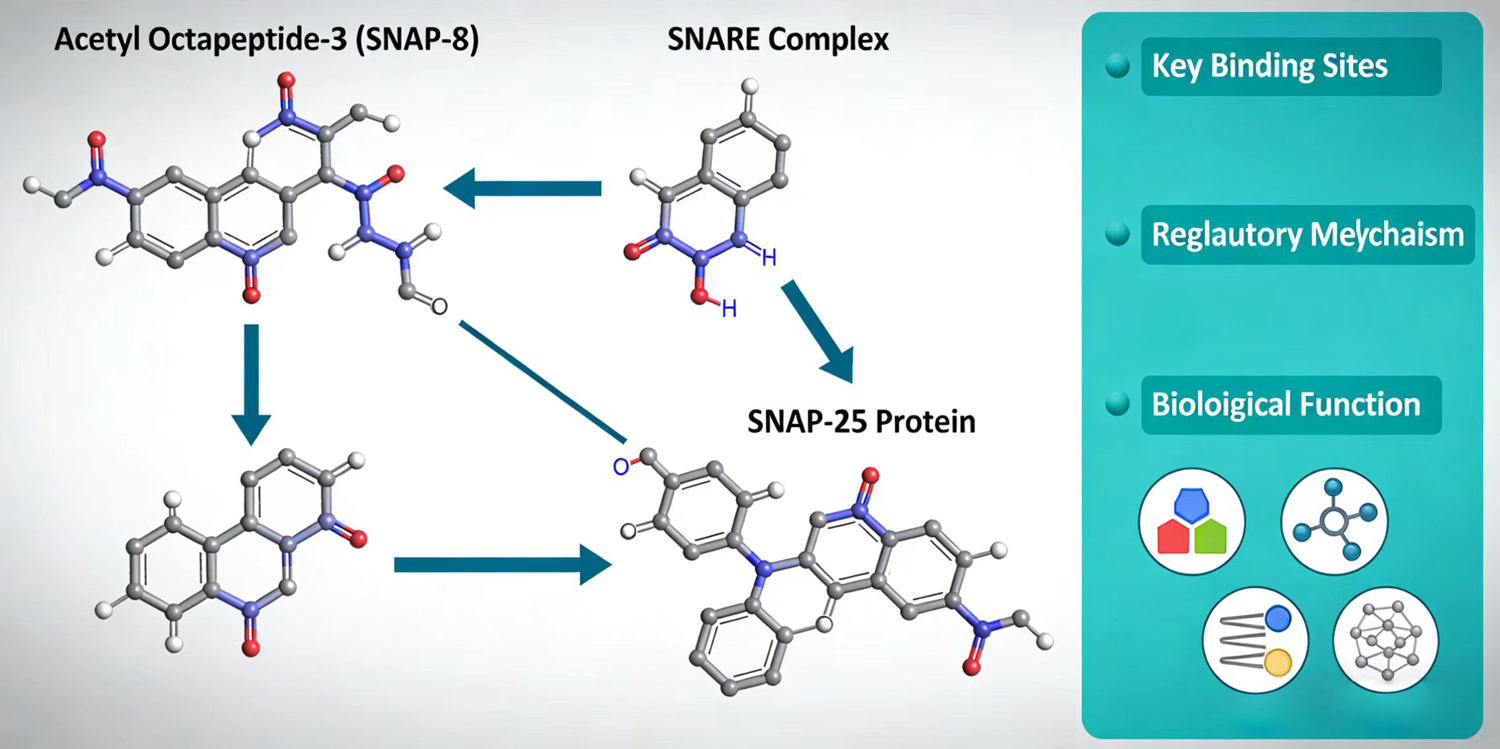
Acetyl Octapeptide-3/SNAP-8, the SNARE complex, and the SNAP-25 protein is based on molecular mimicry and competitive inhibition within the neurotransmitter release machinery at nerve terminals.
1. Normal role of the SNARE complex and SNAP-25
The SNARE complex is the protein system that enables synaptic vesicle fusion and neurotransmitter release.
It is mainly composed of three proteins:
- SNAP-25–membrane-associated cytosolic protein
- Syntaxin-1–located on the presynaptic plasma membrane
- Synaptobrevin–located on the synaptic vesicle
These proteins assemble into a four-helix bundle, often called the SNARE “zipper”. When the helices zip together:
- The vesicle membrane is pulled toward the presynaptic membrane
- Membrane fusion occurs
- Neurotransmitters (e.g., acetylcholine) are released into the synaptic cleft.
2. Structural relationship between SNAP-8 and SNAP-25
Acetyl Octapeptide-3/SNAP-8 was designed as a short peptide fragment that mimics part of the N-terminal region of SNAP-25.
- Sequence: Ac-Glu-Glu-Met-Gln-Arg-Arg-Ala-Asp-NH₂
- Length: 8 amino acids (octapeptide)
Because of this structural similarity, Acetyl Octapeptide-3/SNAP-8 can imitate the binding region of SNAP-25 used in SNARE complex assembly.
3. How SNAP-8 interacts with the SNARE complex
Acetyl Octapeptide-3/SNAP-8 interferes with SNARE assembly through competitive binding.
Mechanism
- During SNARE assembly, SNAP-25 normally interacts with syntaxin and synaptobrevin to form the fusion complex.
- Acetyl Octapeptide-3/SNAP-8 competes with SNAP-25 for these interaction sites.
- The peptide binds near the N-terminal domain of SNAP-25, disrupting proper alignment of SNARE helices.
- As a result, the SNARE complex forms more slowly or becomes unstable.
4. Consequence of this interference
When SNARE assembly is impaired:
- Vesicle fusion efficiency decreases
- Neurotransmitter exocytosis (especially acetylcholine) is reduced
- Neuromuscular signaling becomes weaker
This reduces muscle contraction signals, which is why Acetyl Octapeptide-3/SNAP-8 is used in cosmetics to reduce expression wrinkles.
5. Summary of the relationship
| Component | Role | Relationship |
| SNAP-25 | Core SNARE protein needed for vesicle fusion | Target of Acetyl Octapeptide-3/SNAP-8 |
| SNARE complex | Machinery for neurotransmitter release | Assembly is inhibited by Acetyl Octapeptide-3/SNAP-8 |
| Acetyl Octapeptide-3/SNAP-8 | Synthetic peptide derived from SNAP-25 region | Mimics SNAP-25 and competitively blocks SNARE assembly |
In short:
Acetyl Octapeptide-3/SNAP-8 is a synthetic mimic of the SNAP-25 N-terminal region that competitively interferes with SNARE complex formation, thereby reducing neurotransmitter release and muscle contraction.
If you’d like, I can also explain the exact SNARE helical structure (4-helix bundle) and where SNAP-25 contributes two helices, which clarifies why small peptides like Acetyl Octapeptide-3/SNAP-8 can disrupt the complex.