
Saccharide Isomerate is a carbohydrate-based cosmetic humectant, commonly used in skin-care and hair-care formulations. It is produced by rearranging naturally occurring sugars into a mixture of low-molecular-weight saccharide derivatives. Its major value is long-lasting moisturization and improvement of skin-barrier hydration.
1. Main Effects
| Efficacy | How it works | Expected benefit |
| Deep moisturization | Attracts and retains water in the stratum corneum | Skin feels softer and less dry |
| Long-lasting hydration | Has strong affinity for skin components and can remain associated with the skin | More persistent hydration than many conventional humectants |
| Barrier-supporting | Helps maintain adequate water content in the outer skin layer | Supports a healthier skin barrier |
| Reduces dryness | Increases water availability in the stratum corneum | Helps relieve rough, tight, flaky-feeling skin |
| Improves skin smoothness | Hydrated corneocytes become more flexible and less rough | Smoother skin texture |
| Soothing support | Maintaining hydration can reduce discomfort associated with dryness | Skin feels more comfortable |
| Hair conditioning | Retains moisture around the hair fiber | Softer, more manageable hair |
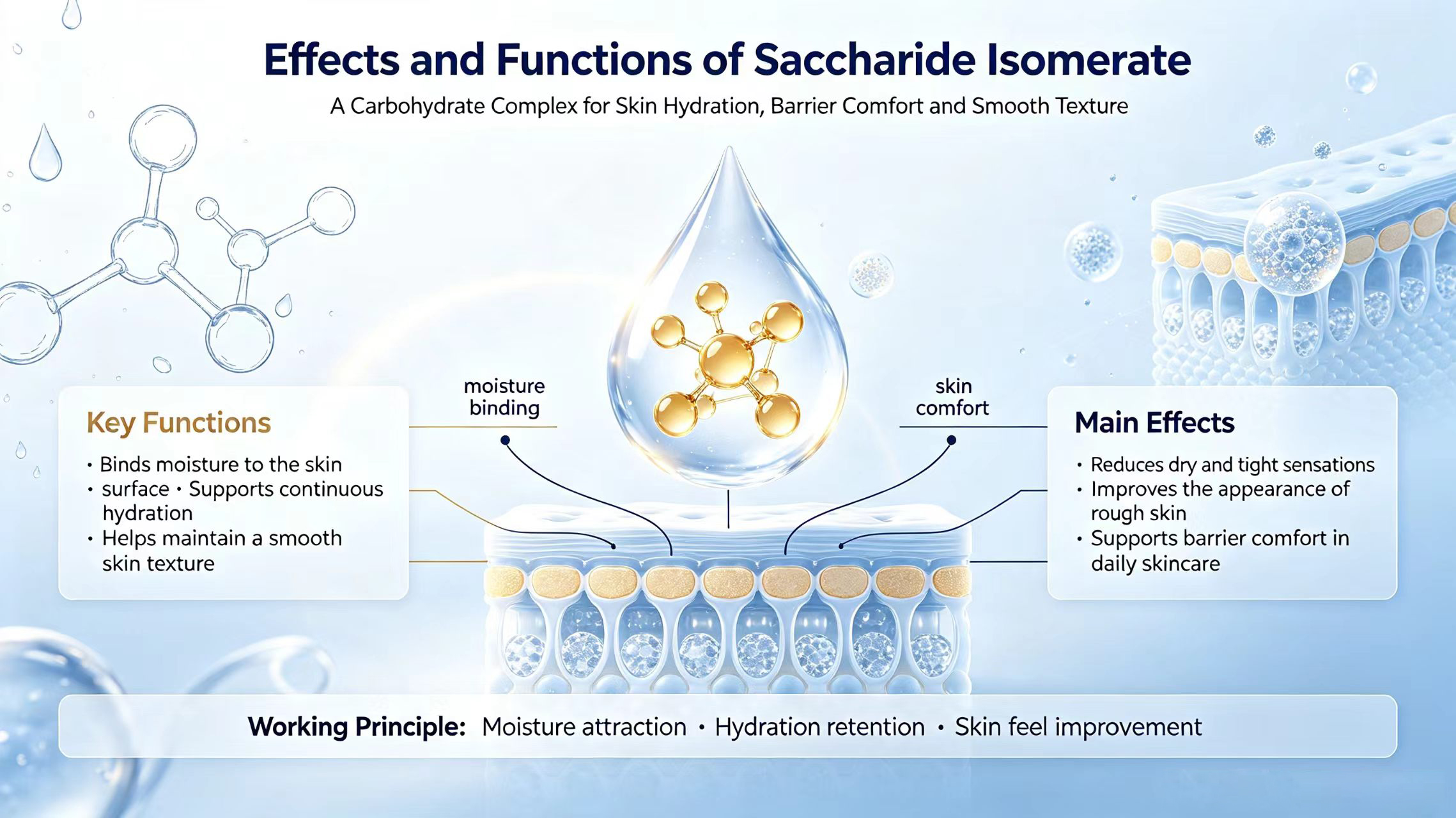
2. Key Functions
① Humectant function
Its primary function is to act as a moisture-binding ingredient. It attracts water and helps maintain hydration in the skin’s outer layers.
② Long-lasting moisturizing function
One of Saccharide Isomerate is distinguishing characteristics is its ability to interact with components of the stratum corneum. This can provide relatively persistent moisturization rather than only producing a short-term surface-hydration effect.
③ Skin-barrier support
Adequate hydration is essential for normal barrier function. By maintaining water content in the stratum corneum, Saccharide Isomerate can help skin remain more resilient and reduce the dry, rough sensation associated with barrier stress.
④ Skin-softening and smoothing
Improved hydration increases the flexibility of the outermost skin cells, which can make rough or dry skin feel smoother and softer.
⑤ Anti-dryness/comfort function
It is particularly useful in formulations designed for dry, dehydrated, sensitive-feeling, or environmentally stressed skin, where maintaining moisture is a major formulation objective.
⑥ Hair and scalp moisturization
In hair-care products, Saccharide Isomerate can function as a moisturizing/conditioning ingredient, helping improve the feel of dry hair and supporting moisture retention.
3. Effect on Different Skin Concerns
- Dry skin: ★★★★★ — one of its strongest applications.
- Dehydrated skin: ★★★★★ — helps increase and maintain water content.
- Rough texture: ★★★★☆ — improved hydration can make skin feel smoother.
- Tightness after cleansing: ★★★★☆ — useful in moisturizing cleansers and leave-on products.
- Fine lines caused by dehydration: ★★★☆☆ — hydration can temporarily make them appear less prominent, but it is not a retinoid or collagen-stimulating active.
- Compromised barrier: ★★★★☆ — useful as part of a broader barrier-support formulation.
- Pigmentation/acne: ★☆☆☆☆ — it is not primarily a brightening or anti-acne active.
4. Why Saccharide Isomerate Is Interesting
A major advantage is that it is more than a simple water-attracting ingredient. Saccharide Isomerate has an affinity for the skin’s carbohydrate-containing structures, which contributes to its substantive, longer-lasting moisturizing effect.
This makes it particularly valuable in:
- Facial moisturizers
- Hydrating serums
- Toners and essences
- Eye-care products
- Body lotions
- Hand creams
- Facial cleansers
- Sensitive-skin formulations
- Shampoos and conditioners
- Scalp-care products
5. Overall Assessment
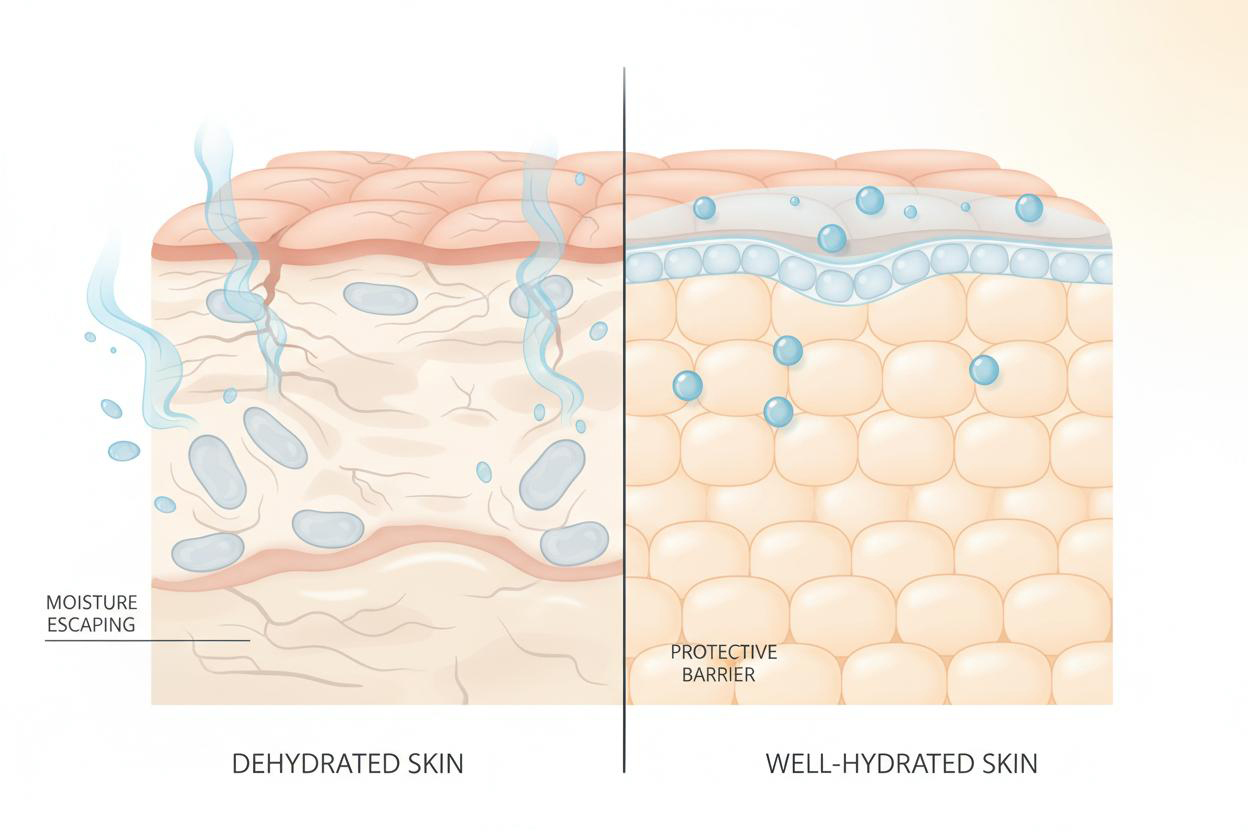
Saccharide Isomerate is core function is sustained moisturization. Its strongest benefits are water retention, reduction of dryness, improved skin softness, smoother texture, and support of the skin barrier. It is generally best considered a high-performance humectant/moisturizing ingredient, rather than an anti-aging, antioxidant, exfoliating, or pigment-targeting active.
For formulation purposes, it is especially attractive when a product needs longer-lasting hydration and a comfortable skin feel without relying exclusively on traditional humectants such as glycerin or hyaluronic acid.