
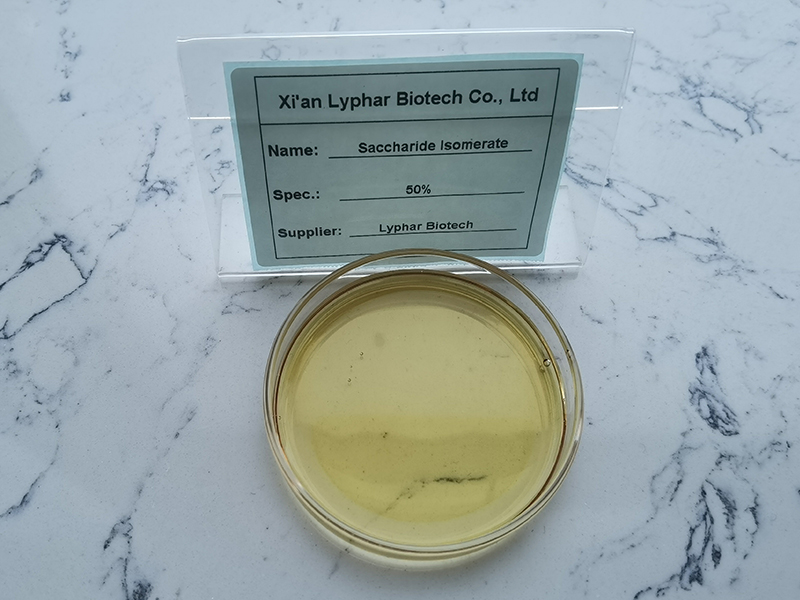
Saccharide Isomerate is a sugar-derived cosmetic humectant and skin-conditioning ingredient, commonly used in moisturizers, serums, toners, cleansers, and other personal-care products. Its main value is long-lasting skin hydration rather than exfoliation, anti-aging activity, or pigment reduction. The Cosmetic Ingredient Review (CIR) has concluded that it is safe in cosmetics under the present practices of use and concentration.
1. Effectiveness
a. Strong moisturizing/humectant effect
Saccharide Isomerate attracts and retains water at the skin surface, helping increase hydration and reduce the feeling of dryness. It is particularly useful in products designed for dry or dehydrated skin.
b. Helps support the skin barrier
Better hydration can improve the condition and flexibility of the stratum corneum and reduce rough, tight-feeling skin. Some clinical evidence suggests improvements in hydration-related and barrier-related measurements, although the clinical evidence specifically attributable to Saccharide Isomerate remains relatively limited.
c. Long-lasting hydration
One of its distinguishing characteristics is its ability to interact with components of the stratum corneum, contributing to persistent moisturization. This makes it useful when a formulation is intended to provide hydration beyond the immediate application period.
d. Improves skin softness and smoothness
By increasing water content in the outer skin layers, Saccharide Isomerate can make dry, rough skin feel softer and smoother. Evidence for improvements in skin texture exists, but is still considered preliminary.
e. Useful for dry and dehydrated skin
It can be especially valuable in formulations targeting:
- Dry skin
- Dehydrated skin
- Rough or flaky skin
- Compromised-feeling skin
- Tightness after cleansing
- Daily barrier-support moisturizers
2. Side Effects
Saccharide Isomerate has a generally favorable topical safety profile. The CIR Expert Panel concluded that it is safe in cosmetic products at the concentrations and usage practices evaluated.
Potential problems are generally uncommon but can include:
| Possible effect | Likelihood/importance |
| Mild irritation | Low |
| Redness or stinging | Uncommon; possible in very sensitive skin |
| Allergic/contact reaction | Possible but considered low risk |
| Breakouts | Not generally considered an intrinsic characteristic of Saccharide Isomerate |
| Photosensitivity | Not considered a significant concern |
| Systemic toxicity from normal topical cosmetic use | Not expected |
Importantly, irritation from a finished product does not necessarily mean Saccharide Isomerate is responsible. Other ingredients—such as preservatives, fragrances, acids, solvents, or botanical extracts—may be responsible.
Available safety summaries characterize irritation and sensitization risks as low, although uncommon reactions cannot be completely excluded because clinical studies are relatively limited.
3. Special Precautions
Patch testing:
People with highly reactive or allergy-prone skin can perform a small-area patch test before applying a new product extensively.
Avoid applying to severely damaged skin:
Although Saccharide Isomerate is generally gentle, products containing it should not automatically be assumed to be appropriate for severely injured or actively inflamed skin.
Consider the whole formulation:
The safety and tolerability of a cosmetic product depend on the complete formulation, not just Saccharide Isomerate.
Follow the manufacturer’s recommended concentration:
There is no single universally established “best” concentration for every cosmetic application. The appropriate level depends on the product type and formulation. Clinical evidence has generally evaluated finished formulations rather than establishing one universal optimal concentration.
Use good manufacturing practices:
CIR specifically emphasized controlling impurities, including potential heavy-metal contamination, through appropriate manufacturing practices.
4. Overall Assessment
Effectiveness: ★★★★☆ for moisturization
Barrier-support potential: ★★★★☆
Skin-softening: ★★★★☆
Anti-aging evidence: ★★☆☆☆
Pigment-lightening effect: ★☆☆☆☆
Irritation risk: Low
Sensitization risk: Low
Overall cosmetic safety: Very good
Bottom line
Saccharide Isomerate is best regarded as a high-value moisturizing and skin-conditioning ingredient. Its strongest benefit is improving and maintaining skin hydration, with secondary benefits for softness, smoothness, and the appearance of dry skin. The available safety assessments support its use in cosmetics at current concentrations, while clinical evidence for additional effects such as texture or barrier improvement is promising but less robust.
It should not be considered a replacement for proven actives such as retinoids, sunscreen, or pigment-targeting ingredients when those specific effects are desired.