
Sepiwhite MSH and α-Arbutin are cosmetic skin-brightening agents, but they target melanogenesis at different points. Sepiwhite MSH is Undecylenoyl Phenylalanine, while α-arbutin is 4-hydroxyphenyl α-D-glucopyranoside.
| Feature | Sepiwhite MSH | Alpha–Arbutin |
| INCI | Undecylenoyl Phenylalanine | Alpha-Arbutin |
| Main origin | Lipoamino-acid derivative of phenylalanine | Glycosylated hydroquinone derivative |
| Primary target | α-MSH/MC1R signaling pathway | Tyrosinase enzyme |
| Main action | Reduces melanocyte stimulation and tyrosinase activation | Reduces tyrosinase activity and melanin synthesis |
| Mechanism position | Relatively upstream | More downstream |
| Best suited for | UV-/signal-driven pigmentation, uneven tone, dark spots | Dark spots, post-inflammatory pigmentation, general brightening |
| Typical raw-material use | Seppic recommends 2% for Sepiwhite MSH; Sepiwhite MSH QD is designed for 0.2% | Common cosmetic formulations use roughly 0.5–2% |
| Water solubility | Amphiphilic/hydrodispersible; formulation dependent | Water-soluble |
| Stability | Generally formulation dependent | Better stability than β-arbutin, but still requires appropriate formulation |
| Irritation potential | Generally considered mild | Generally considered mild |
| Evidence | Cosmetic clinical/in-vitro evidence | Clinical evidence exists, although strength varies by formulation |
| Can combine? | Yes | Yes |
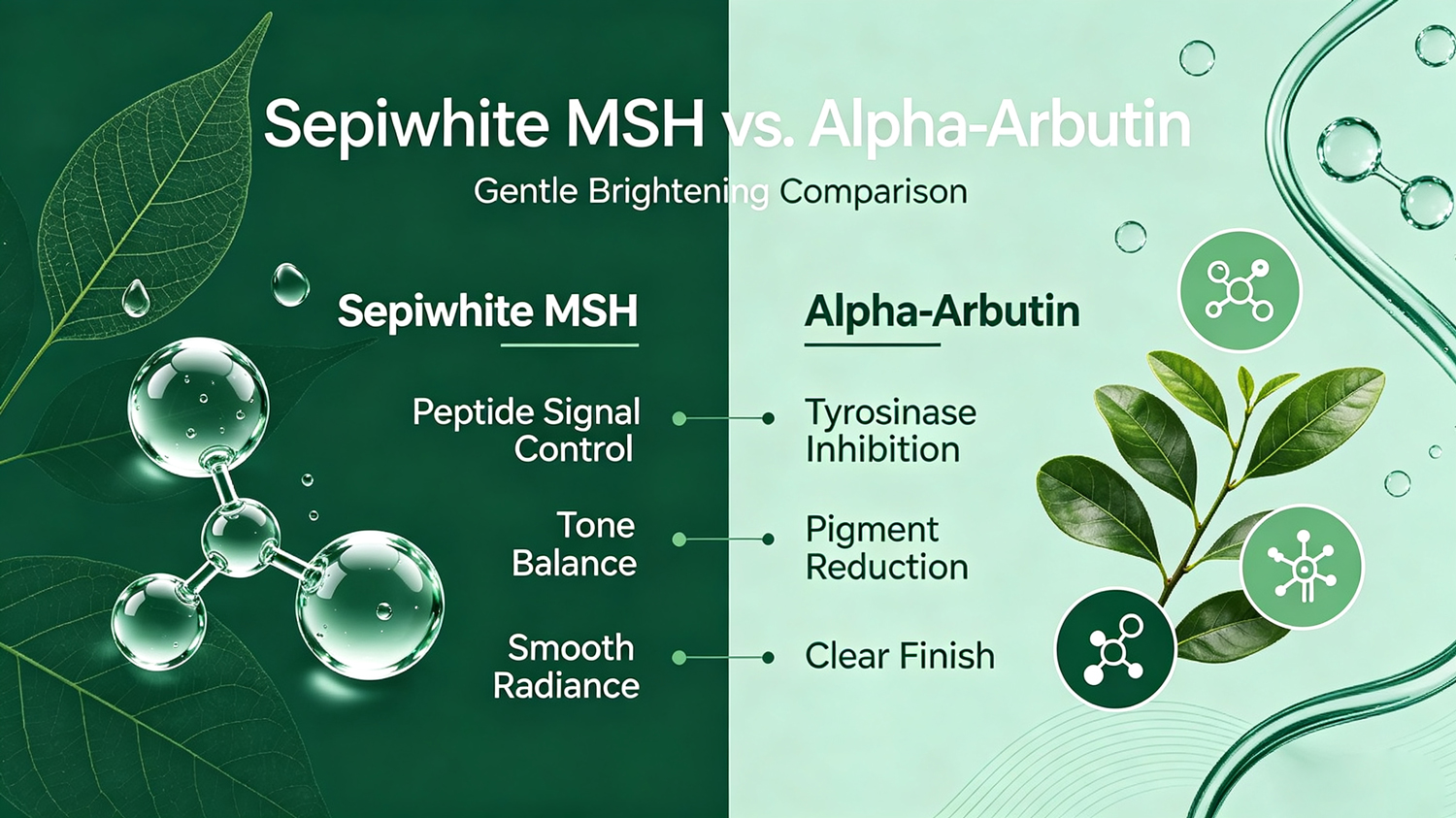
1. Difference in mechanism
Sepiwhite MSH (undecylenoyl phenylalanine) acts primarily by modulating the α-MSH pathway. α-MSH normally stimulates melanocytes through melanocortin signaling, ultimately increasing tyrosinase activity and melanin production. Sepiwhite MSH antagonizes this signaling and therefore acts relatively early in the pigmentation pathway. Seppic describes it specifically as an α-MSH-pathway modulator that inhibits metabolic activation of tyrosinase.
Alpha-Arbutin, in contrast, is principally used as a tyrosinase-targeting brightening ingredient. It therefore attacks melanin production more directly at the enzyme level. However, laboratory work suggests that arbutin is a relatively weak inhibitor of human tyrosinase compared with some stronger depigmenting agents.
2. Which is better for dark spots?
Alpha-Arbutin:
A strong choice when the primary objective is gradual reduction of existing dark spots and overall brightening.
Sepiwhite MSH:
Particularly interesting when you want to interfere with the signaling that drives melanogenesis, rather than relying solely on direct tyrosinase inhibition.
Importantly, these mechanisms are complementary rather than redundant.
3. Which has stronger evidence?
Both have supporting evidence, but the evidence is not directly comparable because studies use different concentrations, formulations, populations, and combinations.
For Sepiwhite MSH, a controlled clinical study evaluated 1% undecylenoyl phenylalanine with 5% niacinamide and found greater reduction in facial hyperpigmentation than niacinamide alone after eight weeks.
For Alpha-Arbutin, a 2025 clinical study using 2% Alpha-Arbutin together with 10% trihydroxybenzoic acid glucoside and sunscreen reported significant improvements in pigmentation and melasma measures after 90 days. Because it was a combination regimen, the result should not be interpreted as the effect of Alpha-Arbutin alone.
4. Which is better for melasma?
For melasma, I would favor a multi-pathway combination rather than choosing one ingredient.
A rational formulation could use:
Sepiwhite MSH + Alpha-Arbutin + niacinamide + sunscreen
The rationale is:
- Sepiwhite MSH: suppresses α-MSH-driven pigmentation signaling.
- Alpha-Arbutin: acts at the tyrosinase/melanogenesis level.
- Niacinamide: helps reduce melanosome transfer.
- Broad-spectrum sunscreen: reduces the UV stimulus that drives pigmentation.
The complementary nature of Sepiwhite MSH and niacinamide has been demonstrated experimentally/clinically, with the combination outperforming niacinamide alone in one study.
5. Which is better for sensitive skin?
Neither is inherently an aggressive exfoliating active.
Alpha-Arbutin is generally an attractive option for a simple, gentle brightening formulation.
Sepiwhite MSH is also generally suitable for leave-on cosmetic products, and Seppic positions it as a face-care lightening active.
The overall irritation profile will depend heavily on what else is in the formula—especially acids, retinoids, fragrances, and solvents.
6. Which should you choose?
Choose Alpha-Arbutin if:
- You want a straightforward brightening ingredient.
- Your primary concern is dark spots/PIH.
- You prefer a water-soluble active.
- You want an ingredient with a well-established cosmetic formulation history.
Choose Sepiwhite MSH if:
- You want a different mechanism from conventional tyrosinase inhibitors.
- Your formulation is focused on controlling melanocyte signaling.
- You want to combine multiple complementary anti-pigmentation mechanisms.
- You are developing a more sophisticated professional brightening formula.
For maximum pigmentation control, using both can make more mechanistic sense than treating them as competitors.
Bottom line
Alpha-Arbutin = primarily a tyrosinase/melanogenesis-targeting brightener.
Sepiwhite MSH = an α-MSH signaling-pathway modulator.
So, if I had to rank them by mechanistic complementarity, I’d favor:
Sepiwhite MSH + Alpha-Arbutin > either ingredient alone, provided the formulation is stable and well tolerated.
One important distinction: Seppic’s recommended concentration for Sepiwhite MSH itself is 2%, whereas its Sepiwhite MSH QD product is a separate grade with a recommended use level of 0.2%. These should not be treated as interchangeable specifications.