
Sepiwhite MSH is the trade name used by Seppic for Undecylenoyl Phenylalanine, a lipoamino-acid cosmetic active. The commercial material is positioned as a preservative-free, natural-origin ingredient and is supplied primarily as a powder.
1. Production principle
The active molecule is produced by modifying the amino acid L-phenylalanine with a lipid-derived undecylenoyl group. In simplified terms:
Phenylalanine + undecylenoyl lipid moiety → Undecylenoyl Phenylalanine
This converts the relatively polar amino acid into an amphiphilic/lipophilic lipoamino acid, giving it substantially different solubility and formulation behavior. Commercial technical information describes the raw-material sources as amino acid and lipids.
The exact industrial synthesis conditions, catalysts, purification parameters, reaction yields, and proprietary specifications used by Seppic are not publicly disclosed in the manufacturer’s product page, so a commercial manufacturing process should not be assumed from laboratory procedures.
2. General manufacturing sequence
At an industrial level, production can be understood as:
(1)Raw-material selection
- High-purity phenylalanine
- Appropriate undecylenoyl/lipid-derived acyl source
- Process reagents and solvents meeting pharmaceutical/cosmetic raw-material standards.
(2)Acylation
- The phenylalanine amino group is chemically acylated with the undecylenoyl moiety.
- This creates N-undecylenoyl-L-phenylalanine, the chemical identity associated with Sepiwhite MSH.
(3)Reaction control
- Temperature, pH, stoichiometry, reaction time and impurity formation are monitored.
- Control of these parameters is important because incomplete acylation can leave phenylalanine or other intermediates in the product.
(4)Purification
- Unreacted starting materials, reaction by-products, salts and residual processing materials are removed.
- Industrial purification can involve controlled phase separation, washing, crystallization and/or other proprietary purification operations.
(5)Isolation and drying
- The purified material is converted into a stable solid.
- Seppic identifies Sepiwhite MSH as a preservative-free ingredient; Seppic’s broader ingredient documentation identifies the form as powder.
(6)Milling/sieving and packaging
- Particle characteristics are controlled to provide reproducible dispersion and incorporation into cosmetic formulations.
3. Important quality-control parameters
For a high-quality Undecylenoyl Phenylalanine/Sepiwhite MSH raw material, manufacturers would typically control:
| Quality parameter | Why it matters |
| Identity | Confirms that the material is Undecylenoyl Phenylalanine |
| Assay/purity | Determines active concentration |
| Related substances | Detects unreacted phenylalanine and synthesis by-products |
| Appearance | Detects discoloration, agglomeration or degradation |
| Moisture/water | Important for stability and processing |
| Residual solvents | Demonstrates adequate purification |
| Heavy metals/elemental impurities | Ensures cosmetic raw-material safety |
| Microbial quality | Particularly important for cosmetic manufacturing |
| Particle size | Influences dispersion and processing |
| Solubility/dispersibility | Determines formulation performance |
| Stability | Ensures consistent performance during storage |
A useful distinction is that chemical purity and formulation quality are not the same thing. A material can have high chemical assay but still perform poorly if its particle characteristics, residual solvent profile, moisture or physical form are unsuitable.
4. What indicates good commercial quality?
Seppic states that Sepiwhite MSH has NOC (ISO 16128) >99%, is preservative-free, and has COSMOS, NATRUE, HALAL and vegan suitability claims; the manufacturer also indicates China compliance.
These claims are useful for evaluating commercial quality, but they should not be interpreted as meaning the material is literally >99% chemically pure. ISO 16128’s natural-origin calculation is different from an HPLC assay/purity specification.
For purchasing or incoming-QC purposes, it is therefore better to request the supplier’s:
- Certificate of Analysis (CoA)
- Specification sheet
- HPLC/assay method
- Residual-solvent specification
- Heavy-metal specification
- Microbiological specification
- SDS
- Batch/lot traceability
- Country of manufacture
- Stability/shelf-life information
5. Physical quality and formulation behavior
Undecylenoyl Phenylalanine is relatively difficult to incorporate directly into water-based systems. A technical specification for the ingredient describes it as a white-to-yellow powder/granular material and indicates that it is soluble in oils while requiring appropriate processing for incorporation.
Seppic’s current product information recommends 2% Sepiwhite MSH for the standard product, while the Sepiwhite MSH QD grade is designed for much lower use levels, with Seppic listing 0.2%.
6. Production quality vs. counterfeit/alternative material
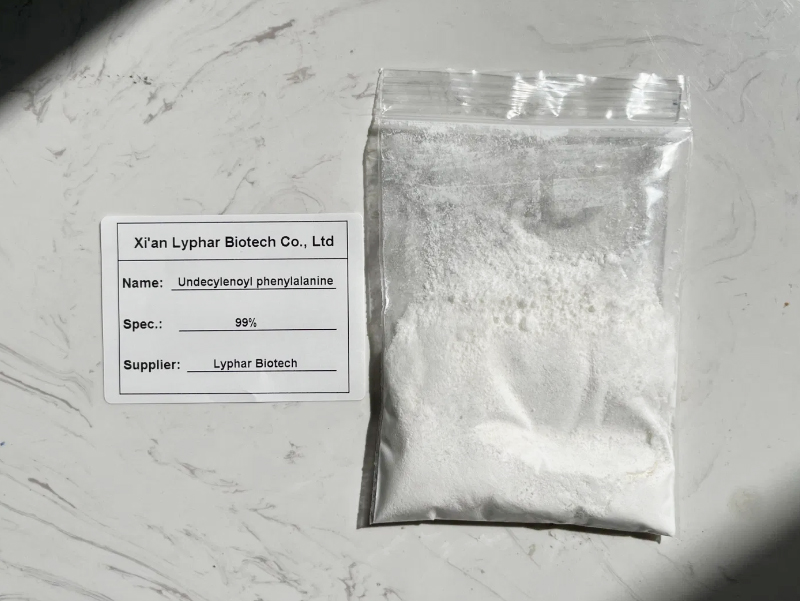
This distinction is particularly important. “Undecylenoyl Phenylalanine” is the INCI/chemical ingredient; “Sepiwhite MSH” is Seppic’s branded commercial ingredient. Other suppliers can potentially sell Undecylenoyl Phenylalanine without it being genuine Seppic Sepiwhite MSH. The chemical identity alone therefore does not establish that a material is authentic Sepiwhite MSH.
For genuine Sepiwhite MSH, verify the Seppic manufacturer/supplier documentation and lot traceability, rather than relying solely on the INCI name.
7. Overall assessment
High-quality Sepiwhite MSH production depends on four stages:
high-quality phenylalanine/lipid raw materials → controlled acylation → effective purification → rigorous batch QC.
The final material should have consistent identity, purity, physical characteristics and stability, while remaining free of problematic residuals and microbial contamination.
One important limitation: Seppic does not publicly disclose its complete proprietary industrial synthesis and purification process, so detailed reaction conditions presented as the “official Sepiwhite MSH manufacturing process” would be speculative. Public patent literature does, however, confirm that Undecylenoyl Phenylalanine can be handled as a chemically synthesized lipoamino acid and describes downstream purification approaches.
If your goal is manufacturing rather than simply understanding the ingredient, I can next give you a laboratory/industrial production process for Undecylenoyl Phenylalanine, including raw materials, reaction principle, purification, QC tests, HPLC analysis and expected specifications.