
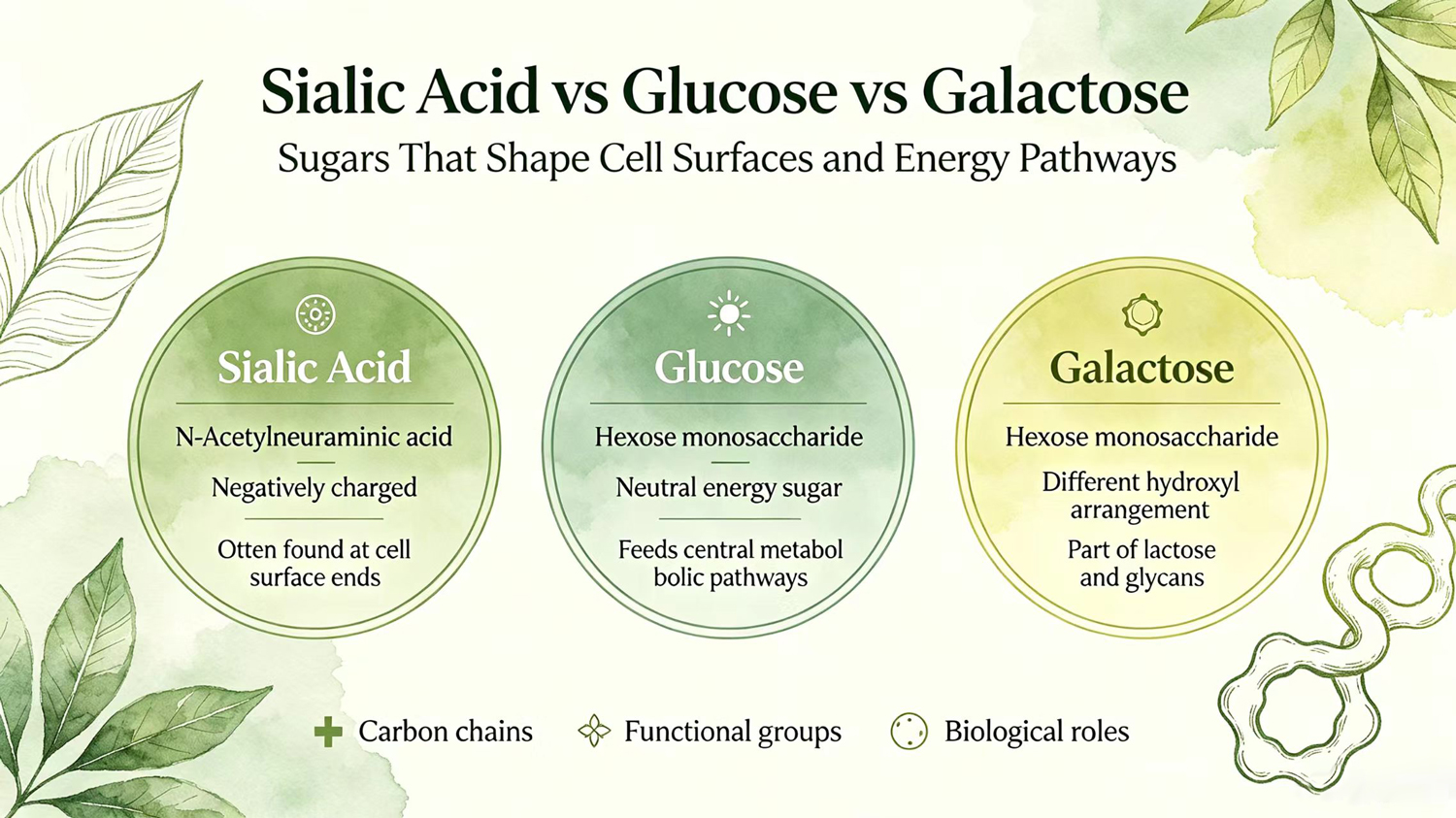
Sialic acid (specifically N-acetylneuraminic acid, Neu5Ac) differs substantially from glucose and galactose. Glucose and galactose are six-carbon monosaccharides, whereas Neu5Ac is a nine-carbon acidic amino sugar derivative that is commonly found at the terminal positions of glycoconjugates.
| Feature | Sialic acid (Neu5Ac) | Glucose | Galactose |
| Chemical class | Sialic acid; acidic amino sugar derivative | Aldohexose monosaccharide | Aldohexose monosaccharide |
| Molecular formula | C₁₁H₁₉NO₉ | C₆H₁₂O₆ | C₆H₁₂O₆ |
| Carbon atoms | 9-carbon backbone | 6 | 6 |
| Nitrogen | Yes | No | No |
| Carboxyl group | Yes (–COOH) | No | No |
| Amino/acetamido group | N-acetyl group | No | No |
| Reducing sugar | Generally considered a reducing monosaccharide, although its biological behavior differs greatly from glucose/galactose | Yes | Yes |
| Main biological location | Usually terminal residues of glycoproteins and glycolipids | Blood, cytosol, glycogen, many carbohydrates | Glycoproteins, glycolipids, lactose and other glycans |
| Major role | Cell recognition, receptor interactions, immune regulation, pathogen binding, glycoprotein stability | Major cellular energy substrate | Structural and glycan-building component |
| Energy metabolism | Not a major direct energy fuel | Major energy source | Can be converted into glycolytic intermediates |
| Typical dietary role | Present in some animal-derived foods; also synthesized by humans | Widely present in carbohydrates | Present in dairy and many glycans |
| Typical biological distribution | Especially abundant in vertebrates and deuterostomes | Extremely widespread | Extremely widespread |
1. Structural difference
Glucose and galactose are stereoisomers. They have the same molecular formula, C₆H₁₂O₆, but differ in the spatial configuration around carbon 4.
Sialic acid is structurally much more complex. It is derived biosynthetically from N-acetylmannosamine (ManNAc) and phosphoenolpyruvate (PEP) and contains:
- a nine-carbon skeleton;
- a carboxyl group, giving it acidic properties;
- an N-acetyl substituent;
- several hydroxyl groups;
- a cyclic/noncyclic equilibrium in solution.
This carboxyl group is particularly important because it gives Neu5Ac a negative charge at physiological pH.
2. Difference in biological function
Glucose → primarily energy
Glucose is the central carbohydrate fuel of human metabolism. It enters glycolysis and can ultimately generate ATP. It is also stored as glycogen or used to synthesize other biomolecules.
Galactose → primarily structural and biosynthetic
Galactose is important in the synthesis of:
- glycoproteins;
- glycolipids;
- proteoglycan-associated glycans;
- lactose in mammary tissue.
Dietary galactose can be converted through the Leloir pathway into intermediates that enter glucose metabolism.
Neu5Ac → primarily information and recognition
Neu5Ac is generally not used as a major energy substrate. Instead, it is attached to the ends of glycans on:
- cell-surface glycoproteins;
- glycolipids;
- mucins;
- other glycoconjugates.
Its terminal position and negative charge allow it to influence cell–cell recognition, receptor binding, immune interactions, cellular adhesion, and the lifetime of circulating glycoproteins.
3. A key difference: Neu5Ac is often a terminal sugar
A useful way to visualize the distinction is:
Glucose / galactose:
[carbohydrate building blocks] → structural and metabolic roles
Neu5Ac:
[glycan chain]—Neu5Ac
Sialic acid is frequently positioned at the outermost/terminal end of a glycan, where it can interact directly with proteins such as lectins and receptors.
This is why relatively small amounts of sialic acid can have major biological effects.
4. Metabolic importance
Glucose is directly integrated into central energy metabolism:
Glucose → glycolysis → pyruvate → acetyl-CoA/TCA cycle → ATP
Galactose can be converted through the Leloir pathway:
Galactose → Gal-1-P → Glc-1-P → Glc-6-P → glycolysis
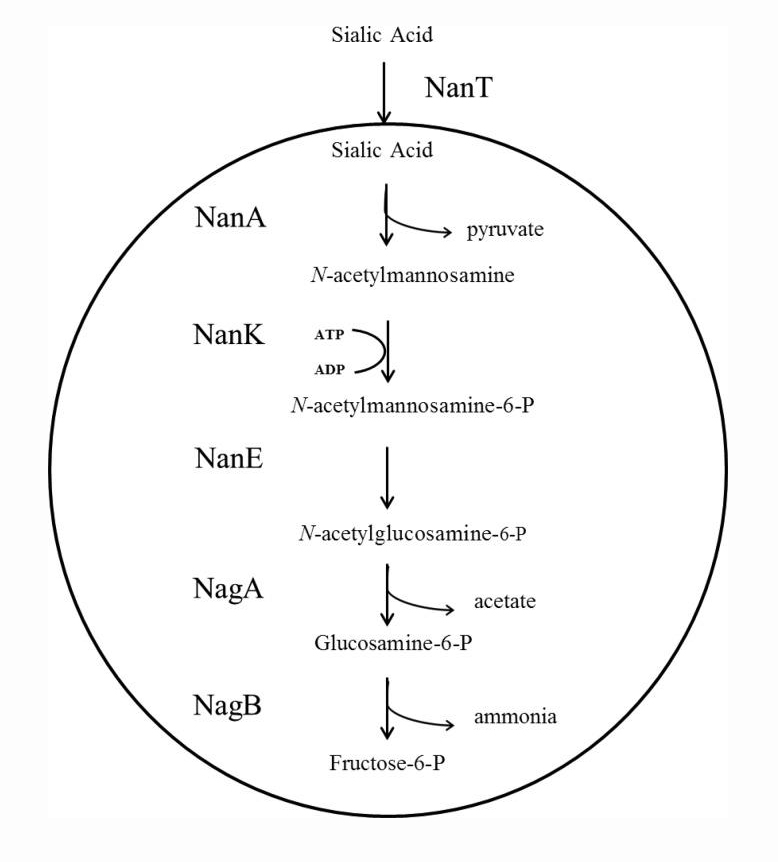
Neu5Ac has a different metabolic fate. Cells can synthesize it de novo or salvage/free sialic acid and convert it into the activated donor:
Neu5Ac → CMP-Neu5Ac → sialylated glycoconjugates
Thus, Neu5Ac metabolism is closely linked to glycosylation rather than energy production.
5. Why Neu5Ac is acidic but glucose and galactose are not
Glucose and galactose contain mainly alcohol (–OH) groups and an aldehyde-derived functional group. They do not possess a carboxylic acid group.
Neu5Ac contains a carboxylic acid group:
–COOH ⇌ –COO⁻ + H⁺
At physiological pH, much of the carboxyl group is ionized to –COO⁻, making sialylated cell surfaces relatively negatively charged.
This contributes to properties such as electrostatic interactions, hydration, and molecular recognition.
6. Relationship among the three
All three are carbohydrates or carbohydrate-related molecules, but they occupy different biochemical niches:
Glucose
→ central metabolic fuel
Galactose
→ monosaccharide used extensively in glycan biosynthesis and energy metabolism after conversion
N-Acetylneuraminic acid (Neu5Ac)
→ terminal acidic sugar residue involved predominantly in biological recognition and regulation
Bottom line
The simplest distinction is:
Glucose is mainly an energy sugar; galactose is mainly a structural/biosynthetic hexose that can also provide metabolic fuel; Neu5Ac is an acidic, nitrogen-containing nine-carbon sugar derivative that mainly serves as a cell-surface and glycoconjugate recognition signal.
Importantly, Sialic acid should not be thought of simply as another dietary sugar equivalent to glucose or galactose. Its most important biological role is as a component of complex glycans rather than as a bulk source of metabolic energy.