
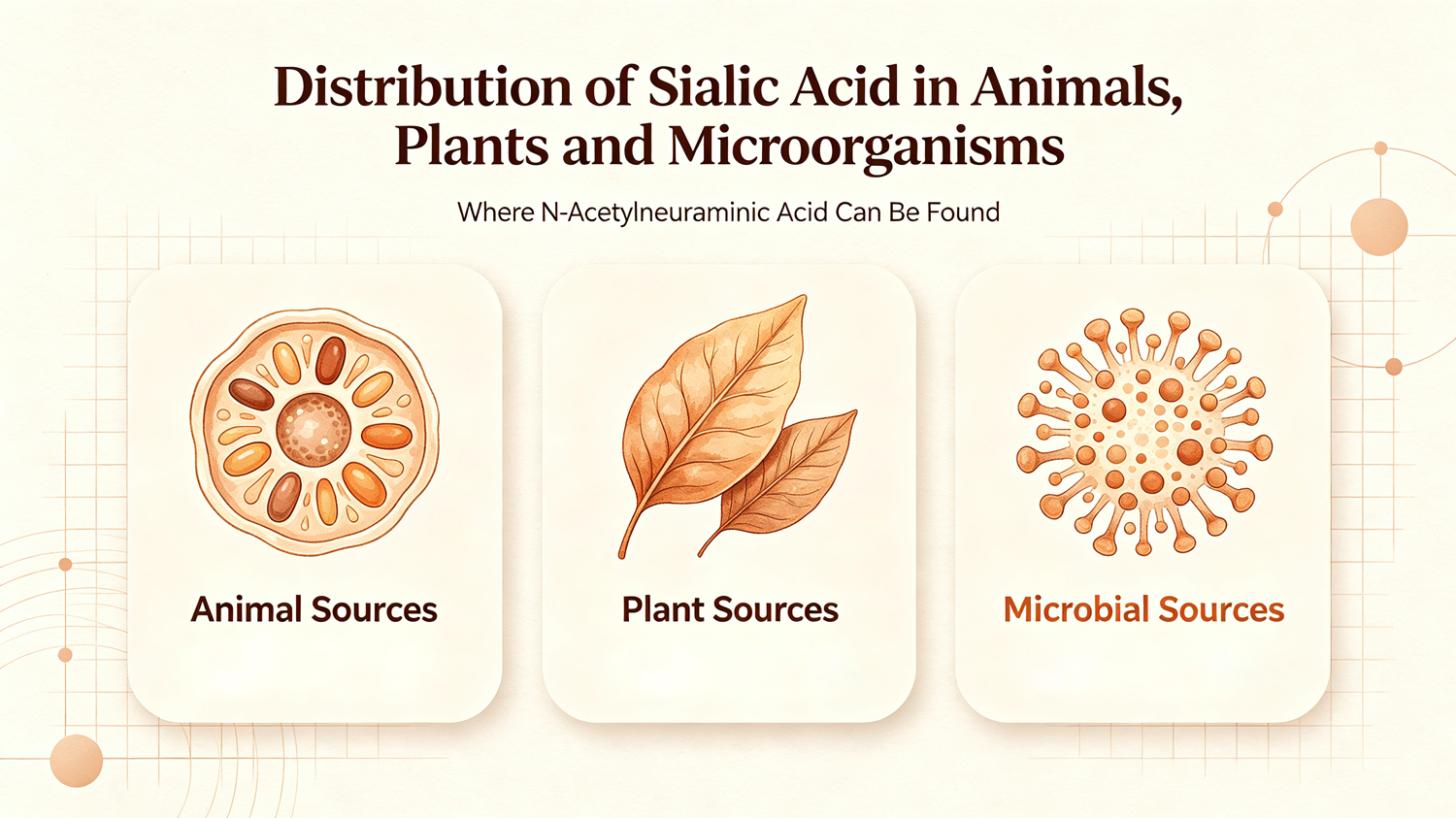
Sialic acid is a family of nine-carbon acidic sugars, with N-acetylneuraminic acid (Neu5Ac) being the predominant form in humans and many vertebrates. Its distribution is highly uneven among biological kingdoms.
1. Distribution in animals
Sialic acids are particularly abundant in animals, where they are usually found at the terminal positions of glycoconjugates such as glycoproteins and glycolipids.
| Animal group | Distribution characteristics |
| Mammals | Very widespread; Neu5Ac is generally the major sialic acid |
| Birds | Widely distributed in cell-surface glycoproteins and glycolipids; Neu5Ac and Neu5Gc can occur |
| Fish | Present in many tissues, especially mucosal and nervous tissues |
| Reptiles & amphibians | Sialylated glycoconjugates occur widely, although composition varies among species |
| Invertebrates | More variable; some groups have relatively little sialic acid or unusual sialic-acid pathways |
| Humans | Neu5Ac is the principal sialic acid; it is abundant on cell surfaces, particularly in the nervous system and mucosal tissues |
In vertebrates, sialic acid is especially important in:
- Cell-surface recognition and communication
- Immune regulation
- Protection of glycoproteins from rapid clearance
- Mucus and epithelial protection
- Neural development and synaptic function
- Pathogen–host interactions
A major species-dependent difference is the presence of N-glycolylneuraminic acid (Neu5Gc). Many non-human mammals synthesize Neu5Gc, whereas humans generally cannot synthesize Neu5Gc because the CMAH gene is inactive. Consequently, human tissues predominantly contain Neu5Ac.
2. Distribution in plants
Sialic acids are not considered ubiquitous or characteristic plant sugars.
Unlike animals, plants generally do not have the extensive, canonical sialylated glycoprotein and glycolipid systems found on animal cell surfaces. Classical plant cell-surface glycans are dominated by sugars such as:
- Glucose
- Galactose
- Mannose
- Fucose
- Xylose
- Rhamnose
- Glucuronic acid
- Galacturonic acid
Some reports have detected Neu5Ac or related sialic-acid-like compounds in particular plants or plant-associated systems, but their occurrence is sporadic and much less established than in animals. Therefore, sialic acid should not be regarded as a general structural component of higher-plant glycans.
This difference is important when comparing animal and plant carbohydrates: animal glycobiology is strongly characterized by terminal sialylation, whereas plant glycobiology generally is not.
3. Distribution in microorganisms
Microorganisms show a particularly interesting and diverse pattern.
Bacteria
Some bacteria can:
- Synthesize sialic acid de novo
- Import and salvage sialic acid from the environment
- Use sialic acid as a nutrient
- Incorporate sialic acid into their own surface glycans
- Modify or degrade host sialic acids
Several pathogenic bacteria use sialic acid-containing structures to resemble host-cell surfaces and thereby reduce recognition by the host immune system.
Examples include certain species of Neisseria, Escherichia, Haemophilus, Campylobacter, Streptococcus, and Pasteurella.
Some bacteria produce capsular polysaccharides containing sialic acid, which can contribute to resistance against complement-mediated immune attack.
Fungi and other microorganisms
Sialic-acid metabolism is also found in some fungi and other microorganisms, but it is far less universally distributed than in vertebrates. Certain microorganisms possess pathways for synthesizing, modifying, transporting, or degrading sialic acids.
Importantly, microorganisms vary greatly: the presence of a sialic-acid metabolic pathway in one species does not imply that closely related species necessarily possess the same pathway.
4. Major species-distribution characteristics
The distribution of Neu5Ac can be summarized by several principles:
A. Vertebrates have the strongest and most consistent distribution
Sialic acids are particularly characteristic of vertebrate glycoconjugates. They frequently occupy the outermost position of oligosaccharide chains, making them readily accessible for interactions with other cells, proteins, toxins, and pathogens.
B. Sialic-acid composition differs between species
Species may differ in:
- Amount of total sialic acid
- Neu5Ac/Neu5Gc ratio
- Types of glycosidic linkages
- Tissue distribution
- Degree of polysialylation
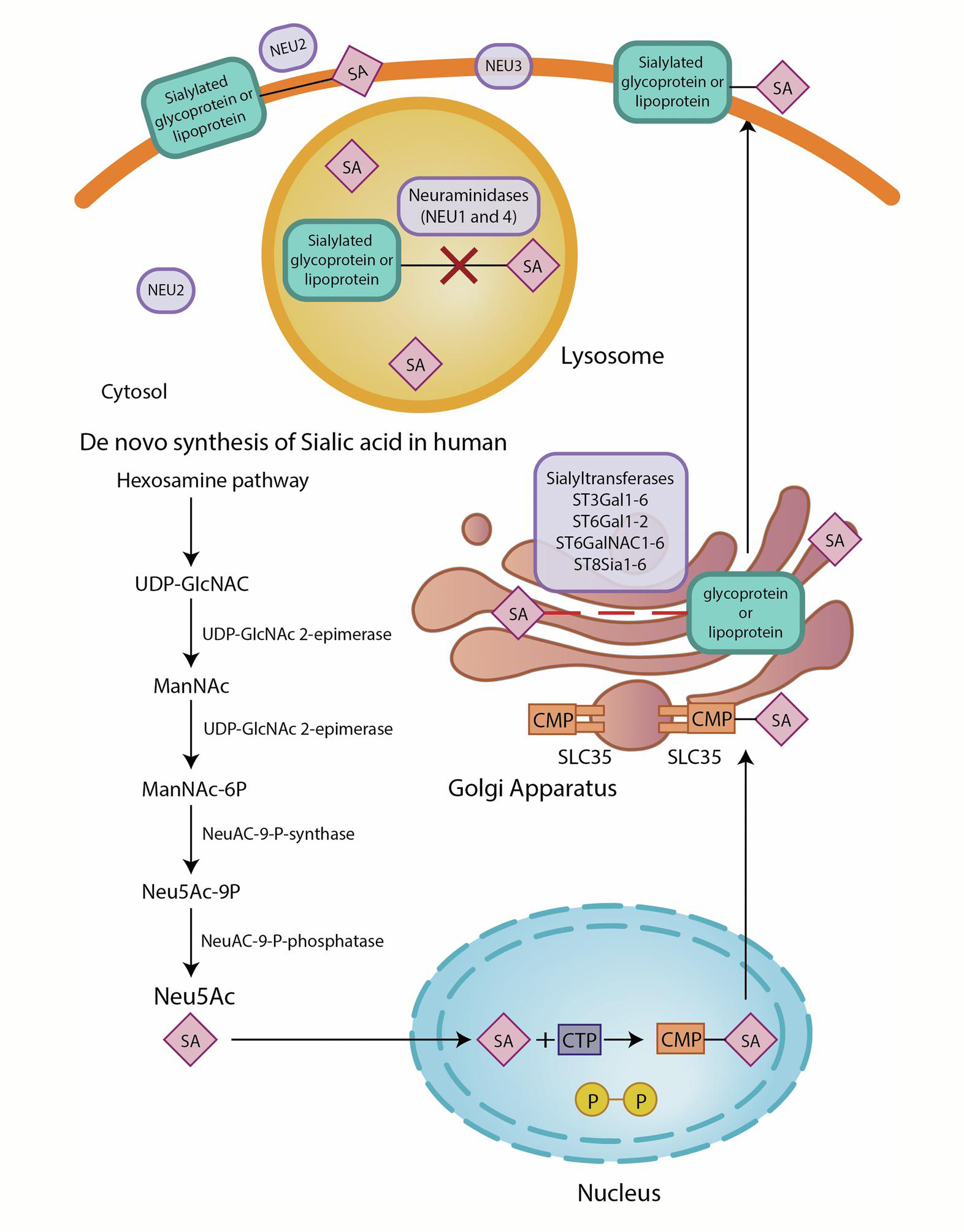
- Sialyltransferase activity
- Sialidase activity
Thus, “sialic acid” is not chemically or biologically identical across all species.
C. Tissue distribution also varies
Within an individual animal, Neu5Ac is particularly prominent in:
- Brain and nervous tissue
- Cell membranes
- Salivary and respiratory secretions
- Intestinal mucus
- Blood-cell surfaces
- Immune-cell surfaces
The brain is especially rich in sialylated glycoconjugates because of their roles in neuronal membranes, cell–cell interactions, and nervous-system development.
D. Evolutionary distribution is patchy
The ability to synthesize or utilize sialic acids appears to have evolved and been retained differently among lineages. Consequently, there is no simple rule such as “all animals have it and all microorganisms do not.”
Instead, there are three overlapping patterns:
Animals:
High and widespread → structural and regulatory component of glycoconjugates
Plants:
Generally absent or uncommon → not a major universal component of plant glycans
Microorganisms:
Highly variable → some synthesize/use it, others lack the pathway
5. Simplified evolutionary comparison
Animals
→ extensive sialylation
→ Neu5Ac commonly terminal on glycans
→ important in recognition, immunity, mucus, nervous system
Plants
→ conventional sialylation generally uncommon
→ different carbohydrate structures dominate
→ reported sialic-acid occurrence is limited and species-dependent
Microorganisms
→ highly heterogeneous
→ some synthesize Neu5Ac
→ some salvage it from hosts
→ some degrade it
→ some use it for immune evasion or surface mimicry
Key conclusion
N-Acetylneuraminic acid is primarily an animal-associated carbohydrate derivative, particularly characteristic of vertebrates, rather than a universally distributed biological sugar. Its distribution in animals is broad and functionally important, while its occurrence in plants is comparatively limited and its occurrence among microorganisms is highly species- and pathway-dependent. The striking species differences are closely related to differences in glycosylation pathways, sialyltransferases, sialidases, transport systems, and evolutionary adaptation to host–microbe interactions.