
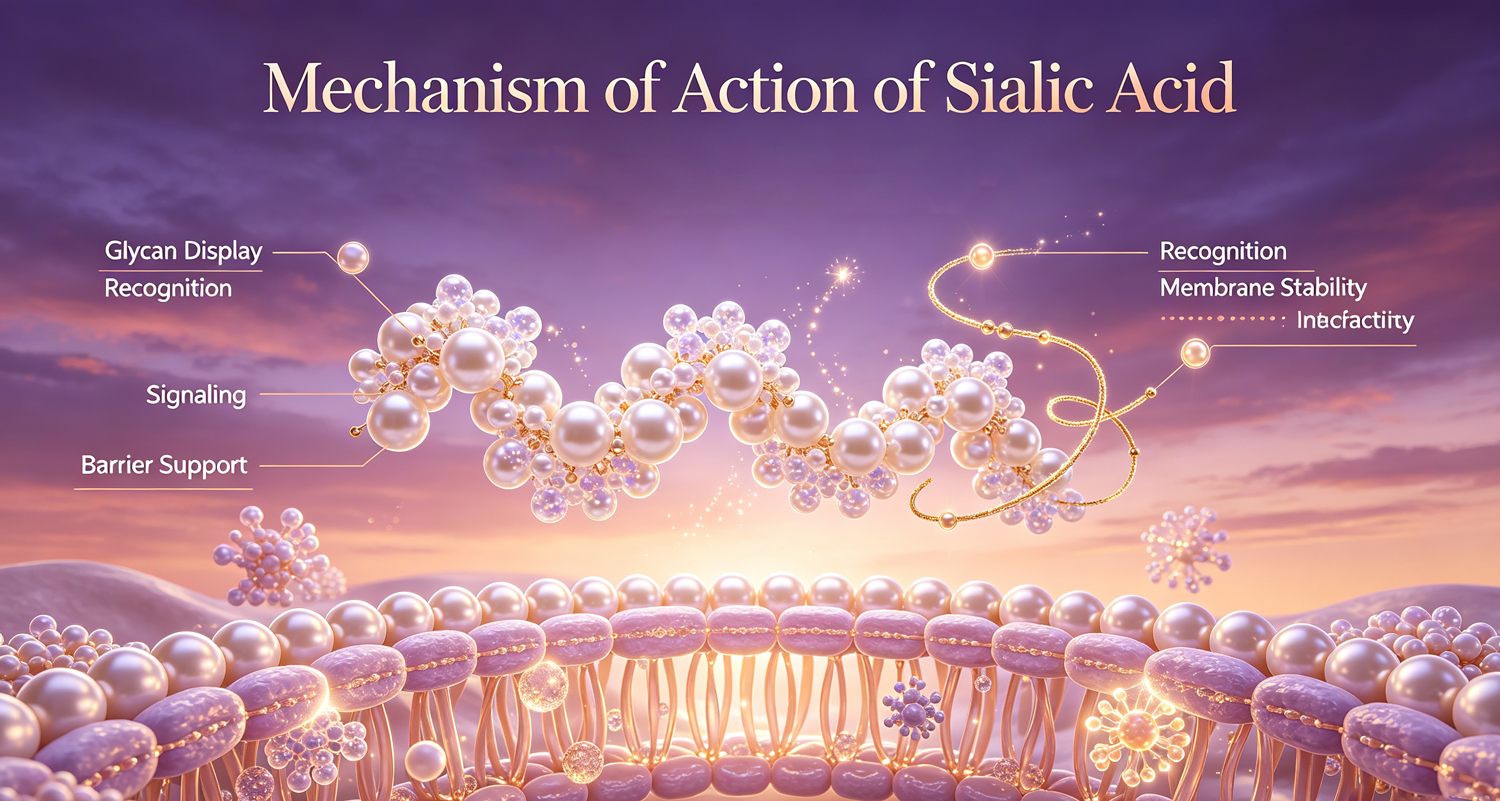
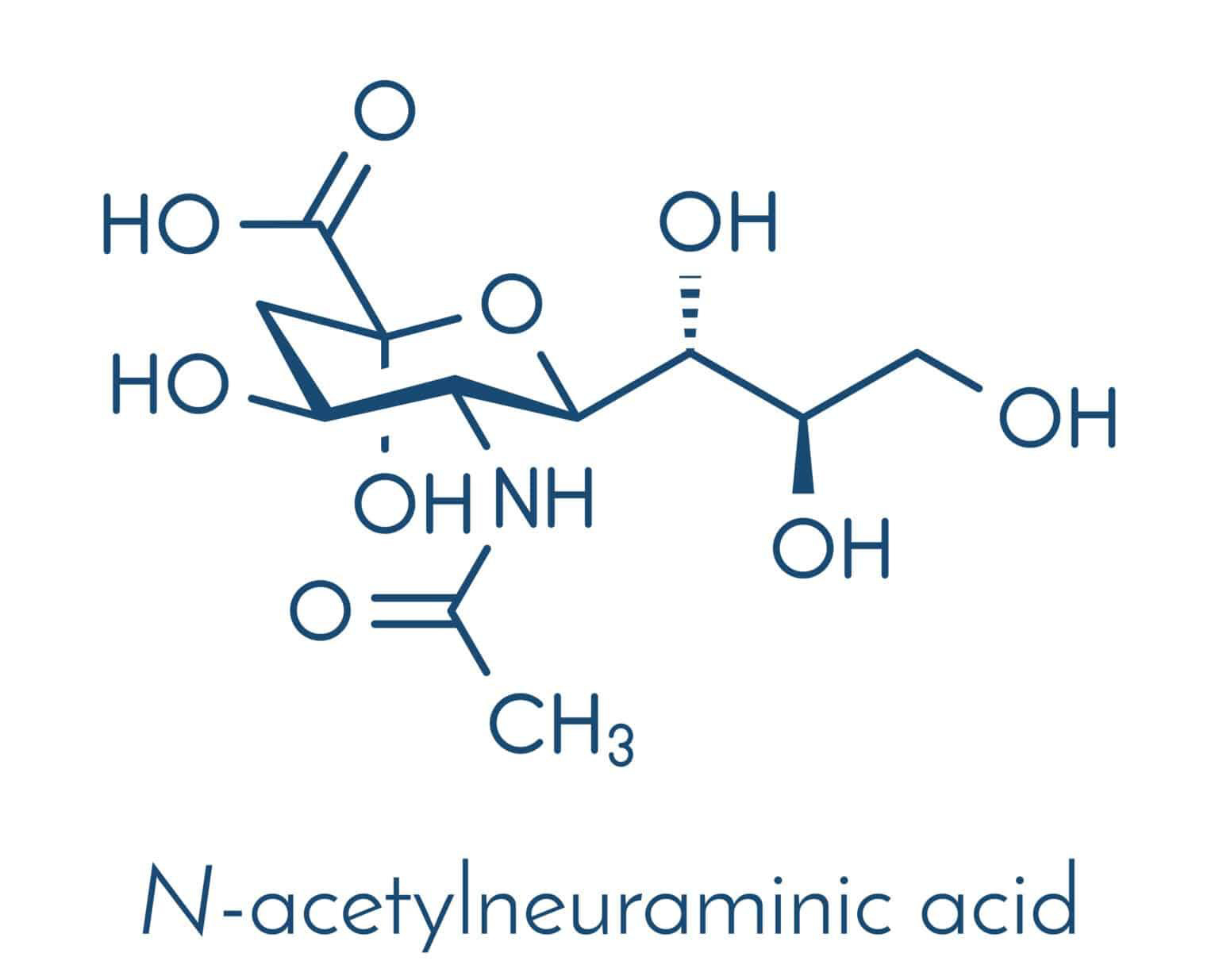
Sialic acid, particularly N-acetylneuraminic acid (Neu5Ac), is a nine-carbon acidic monosaccharide that commonly occurs at the terminal positions of glycoproteins and glycolipids on cell surfaces. Rather than acting mainly as a conventional receptor-activating drug, sialic acid regulates biological processes largely through cell-surface recognition, glycan interactions, receptor signaling, and modulation of immune responses.
1. Cell-surface recognition and signaling
Sialic acid frequently forms the outermost part of cell-surface glycans. Its negatively charged carboxyl group contributes to the electrical and structural properties of the cell membrane.
It can therefore influence:
- Cell–cell recognition
- Cell adhesion
- Receptor organization
- Cellular communication
- Interactions between cells and extracellular molecules
Changes in the amount or linkage of sialic acid can alter how cells are recognized by other cells and proteins.
2. Interaction with Siglec receptors
One of the most important mechanisms is interaction with sialic-acid-binding immunoglobulin-like lectins (Siglecs).
Siglecs recognize sialylated glycans on cell surfaces. Many Siglecs contain intracellular signaling motifs that can regulate immune-cell activity.
A simplified pathway is:
Sialylated glycan → Siglec binding → intracellular signaling → modulation of immune-cell activation
Depending on the Siglec and cell type, this can reduce excessive activation of immune cells and help maintain immune tolerance and homeostasis.
3. Regulation of inflammation
Sialylation of cell-surface proteins can influence inflammatory signaling. Sialic-acid/Siglec interactions can modify pathways associated with immune-cell activation, including signaling involving:
- Cytokine production
- Leukocyte activation
- Innate immune responses
- Inflammatory signaling pathways
This is one reason the sialic-acid system is being investigated in relation to inflammatory and immune-mediated conditions.
4. Regulation of complement and immune recognition
Terminal sialic acids can affect how the immune system distinguishes host cells from foreign or altered cells.
Sialylated glycans can contribute to protection of host cells from inappropriate immune attack, partly by influencing complement-related processes and interactions with complement-regulatory proteins.
Thus, loss or alteration of cell-surface sialylation can change immune recognition.
5. Pathogen attachment and infection
An important—and sometimes opposite—aspect of sialic acid biology is that some pathogens exploit sialylated glycans as attachment sites.
For example, influenza viruses recognize particular sialic-acid-containing receptors on respiratory epithelial cells.
The general mechanism is:
Viral hemagglutinin → recognition of sialylated glycan → attachment to host cell → viral entry/infection
Therefore, sialic acid can be protective in normal cellular biology but also serve as a receptor exploited by certain pathogens.
6. Regulation of cell adhesion and migration
Sialylation changes the physical and biochemical properties of cell-surface glycoproteins and glycolipids. This can influence interactions between cells and with the extracellular matrix.
Consequently, sialic acid participates in processes such as:
- Cell adhesion
- Cell migration
- Tissue organization
- Development
- Cell differentiation
Altered sialylation is particularly important in cancer biology, where abnormal glycosylation can influence tumor-cell interactions with the immune system.
7. Role in glycoprotein stability
Terminal sialic acid residues can influence the biological lifetime of circulating glycoproteins.
When terminal sialic acid is removed from certain glycoproteins, the newly exposed galactose residues can be recognized by hepatic receptors, promoting uptake and clearance.
Thus:
Terminal sialylation → reduced recognition by hepatic clearance receptors → potentially longer circulating lifetime
This is particularly important for several endogenous plasma proteins and therapeutic glycoproteins.
8. Role in the nervous system
Sialic acid is abundant in the nervous system and is incorporated into gangliosides and glycoproteins.
It contributes to:
- Neuronal membrane structure
- Cell–cell interactions
- Synaptic development
- Neural cell recognition
- Brain development and function
Because of its abundance in neuronal membranes, alterations in sialylation can affect nervous-system development and cellular communication.
9. Antioxidant effects: an important qualification
Sialic acid is sometimes described in supplement or cosmetic literature as an antioxidant or anti-aging compound. However, this should be interpreted cautiously.
Free N-acetylneuraminic acid does not have the same well-established direct antioxidant role as classical antioxidants such as ascorbic acid. Many of the biological effects attributed to sialic acid arise from its role in glycoconjugates and cell-surface signaling, rather than simply from direct scavenging of reactive oxygen species.
Overall mechanism
The mechanism can be summarized as:
N-Acetylneuraminic acid
↓
Incorporation into glycoproteins/glycolipids
↓
Modification of cell-surface glycans
↓
Recognition by lectins, Siglecs, receptors and other binding proteins
↓
Changes in cell adhesion, immune signaling, inflammation and cellular recognition
↓
Effects on tissue organization, immune homeostasis, protein clearance and host–pathogen interactions
Key point
Sialic acid is best understood as a biological signaling and recognition molecule within the glycocalyx, rather than simply as an ordinary nutritional antioxidant. Its effects depend strongly on where it is located, which glycan it is attached to, its linkage type, and which receptor recognizes it. Free Neu5Ac and glycosidically bound sialic acid can therefore have substantially different biological behavior.