
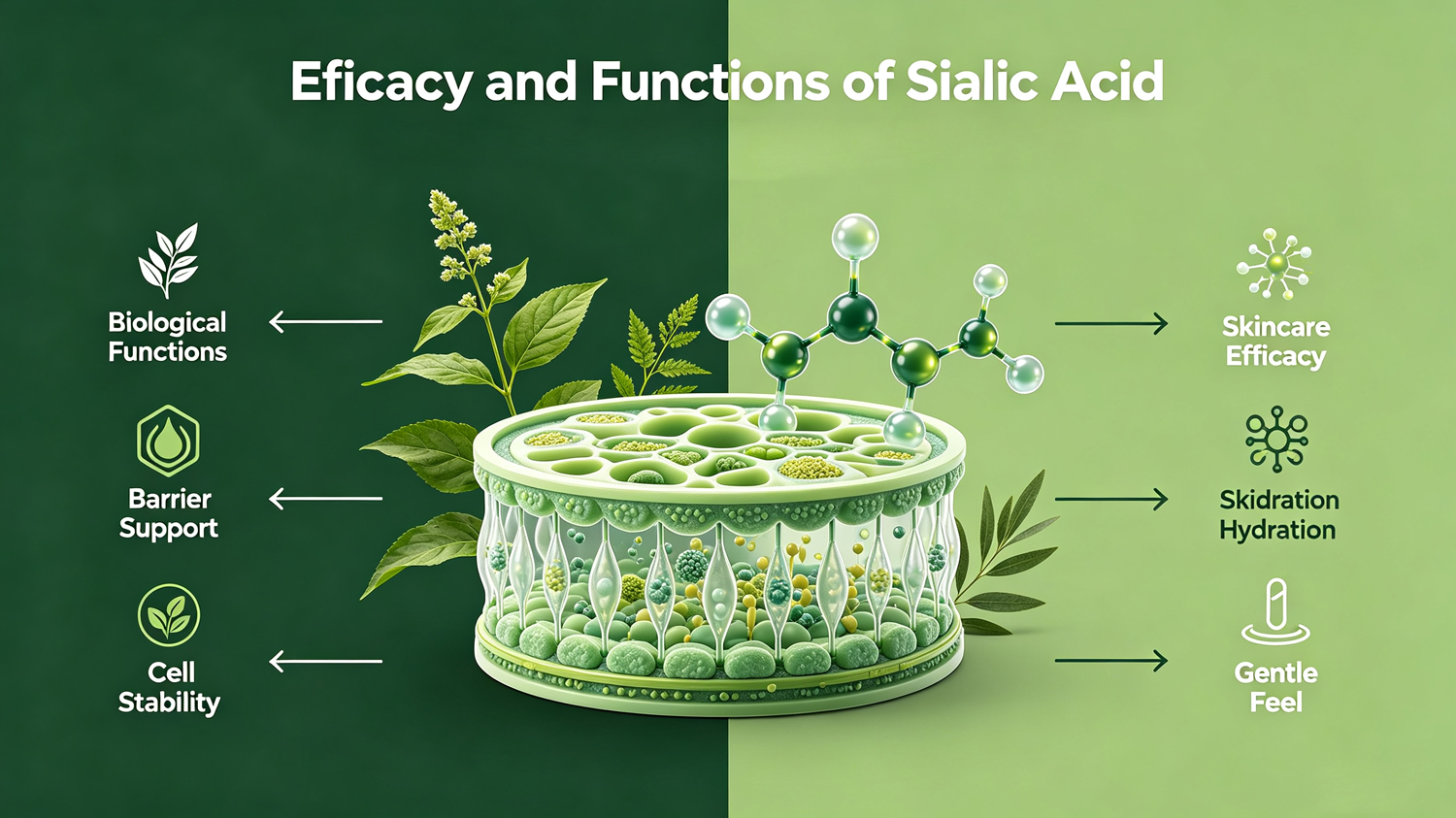
Sialic acid, with N-acetylneuraminic acid (Neu5Ac) being the predominant form in humans, is a nine-carbon acidic monosaccharide found mainly at the terminal positions of cell-surface glycoproteins and glycolipids. It is not simply a structural sugar; it participates in cell recognition, signaling, immune regulation, protein stability, and host–pathogen interactions.
1. Major biological functions
| Function | Role of Sialic Acid |
| Cell recognition | Provides molecular “identity tags” on cell surfaces and helps cells recognize one another |
| Cell signaling | Modulates receptors and signaling molecules through interactions with sialylated glycans |
| Immune regulation | Helps regulate immune-cell activation and can distinguish self from non-self |
| Protein stability | Terminal sialylation can prolong the circulation time of glycoproteins by reducing their recognition and clearance |
| Cell adhesion | Participates in interactions between cells and between cells and extracellular molecules |
| Pathogen interactions | Many viruses and bacteria recognize sialylated glycans as attachment sites |
| Glycocalyx formation | Contributes to the negatively charged carbohydrate-rich layer surrounding cells |
| Neural function | Abundant in the nervous system and involved in neuronal development, synaptic biology, and membrane organization |
2. Potential nutritional and health-related relevance
Sialic acid is particularly concentrated in human milk, nervous tissue, and cell membranes. Dietary sialic acid can be obtained from foods containing glycoproteins and glycolipids.
Research has investigated whether supplemental sialic acid may contribute to:
- Brain and cognitive development: Sialylated glycoconjugates are important components of neuronal membranes and synaptic structures. Some nutritional studies suggest that increased sialic-acid availability may influence learning and memory, although evidence for benefits from supplementation in healthy adults remains limited.
- Neurodevelopment: Sialic acid participates in neuronal growth, differentiation, and cell–cell interactions during development.
- Immune function: Sialylation regulates interactions between immune receptors and ligands, but this does not mean that oral sialic acid is established as an immune-boosting supplement.
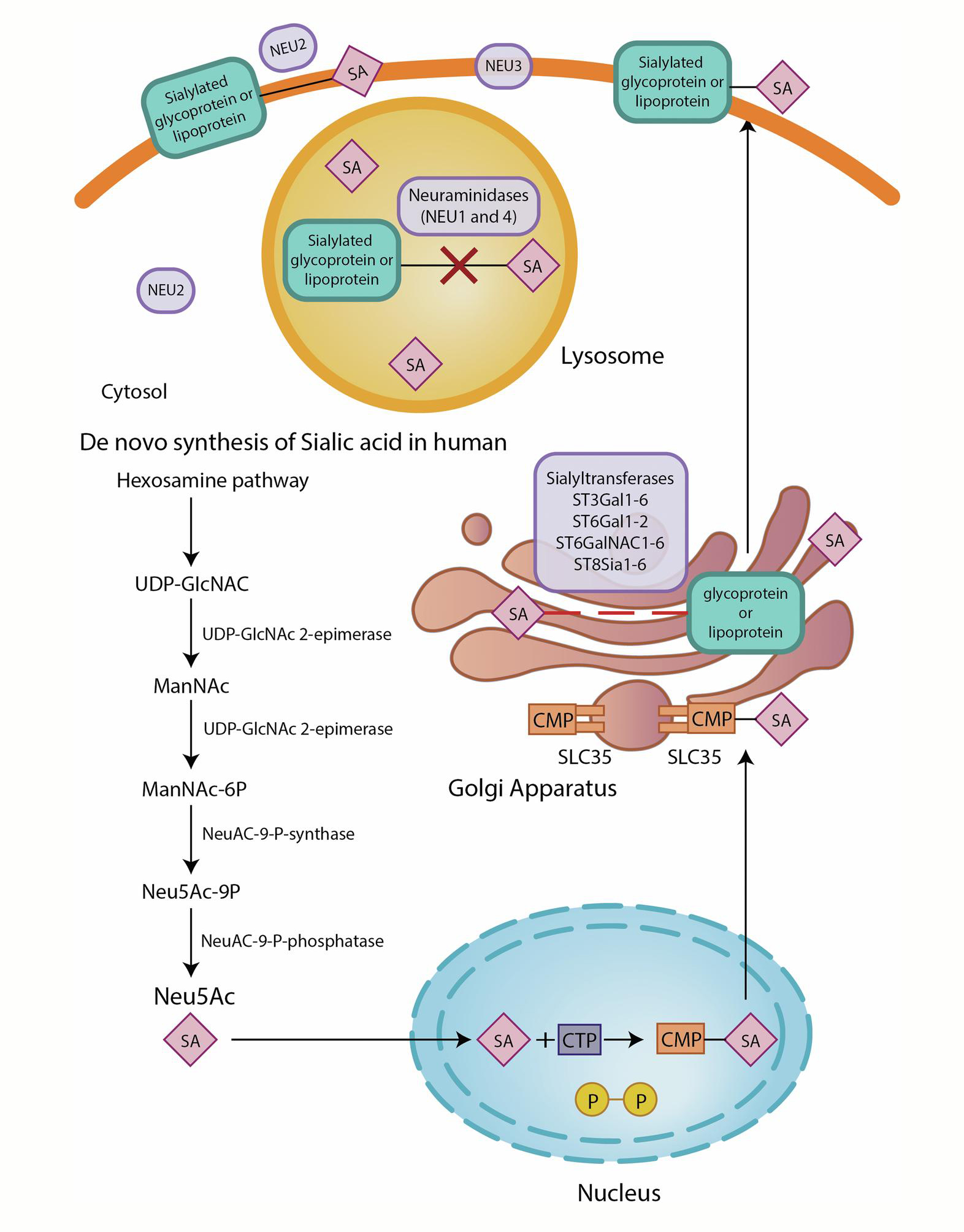
- Glycoprotein metabolism: Sialic acid is incorporated into glycoproteins and glycolipids through cellular metabolic pathways.
3. Importance in the nervous system
One of the most interesting functions of Neu5Ac is its role in the brain.
Sialic acid is incorporated into gangliosides and other glycoconjugates that are abundant in neuronal membranes. These molecules contribute to:
- neuronal membrane structure;
- neurite growth;
- synaptic organization;
- cell–cell recognition;
- receptor activity;
- neural development and plasticity.
Because of this, sialic acid has attracted research interest in cognitive development and neurobiology, particularly in infancy.
4. Role in immune regulation
Sialic acid is an important component of the interaction between the immune system and cell surfaces.
Many immune receptors, including Siglecs (sialic-acid-binding immunoglobulin-like lectins), recognize sialylated glycans. These interactions can influence whether immune cells become activated, inhibited, or tolerized.
Thus, sialic acid can have both regulatory and protective effects, rather than simply stimulating immunity.
5. Antioxidant activity: an important distinction
Sialic acid is sometimes marketed as an antioxidant, but this claim needs qualification.
Neu5Ac has chemical properties that allow it to participate in certain reactions involving reactive species, and experimental studies have investigated antioxidant-related effects. However, sialic acid should not be regarded as a clinically established antioxidant comparable to vitamin C or glutathione.
Its best-established biological functions are related to glycobiology, cell recognition, signaling, and membrane biology.
6. Cosmetic and skin-related relevance
Sialic acid and sialylated compounds have also attracted interest in cosmetics and skin biology.
Potential functions include:
- skin conditioning and moisturization, depending on the formulation;
- supporting the biological functions of cell-surface glycans;
- contributing to skin-barrier and cellular communication processes;
- potential interest in anti-aging formulations because glycosylation and cell-surface glycans change during aging.
However, evidence for topically applied free Neu5Ac producing major anti-aging, whitening, or wrinkle-reducing effects in humans is considerably less established than its fundamental biological role.
7. Sialic acid and pathogens
Sialic acid has a particularly important role in host–pathogen biology.
For example, some pathogens exploit sialylated glycans on host cells as attachment or recognition sites. Influenza viruses, for instance, use hemagglutinin to recognize specific sialic-acid-containing receptors.
This illustrates an important point: sialic acid is not inherently “anti-infective.” Its biological effects depend strongly on which glycan structure it is part of and where that structure occurs.
8. Overall efficacy assessment
Strongly established functions
- Cell-surface recognition
- Glycoprotein/glycolipid structure
- Glycocalyx formation
- Immune-cell signaling
- Neural and membrane biology
- Cell adhesion and receptor interactions
Promising but still being researched
- Cognitive and memory-related benefits from supplementation
- Neurodevelopmental benefits beyond normal dietary availability
- Skin-aging and cosmetic effects
- Antioxidant-related effects
Claims that should be treated cautiously
- Significant weight loss
- Strong anti-aging effects from oral supplementation
- Disease treatment
- Broad “immune boosting”
- Powerful antioxidant activity comparable to established antioxidant nutrients
Bottom line
N-Acetylneuraminic acid is biologically important primarily because it is a key terminal sugar in human glycoconjugates. Its most important functions involve cell recognition, immune regulation, nervous-system biology, membrane structure, receptor signaling, and glycoprotein metabolism. Nutritional supplementation is scientifically interesting—especially for early-life brain development—but many marketed health benefits currently have less clinical evidence than its fundamental biochemical functions.