
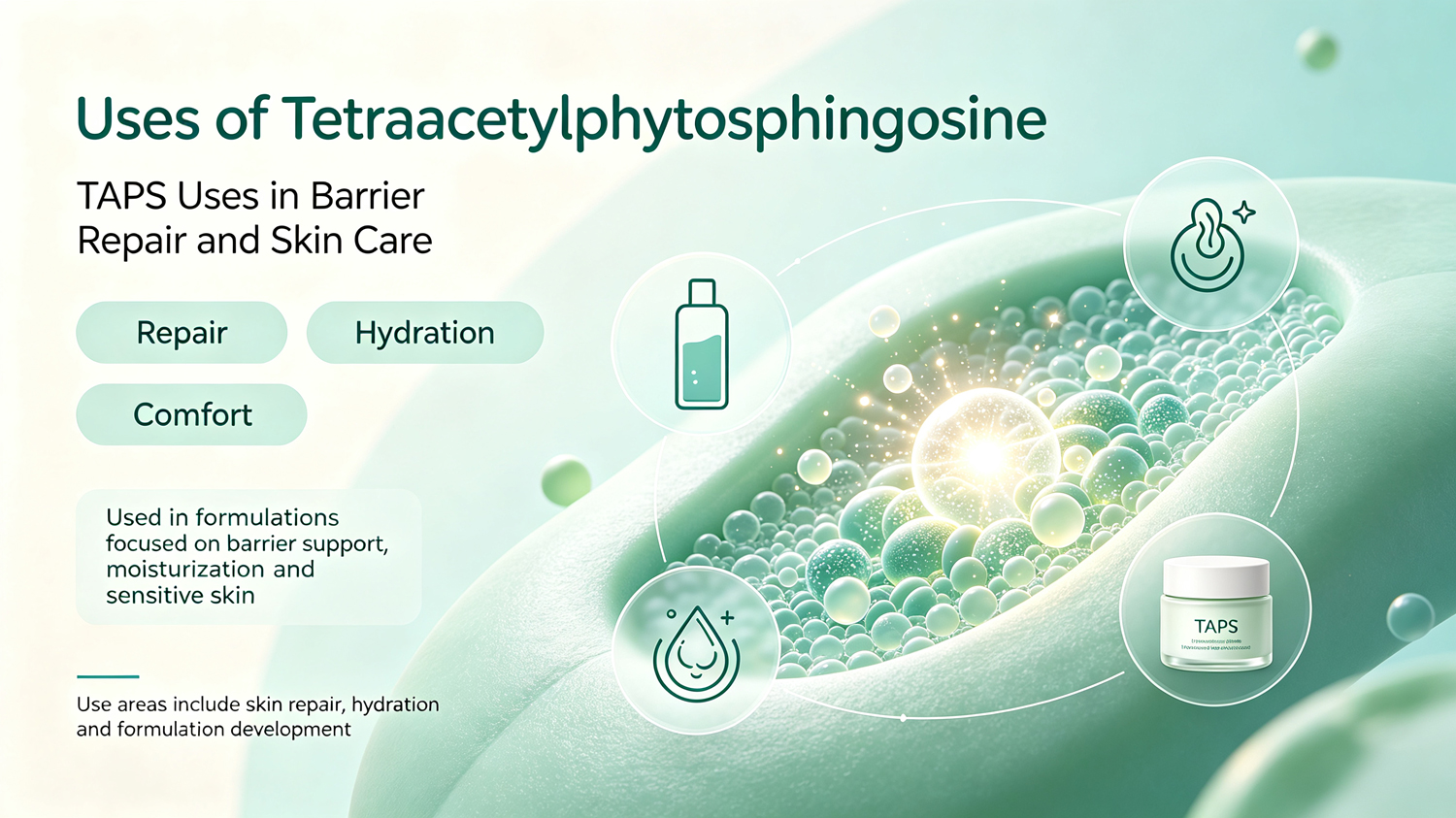
Tetraacetylphytosphingosine (TAPS) is an acetylated derivative of phytosphingosine, a sphingoid base structurally related to naturally occurring skin ceramides. It is primarily investigated and used as a cosmetic skin-conditioning and barrier-support ingredient, particularly in formulations targeting dry, sensitive, or aging skin.
1. Skin-barrier support
Tetraacetylphytosphingosine can be used in skincare formulations designed to support the stratum corneum lipid barrier. Phytosphingosine-related compounds are associated with ceramide metabolism and epidermal lipid organization, making TAPS of interest for barrier-care products.
Typical applications:
- Barrier-repair creams
- Moisturizers
- Dry-skin products
- Sensitive-skin formulations
- Post-environmental-stress skincare
2. Moisturizing and reduction of water loss
Tetraacetylphytosphingosine is used as a functional ingredient in formulations intended to improve skin hydration and help maintain the skin’s ability to retain water.
It may be incorporated into:
- Facial creams and lotions
- Body moisturizers
- Hand creams
- Intensive dry-skin treatments
3. Anti-aging skincare
Because healthy barrier function is important for maintaining skin smoothness and resilience, Tetraacetylphytosphingosine can be incorporated into anti-aging formulations alongside ingredients such as ceramides, cholesterol, fatty acids, peptides, and hyaluronic acid.
Potential formulation objectives include:
- Improving skin smoothness
- Supporting barrier integrity
- Reducing the appearance of dryness-related fine lines
- Improving overall skin condition
4. Sensitive and compromised skin formulations
Tetraacetylphytosphingosine may be useful in products formulated for skin that is prone to dryness, roughness, or barrier disruption. Its relationship to phytosphingosine and sphingolipid biology makes it particularly relevant to barrier-focused formulations.
5. Ceramide-oriented formulations
One of the more interesting uses of Tetraacetylphytosphingosine is in formulations built around ceramide biology. Phytosphingosine is a component or precursor associated with epidermal sphingolipids, so TAPS can be considered when developing products intended to mimic or support the skin’s natural lipid environment.
It can be combined with:
- Ceramides
- Phytosphingosine
- Cholesterol
- Free fatty acids
- Fatty alcohols
- Other skin-conditioning lipids
6. Anti-dryness and rough-skin products
Tetraacetylphytosphingosine can be used in products targeting:
- Rough skin
- Flaking
- Tight-feeling skin
- Low-hydration skin
- Dry hands and body
- Seasonal dryness
7. Functional cosmetic formulations
Beyond its biological rationale, Tetraacetylphytosphingosine can serve as a specialized lipidic cosmetic active in formulations where the manufacturer wants a sphingoid-base-related ingredient rather than simply a conventional emollient.
Potential product formats include:
| Product | Potential use of Tetraacetylphytosphingosine |
| Facial moisturizer | Barrier and conditioning support |
| Barrier cream | Support for compromised barrier |
| Anti-aging cream | Hydration/barrier-oriented anti-aging |
| Serum | Specialized skin-conditioning active |
| Body lotion | Dryness and roughness care |
| Hand cream | Barrier and moisture retention |
| Sensitive-skin cream | Barrier-focused formulation |
| Lip-care products | Lip conditioning and dryness care |
8. Potential use in hair/scalp products
Because sphingolipids are also relevant to the biology of the skin and scalp, Tetraacetylphytosphingosine may have potential in scalp and hair-care formulations. However, compared with its cosmetic skin-barrier applications, evidence for specific hair-growth or follicle effects is considerably less established.
Possible formulation concepts include:
- Scalp-conditioning products
- Dry-scalp treatments
- Barrier-support scalp formulations
- Hair products designed to reduce dryness and improve conditioning
Important distinction
Tetraacetylphytosphingosine should not automatically be considered equivalent to ceramides. Although it is structurally related to phytosphingosine and the broader sphingolipid pathway, its acetylated structure can affect its physicochemical behavior, skin penetration, metabolism, and biological activity. Therefore, claims such as “replaces ceramides” or “repairs the skin barrier” should be supported by product-specific data.
In summary: the main use of Tetraacetylphytosphingosine is as a specialized sphingolipid-related cosmetic ingredient for barrier care, moisturization, dry/sensitive skin, and anti-aging formulations, with additional potential applications in scalp care. Its strongest practical relevance is in skin-barrier and lipid-homeostasis-oriented cosmetics.