
SLU-PP-332 is a synthetic pan-estrogen-related receptor (ERRα/ERRβ/ERRγ) agonist. ERRs cooperate with metabolic transcriptional programs involving PGC-1α and regulate mitochondrial oxidative metabolism.
1. Improves glucose tolerance in obese mice
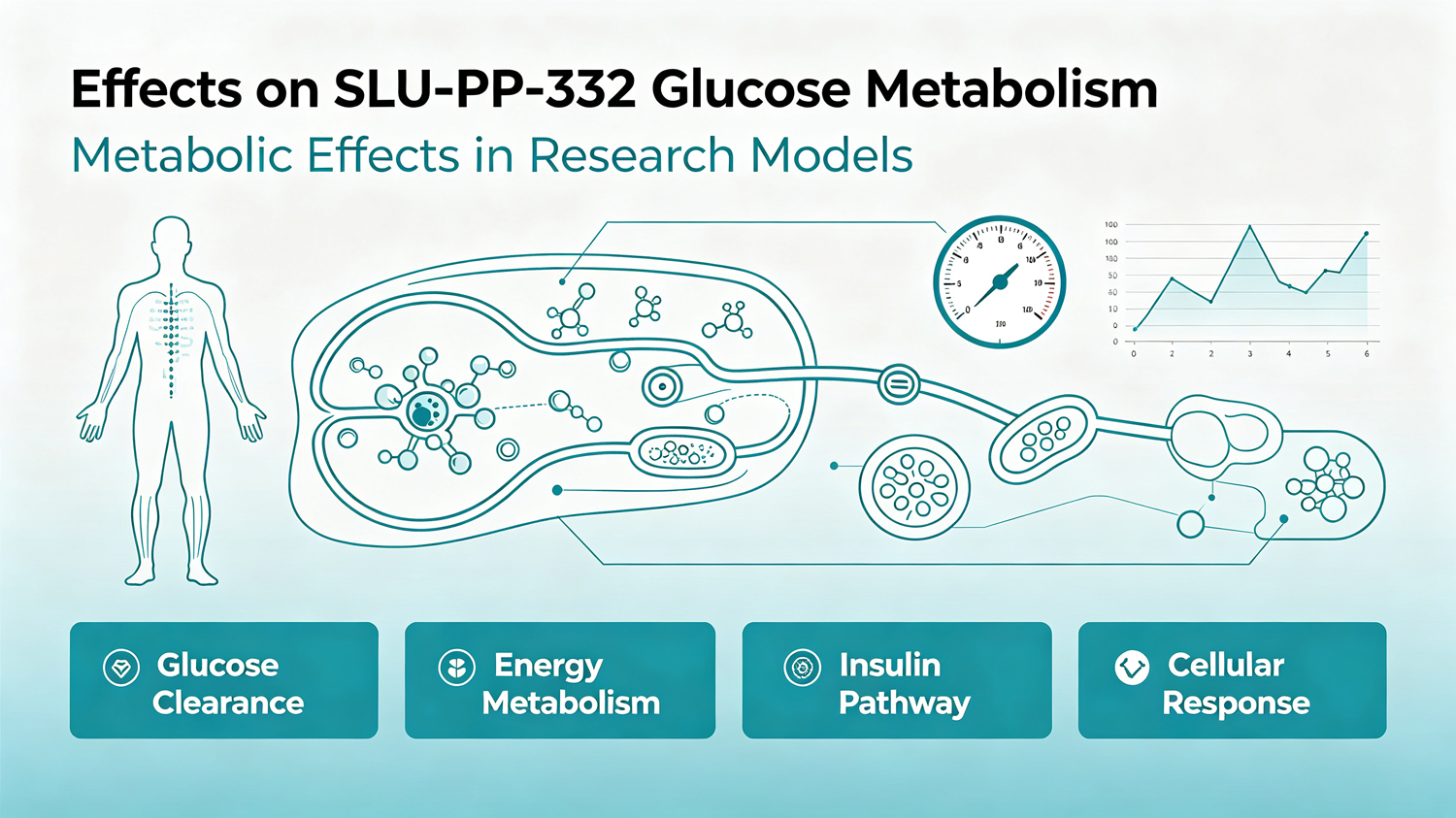
In diet-induced-obesity mouse models, SLU-PP-332 treatment was associated with improved glucose metabolism, including better glucose handling during glucose-tolerance testing. The effects were accompanied by reduced adiposity and increased fatty-acid oxidation.
This is important because improved glucose tolerance suggests that tissues are able to dispose of an incoming glucose load more effectively, although it does not by itself prove that the compound would treat diabetes in humans.
2. May improve insulin sensitivity
The metabolic-syndrome study reported improvements in glucose/insulin metabolism in obese mice. The proposed explanation is that increased oxidative metabolism and reduced ectopic lipid accumulation decrease metabolic stress and improve insulin responsiveness.
A useful conceptual pathway is:
SLU-PP-332 → ERR activation → PGC-1α/oxidative metabolic program → mitochondrial capacity ↑ → fatty-acid oxidation ↑ → lipid burden ↓ → insulin sensitivity ↑ → glucose handling ↑
However, this pathway should be regarded as a mechanistic interpretation of preclinical findings, rather than a demonstrated human mechanism.
3. Shifts muscle toward oxidative fuel utilization
One of SLU-PP-332’s strongest metabolic effects is remodeling skeletal muscle toward a more oxidative phenotype. It increases mitochondrial function and activates genes associated with oxidative metabolism.
This can change the balance between glucose and fatty-acid utilization:
| Metabolic process | Reported/preclinical effect |
| Mitochondrial oxidative capacity | ↑ |
| Fatty-acid oxidation | ↑ |
| Energy expenditure | ↑ |
| Glucose tolerance | ↑ in obese mouse models |
| Insulin sensitivity | ↑ in obese mouse models |
| Fat mass | ↓ |
| Fasting glucose/insulin | Reported to improve in obese models |
| Human glucose control | Unknown |
4. PDK4 may contribute to glucose “sparing”
SLU-PP-332 increases expression of pyruvate dehydrogenase kinase 4 (PDK4) in muscle cells.
PDK4 inhibits pyruvate dehydrogenase, reducing conversion of pyruvate into acetyl-CoA. Functionally, this can decrease carbohydrate oxidation and encourage greater reliance on fatty acids.
So SLU-PP-332 appears capable of producing a metabolic state resembling endurance exercise:
fat oxidation ↑ → carbohydrate oxidation relatively ↓ → glucose conserved/sparing → oxidative capacity ↑
Importantly, glucose sparing is not equivalent to lowering blood glucose. The whole-body glucose effect depends on interactions among muscle, liver, adipose tissue, pancreatic insulin secretion and energy expenditure.
5. Effects are more apparent in metabolically unhealthy mice
An important nuance is that the glucose effect isn’t simply “SLU-PP-332 lowers glucose in every animal.”
The published work found metabolic benefits particularly in diet-induced-obesity and ob/ob mouse models, whereas normal mice did not show the same improvement in glucose metabolism.
That suggests the compound may be acting partly by correcting metabolic dysfunction associated with obesity, rather than functioning simply as a conventional glucose-lowering drug.
Why could glucose metabolism improve?
The proposed integrated mechanism is:
↓
ERRα/β/γ activation
↓
PGC-1α-associated oxidative transcriptional program
↓
Mitochondrial biogenesis + oxidative capacity ↑
↓
Fatty-acid oxidation ↑
↓
Intracellular lipid burden ↓
↓
Insulin signaling potentially improves
↓
Glucose uptake/utilization and glucose tolerance improve
At the same time:
ERR activation → PDK4 ↑ → pyruvate oxidation ↓ → greater reliance on fatty acids
This creates an exercise-like metabolic phenotype, rather than directly acting as an insulin or glucose-lowering drug.
An important limitation
The evidence should not be interpreted as showing that SLU-PP-332 is an established treatment for insulin resistance, prediabetes, or type 2 diabetes.
As of 2026, the evidence remains preclinical, with no published human clinical trials establishing efficacy or safety.
Also, some commercial descriptions make much stronger claims about glucose control than the primary research justifies. The original metabolic-syndrome work is the more appropriate source for interpreting the glucose findings.
Bottom line
SLU-PP-332 appears to improve glucose metabolism mainly indirectly, by reprogramming energy metabolism toward an endurance-like, mitochondria-rich, fat-oxidizing state. In obese mice this was associated with better glucose tolerance and insulin-related metabolic parameters, while PDK4 induction may promote glucose sparing. But whether these effects translate to humans is unknown.