
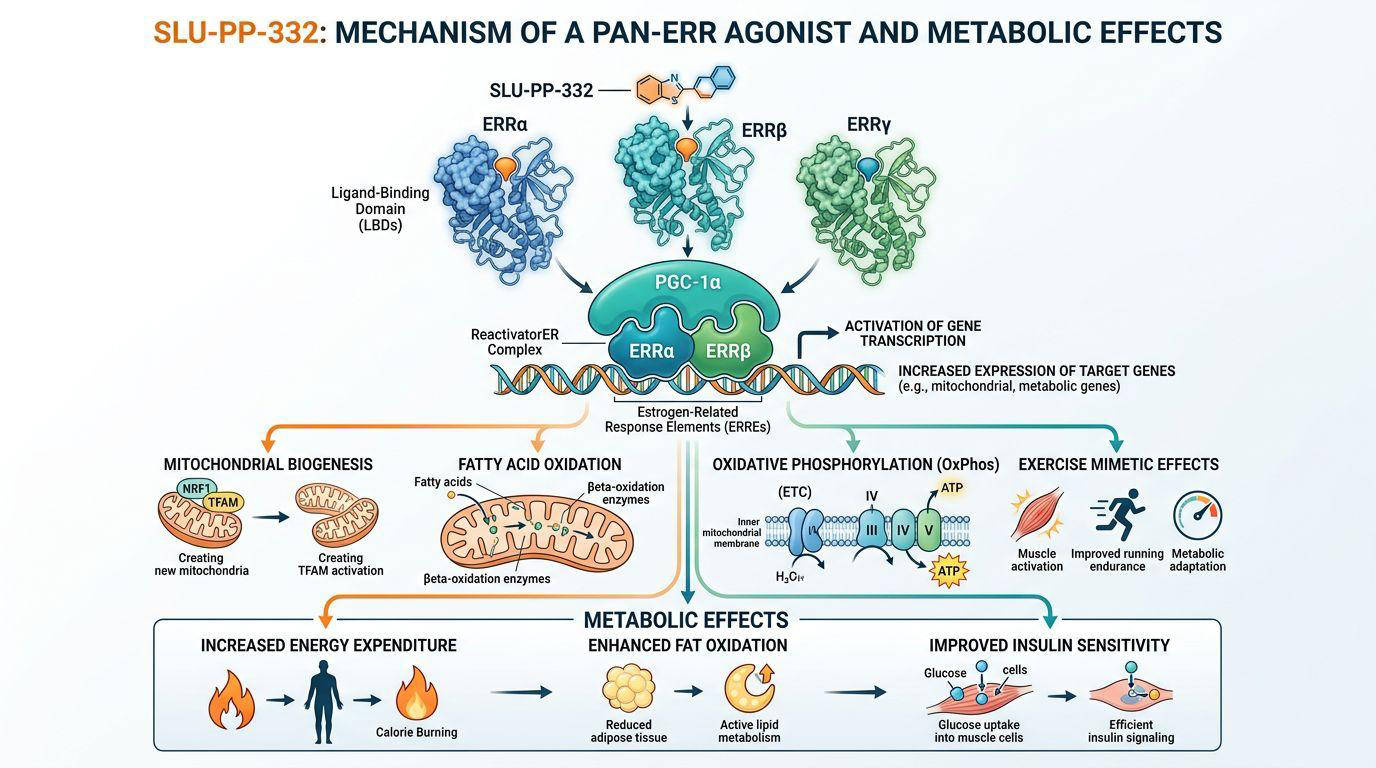
SLU-PP-332 is a synthetic small-molecule pan-estrogen-related receptor (ERRα/ERRβ/ERRγ) agonist developed as an experimental “exercise mimetic.” It is a research compound, not an approved medicine or dietary supplement. Recent analytical work has established LC-HRMS/MS methods for identifying the parent compound and its metabolites.
1. What determines SLU-PP-332 quality?
For a research-grade batch, I would evaluate quality in roughly this order:
| Quality parameter | Preferred evidence | Why it matters |
| Identity | LC-MS/HRMS + ideally NMR | Confirms that the material is actually SLU-PP-332 |
| Chemical purity | HPLC/UPLC chromatogram | Measures chromatographic impurities |
| Assay/content | Quantitative analytical method | Distinguishes purity from actual amount of compound |
| Residual solvents | GC | Important because synthesis/purification uses organic solvents |
| Water | Karl Fischer | Excess moisture can affect stability and weighing |
| Related substances | HPLC/LC-MS | Detects degradation and synthetic by-products |
| Elemental/heavy metals | ICP-MS | Detects inorganic contamination |
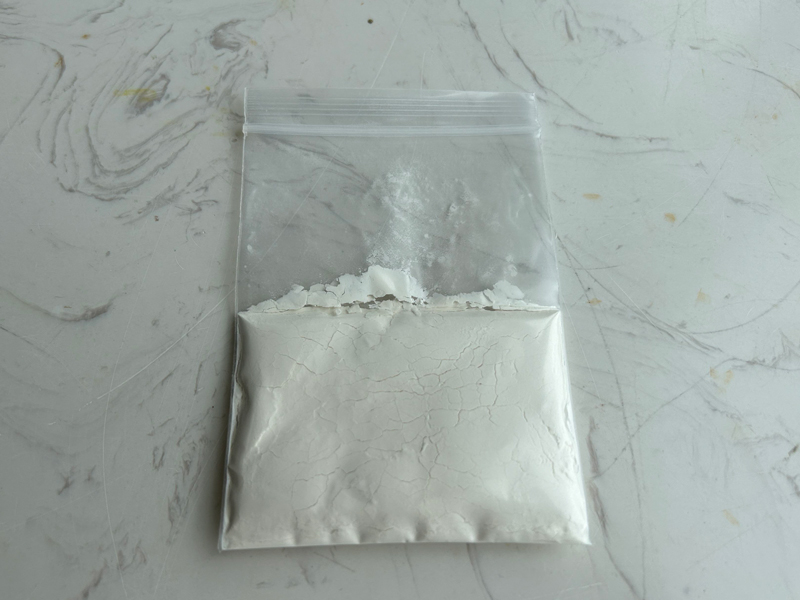
| Physical appearance | Visual inspection | Useful but not sufficient for identity |
| Batch traceability | Batch-specific COA | Allows the actual material to be traced to testing |
A good example of the level of documentation available commercially is a 2026 batch report showing 99.18% RP-HPLC purity, MS identity at m/z 291.18 for [M+H]⁺, 0.77% water, residual-solvent testing, ICP-MS testing and related-substance testing.
However, a claimed “99%+ purity” should not automatically be interpreted as pharmaceutical-grade material. HPLC area percentage primarily indicates chromatographic homogeneity; it does not by itself establish sterility, potency, residual solvent compliance, structural confirmation or suitability for human administration.
2. How is SLU-PP-332 produced?
At a high level, SLU-PP-332 is produced by multi-step organic synthesis, followed by purification and analytical QC.
The overall research-manufacturing workflow is:
Starting materials → organic synthesis → reaction work-up → purification → drying → identity confirmation → HPLC purity testing → batch release
The academic literature confirms that SLU-PP-332 and related ERR agonists are synthetic small molecules and that analytical reference material has been prepared for LC-HRMS/MS characterization.
I would distinguish this from commercial production: the exact industrial synthesis, reaction conditions, yields, purification system and scale-up parameters are not consistently disclosed by commercial suppliers.
3. Purification
After synthesis, purification is critical because structurally similar impurities can potentially retain biological activity.
Typical research-chemical purification may involve:
- chromatographic purification
- solvent exchange
- Concentration
- drying under controlled conditions
- final HPLC/LC-MS confirmation
The goal is not simply to obtain a visually clean powder, but to remove:
- unreacted starting materials
- Intermediates
- regioisomeric/structural impurities
- degradation products
- residual catalysts/reagents
- residual organic solvents
4. Analytical identity is especially important
Recent research provides a useful analytical fingerprint for SLU-PP-332. In positive-ion MS, it was detected as [M+H]⁺ at m/z 291.1142, with characteristic fragment ions including m/z 121.0288.
This makes LC-MS/HRMS + HPLC considerably more convincing than an HPLC purity number alone.
The 2026 metabolism study also demonstrated that SLU-PP-332 can generate multiple metabolites: six Phase-I metabolites and three Phase-II conjugates were identified in the experimental systems used.
5. What does “99% SLU-PP-332” actually mean?
This distinction is important:
99% HPLC purity ≠ 99% verified pharmaceutical-quality SLU-PP-332.
For example, a supplier may report:
HPLC purity = 99.2%
That tells you that approximately 99.2% of the chromatographic peak area is attributed to the principal component under that particular method.
It does not necessarily establish:
- absolute mass fraction
- absence of unidentified impurities
- absence of trace metals
- absence of residual solvents
- biological potency
- Sterility
- Stability
- GMP manufacturing
Therefore, for serious laboratory work, I would look for batch-specific HPLC + LC-MS, rather than relying on a product-page claim.
6. Current commercial quality examples
Publicly available 2026 documentation illustrates the variability between suppliers. One supplier reports a batch at 99.73%, independently tested by an external laboratory, while another publicly reports 99.18% for its August 2026 batch.
Another supplier reports batches around 99.34–99.9%, again based on HPLC testing.
These figures should be treated as supplier-specific batch claims, not as a standardized industry specification.
7. Recommended QC specification for research-grade material
If establishing an internal specification, a robust research-grade release panel would look like:
Identity
- LC-MS/HRMS: PASS
- Ideally NMR confirmation for a new synthesis lot
Purity
- RP-HPLC/UPLC: preferably ≥98–99%
- Full chromatogram retained
Impurities
- Individual unknown impurity limit established
- Total related substances controlled
Residual solvents
- GC-FID or GC-MS
Water
- Karl Fischer titration
Inorganic impurities
- ICP-MS when appropriate
Physical properties
- Appearance
- Melting/decomposition behavior where useful
Stability
- Periodic HPLC/LC-MS testing under defined storage conditions
Bottom line
The biggest quality issue with SLU-PP-332 is not whether a supplier can claim “99% purity,” but whether the identity, purity, impurities and batch traceability are independently demonstrated. Current research supports LC-HRMS/MS as a strong identity/analytical tool, while commercial COAs show that high-purity research material is available but that specifications and testing depth vary substantially between suppliers.
Because SLU-PP-332 remains an experimental research compound, I would not extrapolate research-grade chemical specifications into standards for human pharmaceutical use.