
Sepiwhite MSH is the trade name for Undecylenoyl Phenylalanine, a lipoamino-acid cosmetic active developed to reduce hyperpigmentation. Its main mechanism is upstream inhibition of the α-MSH–melanogenesis signaling pathway, rather than simply blocking tyrosinase directly.
1. Blocks α-MSH signaling at the melanocyte
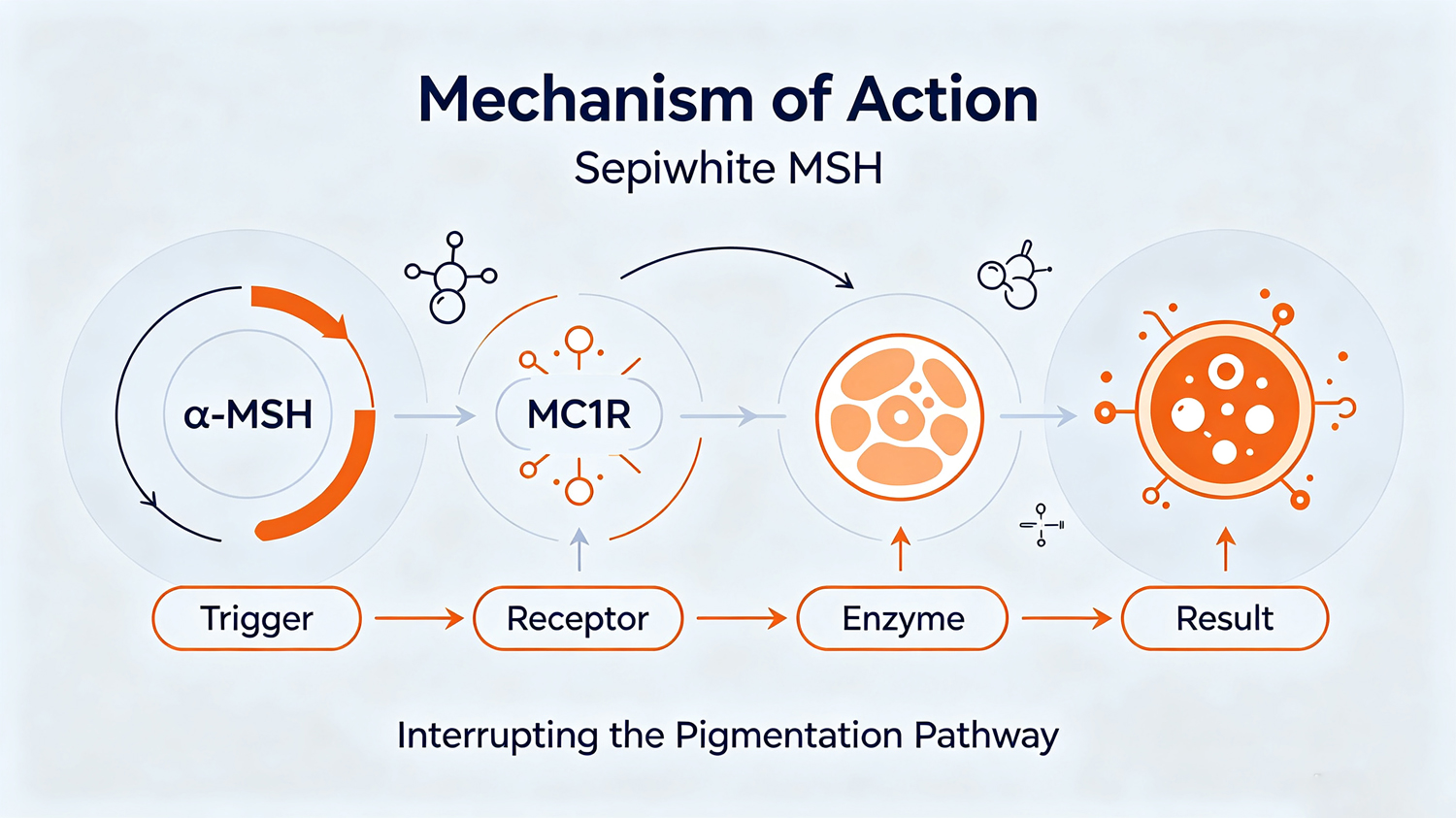
Normally, α-melanocyte-stimulating hormone (α-MSH) binds to the MC1R (melanocortin-1 receptor) on melanocytes.
This activates a signaling cascade:
α-MSH → MC1R → Gs protein → adenylate cyclase → ↑ cAMP → PKA → tyrosinase activation → melanin synthesis
Sepiwhite MSH acts as an α-MSH antagonist, interfering with this signaling pathway. Experimental data describe competition with melanotropin for the MC1R receptor.
2. Reduces intracellular cAMP
When α-MSH signaling is suppressed, activation of adenylate cyclase is reduced, resulting in lower intracellular cAMP.
Lower cAMP means less activation of protein kinase A (PKA), an important signaling step in melanogenesis.
3. Reduces tyrosinase activation
The decrease in PKA signaling reduces downstream activation of tyrosinase, one of the key enzymes controlling melanin production.
Seppic describes the principal action of Sepiwhite as modulation of the α-MSH pathway to inhibit the metabolic activation of tyrosinase.
4. Decreases melanogenesis
With less active tyrosinase and weaker melanogenic signaling, melanocytes produce less melanin.
This can gradually reduce the appearance of:
- Dark spots
- Post-inflammatory hyperpigmentation
- Uneven skin tone
- Sun-related pigmentation
- Other forms of facial hyperpigmentation
Laboratory and clinical research has reported reduced melanin production and reduced appearance of hyperpigmented facial spots with topical undecylenoyl phenylalanine.
Simplified pathway
Without Sepiwhite:
α-MSH
↓
MC1R
↓
Gs protein
↓
Adenylate cyclase
↓
↑ cAMP
↓
PKA
↓
Tyrosinase activation
↓
Melanin ↑
With Sepiwhite MSH:
Sepiwhite
↓
α-MSH/MC1R signaling inhibited
↓
Adenylate cyclase ↓
↓
cAMP ↓
↓
PKA signaling ↓
↓
Tyrosinase activation ↓
↓
Melanin synthesis ↓
↓
Less visible pigmentation
Why this mechanism is interesting
The important distinction is that Sepiwhite MSH works upstream in the melanogenic signaling cascade. It is therefore mechanistically different from ingredients such as direct tyrosinase inhibitors. This also explains why it can be combined with other brightening agents that act at different stages of pigmentation. For example, clinical research found that combining 1% undecylenoyl phenylalanine with 5% niacinamide reduced facial hyperpigmentation more effectively than niacinamide alone in the study population.
In one sentence: Sepiwhite MSH essentially interrupts the α-MSH → MC1R → cAMP/PKA → tyrosinase signaling pathway, thereby reducing melanogenesis and the formation of excess melanin.