
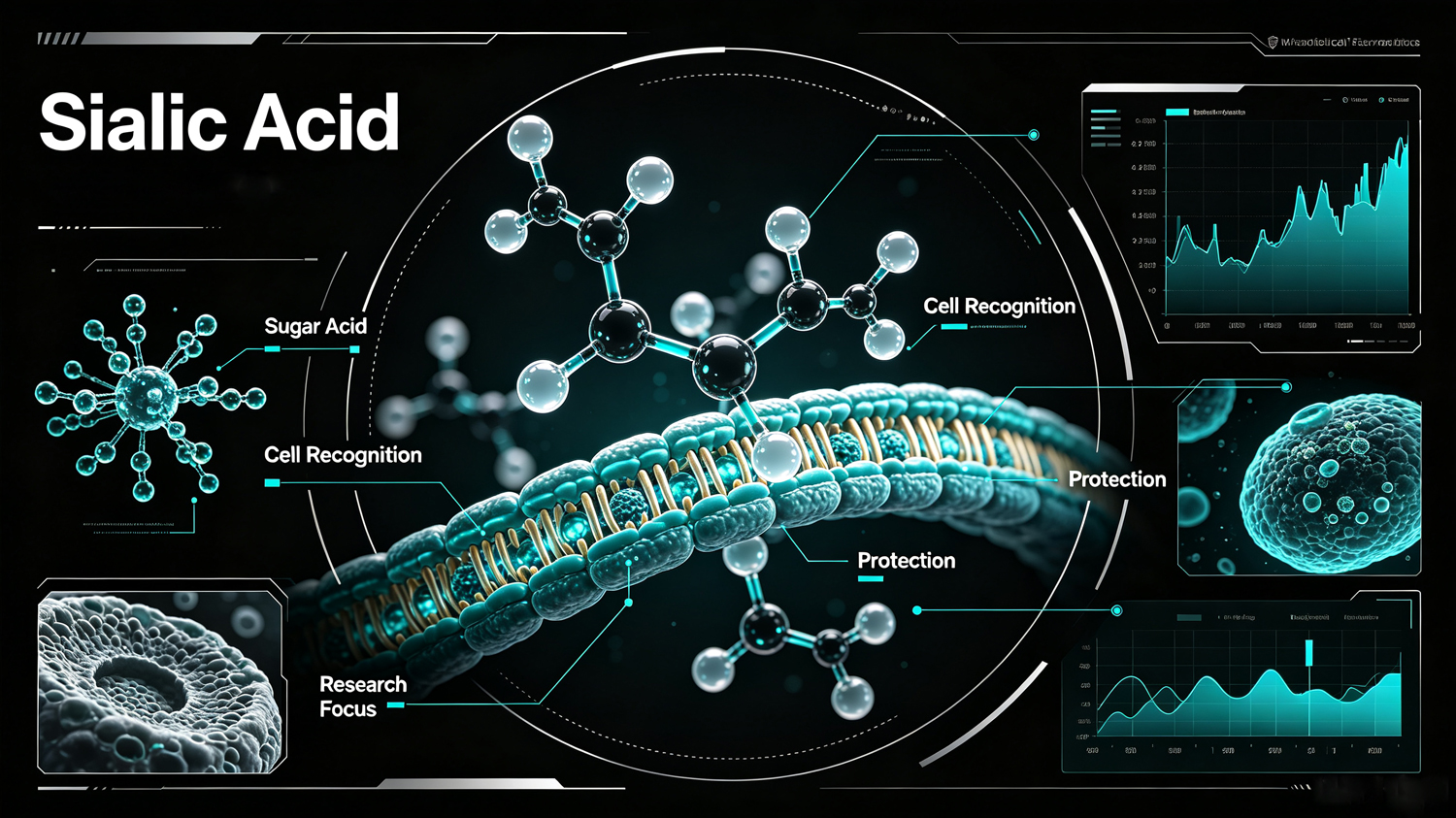
Sialic acid, most commonly referring to N-acetylneuraminic acid (Neu5Ac), is a nine-carbon acidic monosaccharide found at the terminal positions of many glycoproteins and glycolipids. It can be produced by chemical synthesis, enzymatic synthesis, or microbial/biotechnological fermentation. Industrial production generally favors enzymatic or fermentation-based routes because they provide high stereochemical specificity and fewer purification problems.
1. Biosynthesis in living cells
In mammals, Neu5Ac is synthesized through the following pathway:
UDP-N-acetylglucosamine (UDP-GlcNAc)
↓
N-acetylmannosamine-6-phosphate (ManNAc-6-P)
↓
N-acetylneuraminic acid-9-phosphate (Neu5Ac-9-P)
↓
N-acetylneuraminic acid (Neu5Ac)
Key enzymes include:
- UDP-GlcNAc 2-epimerase/ManNAc kinase (GNE) – generates ManNAc-6-P.
- Neu5Ac-9-P synthase (NANS) – combines ManNAc-6-P with phosphoenolpyruvate (PEP) to form Neu5Ac-9-P.
- Neu5Ac-9-P phosphatase (NANP) – removes phosphate to produce free Neu5Ac.
The overall carbon skeleton is formed by condensation of a 6-carbon ManNAc derivative with 3-carbon PEP, giving the characteristic nine-carbon structure of sialic acid.
2. Enzymatic synthesis
A widely used laboratory and industrial strategy is enzymatic conversion of N-acetylmannosamine (ManNAc).
A simplified reaction is:
N-Acetylmannosamine + pyruvate → N-Acetylneuraminic acid
The enzyme N-acetylneuraminate lyase (NAL) can catalyze this reaction in the reverse direction. Because the reaction is reversible, appropriate substrate concentrations and reaction conditions can be used to favor Neu5Ac formation.
An alternative two-enzyme system uses:
ManNAc + PEP → Neu5Ac-9-P → Neu5Ac
This approach is attractive because enzymes provide excellent regioselectivity and stereoselectivity.
3. Microbial/fermentation production
For commercial production, microorganisms can be engineered to produce Sialic acid from inexpensive carbon sources.
A typical strategy is:
Carbon source → central metabolism → GlcNAc/ManNAc pathway → Neu5Ac → recovery and purification
Microbial strains can be genetically modified to:
- increase precursor availability,
- enhance expression of GNE/NANS-related pathway enzymes,
- reduce competing metabolic pathways,
- improve Neu5Ac secretion,
- increase product tolerance.
After fermentation, the product is recovered from the culture broth and purified using processes such as:
- Cell removal by filtration or centrifugation
- Removal of proteins and other macromolecules
- Decolorization and clarification
- Ion-exchange or adsorption purification
- Concentration
- Crystallization or drying
- Quality-control testing
4. Chemical synthesis
Chemical synthesis of Sialic acid is possible but considerably more complicated than enzymatic production. It generally requires construction of the nine-carbon backbone, introduction and protection/deprotection of functional groups, and control of stereochemistry.
A generalized chemical approach is:
Protected carbohydrate precursor → C–C bond formation → nine-carbon sialic-acid framework → stereochemical adjustment → deprotection → Neu5Ac
Chemical routes are mainly important for research, structural studies, and preparation of specialized derivatives, rather than bulk production of ordinary Neu5Ac.
5. Why enzymatic synthesis is preferred
| Feature | Chemical synthesis | Enzymatic/fermentation synthesis |
| Stereochemical control | More difficult | Excellent |
| Number of synthetic steps | Often relatively high | Relatively low |
| Reaction specificity | Moderate–high depending on route | Very high |
| By-products | Can be significant | Generally fewer |
| Scale-up | More complex | Well suited |
| Industrial suitability | Limited for bulk Neu5Ac | High |
6. Important production considerations
The quality of synthesized Neu5Ac is normally evaluated by:
- HPLC for purity and related carbohydrates
- NMR spectroscopy for structural confirmation
- Mass spectrometry for molecular identity
- Optical rotation/stereochemical analysis
- Water content
- Residual proteins and inorganic salts
- Microbial and endotoxin testing where applicable
The molecular formula of Sialic acid is C₁₁H₁₉NO₉, with a molecular mass of approximately 309.27 g/mol.
Summary
The most biologically relevant synthesis of N-acetylneuraminic acid proceeds through ManNAc-6-phosphate and Neu5Ac-9-phosphate, while practical industrial manufacture increasingly relies on enzymatic or engineered microbial processes. Chemical synthesis is useful for research and for producing modified sialic-acid analogues, whereas fermentation/biocatalytic approaches offer better stereochemical control, scalability, and product specificity.