
1. Introduction of Sialic Acid
Sialic acid is a family of acidic nine-carbon monosaccharides that commonly occur as terminal sugars on glycoproteins, glycolipids, and oligosaccharides. The most abundant and biologically important member in humans is N-acetylneuraminic acid (Neu5Ac).
Neu5Ac is particularly important in cell-surface recognition, cell–cell communication, immune regulation, pathogen interactions, and the stability and half-life of circulating glycoproteins. It is also widely studied for applications in pharmaceuticals, biotechnology, nutrition, and cosmetics.
- Common name: Sialic acid
- Specific name: N-Acetylneuraminic acid
- Abbreviation: Neu5Ac or NANA
- Molecular formula: C₁₁H₁₉NO₉
- Molecular weight: approximately 309.27 g/mol
- Chemical class: acidic monosaccharide / nonulosonic acid
- Carbon number: 9-carbon backbone
- Occurrence: mainly as terminal residues of glycoconjugates
2. Origin of Sialic Acid
Sialic acids are naturally occurring carbohydrates found throughout the animal kingdom and in many microorganisms.
Natural biological origin
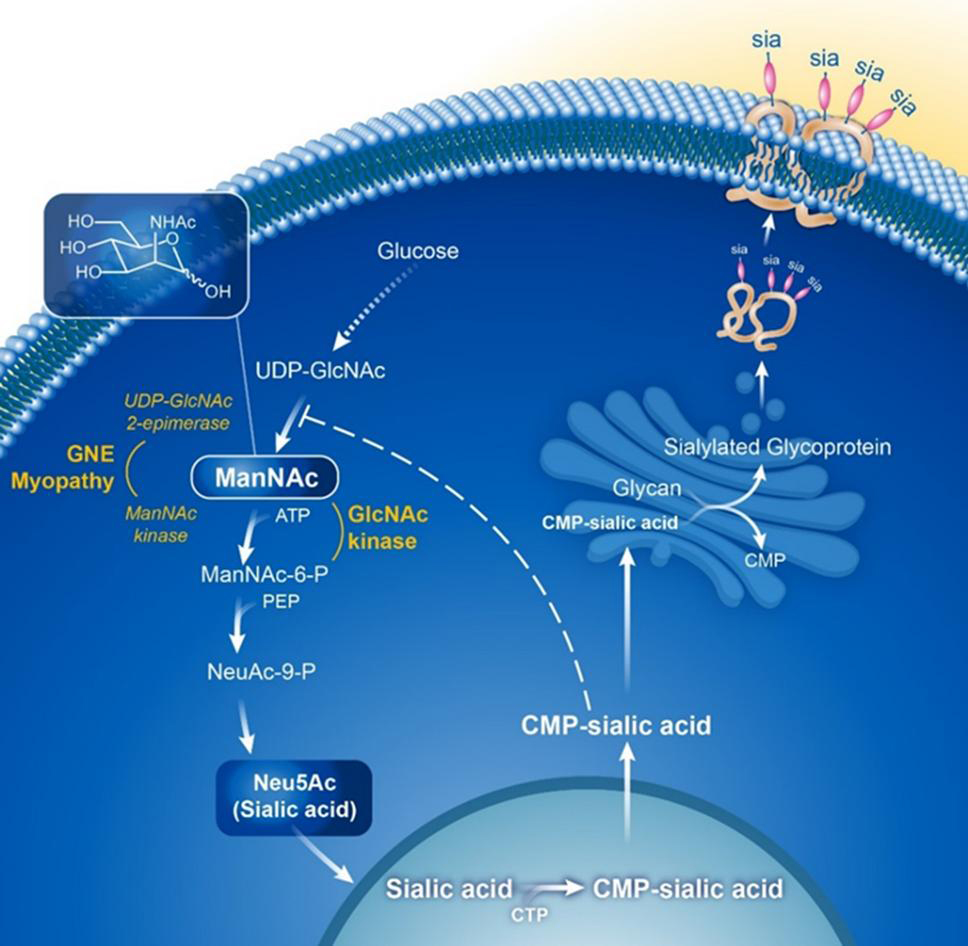
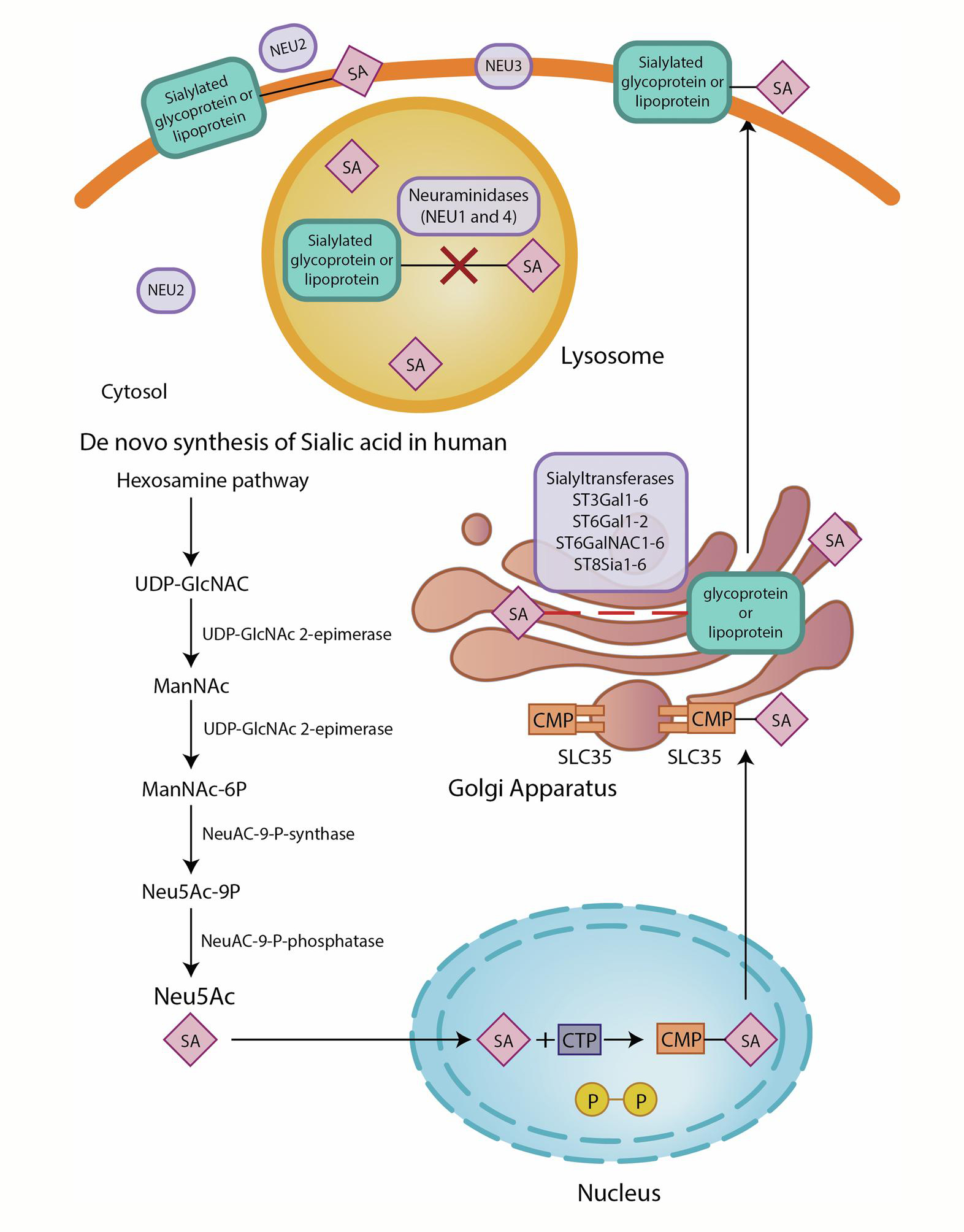
In humans and other mammals, Neu5Ac is produced through the biosynthesis of amino sugars. A key precursor is N-acetylmannosamine (ManNAc), which is metabolically converted through a series of reactions to Neu5Ac.
Neu5Ac is subsequently activated to CMP-Neu5Ac and transferred by sialyltransferase enzymes onto glycoproteins and glycolipids.
The resulting sialylated molecules are particularly abundant on:
- Cell membranes
- Blood-cell surfaces
- Glycoproteins
- Glycolipids
- Mucins
- Nervous-system tissues
- Saliva and other biological secretions
The term sialic acid originated from the Greek word sialon, meaning saliva, because related compounds were initially isolated from salivary glycoproteins.
3. Sources of Sialic Acid
Sialic acid can be obtained or produced through several routes.
| Source | Description |
| Animal tissues | Present naturally in mammalian glycoproteins and glycolipids |
| Milk and dairy products | Especially associated with milk oligosaccharides and glycoproteins |
| Egg-derived materials | Certain egg glycoproteins contain substantial sialylated structures |
| Mucins | Rich sources of sialylated glycoconjugates |
| Microorganisms | Some bacteria synthesize or utilize sialic acids |
| Enzymatic production | Neu5Ac can be manufactured through biocatalytic conversion of precursors |
| Chemical/biotechnological production | Used for production of high-purity material for research and industrial applications |
For commercial use, biotechnological and enzymatic production is increasingly important because it can provide relatively high-purity Neu5Ac without relying exclusively on extraction from animal tissues.
4. Chemical and Physical Properties
Neu5Ac has several characteristic properties:
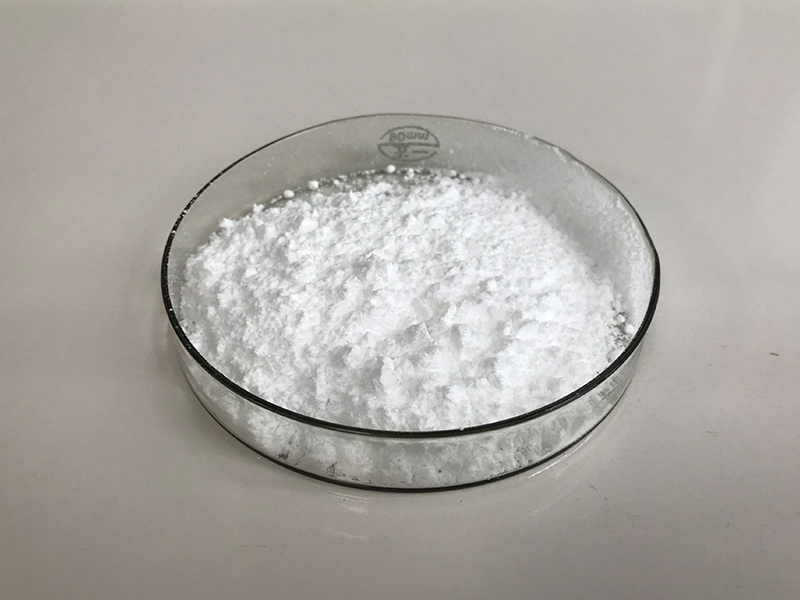
- Appearance: typically white to off-white crystalline or amorphous powder
- Molecular formula: C₁₁H₁₉NO₉
- Molecular weight: 309.27 g/mol
- Water solubility: soluble in water, although solubility depends on temperature and formulation conditions
- Charge: acidic molecule; its carboxyl group is predominantly negatively charged at physiological pH
- Functional groups: carboxylic acid, hydroxyl groups, ketone-related functionality, and an acetamido group
- Chemical nature: acidic, highly oxygenated carbohydrate
- pKa: the carboxyl group has a pKa in the acidic range, contributing to its negative charge under physiological conditions
Its nine-carbon structure distinguishes sialic acids from many common six-carbon monosaccharides such as glucose and galactose.
5. Structural Characteristics
Sialic acid contains a nine-carbon backbone derived biosynthetically from condensation of a six-carbon sugar precursor with a three-carbon unit.
Its structure contains:
- A carboxylic acid group
- Multiple hydroxyl groups
- An acetamido group
- A ketone-derived anomeric center
- A nine-carbon backbone
In biological systems, Neu5Ac is generally found at the outermost/terminal position of carbohydrate chains. It is frequently linked to galactose or other underlying sugars through α-2,3 or α-2,6 glycosidic linkages.
This terminal positioning is biologically significant because it allows sialic acid residues to influence how cells and proteins are recognized by other biological molecules.
6. Biological Origin and Role
One of the most important characteristics of sialic acid is its location at the surface of cells and glycoproteins.
Sialylation can affect:
- Cell recognition
- Cell adhesion
- Receptor activity
- Protein stability
- Immune-system interactions
- Cellular signaling
- Glycoprotein circulation time
- Interactions between host cells and microorganisms
For example, the presence of terminal sialic acid residues can protect certain circulating glycoproteins from rapid removal by the liver.
Sialic acids also participate in interactions with lectins and microbial adhesins, making them important in host–pathogen interactions.
7. Relationship Between “Sialic Acid” and “N-Acetylneuraminic Acid”
These terms are related but are not strictly identical.
Sialic acids = a broader family of nine-carbon acidic sugars.
N-Acetylneuraminic acid (Neu5Ac) = one specific and particularly important member of this family.
In human biology, Neu5Ac is the predominant sialic acid, so the terms are sometimes used interchangeably in general discussions.
Other members include compounds such as N-glycolylneuraminic acid (Neu5Gc), which is found in many mammals but is not normally synthesized by humans because humans lack functional CMAH activity.
8. Why Sialic Acid Is Biologically Important
The biological importance of Neu5Ac arises largely from its position at the end of carbohydrate chains.
It can function as a kind of molecular recognition signal. Changes in cellular sialylation can alter how cells interact with:
- Immune cells
- Other cells
- Hormones and receptors
- Circulating proteins
- Viruses
- Bacteria
- Lectins
Sialic acid is therefore relevant to glycobiology, immunology, neuroscience, microbiology, and pharmaceutical biotechnology.
9. Industrial and Commercial Importance
High-purity Sialic acid is increasingly relevant to several industries:
Pharmaceutical and biotechnology
- Glycoprotein engineering
- Biopharmaceutical development
- Glycan research
- Drug-development research
- Sialylation technologies
Nutrition
- Human-milk oligosaccharide research
- Infant-nutrition research
- Functional-food research
Cosmetics
- Skin-conditioning formulations
- Hydration-oriented products
- Anti-aging research
- Skin-barrier research
Research
- Glycobiology
- Cell-surface biology
- Host–pathogen interaction studies
- Enzyme and glycosylation research
10. Summary
N-Acetylneuraminic acid (Neu5Ac) is the principal human sialic acid and a naturally occurring nine-carbon acidic monosaccharide. It is produced biologically from amino-sugar precursors and is incorporated into glycoproteins and glycolipids, where it frequently occupies the terminal position of carbohydrate chains.
Its combination of acidic character, terminal positioning, structural diversity, and involvement in molecular recognition makes it an important biomolecule with applications extending from fundamental glycobiology to pharmaceuticals, biotechnology, nutrition, and cosmetic research.