
Tetraacetylphytosphingosine (TAPS) is a synthetic, acetylated derivative of phytosphingosine, a sphingoid base related to the ceramides naturally present in the skin barrier. It is mainly investigated and used as a skin-conditioning, barrier-supporting, and anti-aging cosmetic ingredient.
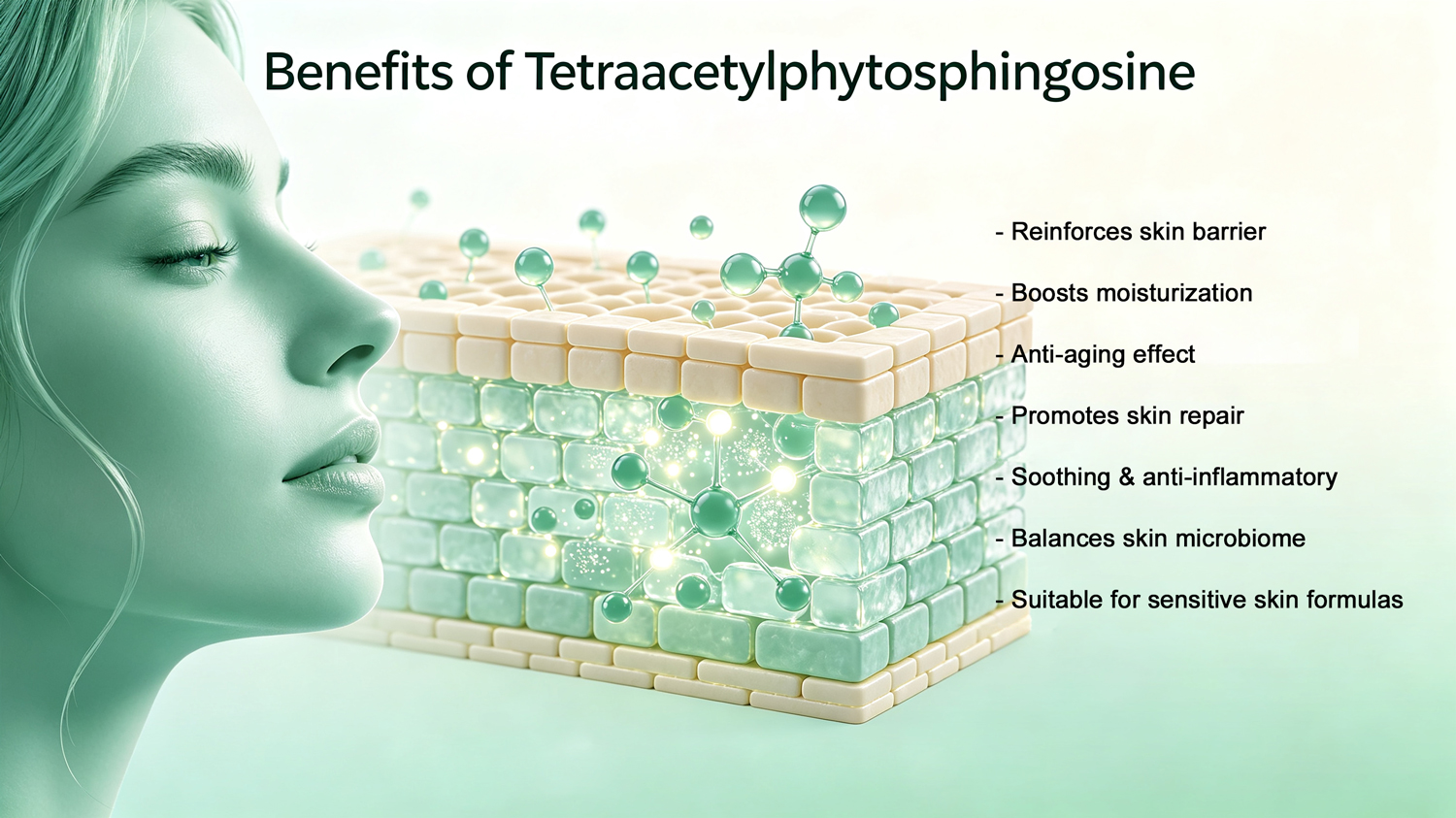
1. Supports the skin barrier
Tetraacetylphytosphingosine can contribute to the skin’s lipid-barrier system. Its sphingoid-base structure is relevant to ceramide and sphingolipid metabolism, potentially helping improve barrier organization and reduce excessive transepidermal water loss (TEWL).
Potential benefits:
- Better moisture retention
- Improved barrier resilience
- Reduced roughness and dryness
- Support for stressed or compromised skin
2. Improves skin moisturization
By supporting barrier lipids, Tetraacetylphytosphingosine may indirectly improve the ability of the stratum corneum to retain water. This can make skin feel softer, smoother, and less dry.
3. Anti-aging potential
Healthy barrier function is closely associated with skin appearance. Tetraacetylphytosphingosine is therefore of interest for formulations targeting:
- Fine lines
- Dryness-related wrinkles
- Loss of smoothness
- Dull or rough skin texture
Its anti-aging role is primarily barrier/skin-quality oriented, rather than being comparable to retinoids that directly influence epidermal differentiation and collagen-related pathways.
4. Supports skin repair and recovery
Phytosphingosine-related lipids participate in epidermal signaling and lipid metabolism. Tetraacetylphytosphingosine is consequently investigated as an ingredient that may help skin recover from environmental or formulation-related stress.
This makes it potentially useful in products designed for:
- Dry or rough skin
- Barrier-stressed skin
- Post-cleansing dryness
- Anti-aging formulations
5. Potential soothing/anti-inflammatory activity
Phytosphingosine itself has documented biological activity involving inflammatory and microbial processes. Tetraacetylphytosphingosine may serve as a pro-ingredient or reservoir for phytosphingosine-related activity, although the evidence for TAPS itself should not be equated with the better-established evidence for free phytosphingosine.
Therefore, claims such as “strong anti-inflammatory” should be treated cautiously unless supported by product-specific clinical data.
6. May help maintain a healthy skin microbiological environment
Sphingoid bases such as phytosphingosine have antimicrobial properties against some microorganisms. Because Tetraacetylphytosphingosine is acetylated, its biological behavior is different from free phytosphingosine, but its use is of interest in formulations intended to support skin microbiome balance and skin defense.
7. Useful for sensitive-skin formulations
Because its principal cosmetic rationale is barrier support rather than aggressive exfoliation, Tetraacetylphytosphingosine can potentially complement formulations for dry or sensitive-feeling skin. However, finished-product tolerability depends on the complete formulation.
Key benefits at a glance
| Benefit | Potential significance |
| Barrier support | ⭐⭐⭐⭐⭐ |
| Moisture retention | ⭐⭐⭐⭐ |
| Skin conditioning | ⭐⭐⭐⭐ |
| Anti-aging/skin smoothing | ⭐⭐⭐ |
| Skin recovery | ⭐⭐⭐ |
| Soothing/anti-inflammatory potential | ⭐⭐⭐ |
| Antimicrobial/microbiome support | ⭐⭐–⭐⭐⭐ |
Important distinction: Tetraacetylphytosphingosine should not simply be considered “another ceramide.” It is an acetylated phytosphingosine derivative, and its cosmetic value may involve both its physicochemical properties and its potential conversion/relationship to sphingolipid pathways.
If you’re evaluating Tetraacetylphytosphingosine as a cosmetic active, the next useful topics are its mechanism of action, chemical structure and physical properties, production/synthesis, efficacy evidence, recommended concentration, and Tetraacetylphytosphingosine vs phytosphingosine vs ceramides.