
Tetraacetylphytosphingosine (TAPS) is a sphingolipid-derived cosmetic ingredient primarily associated with skin barrier repair, ceramide production, moisturization, and skin protection.
Its proposed mechanism of action centers on its role as a precursor of phytosphingosine, which can participate in the formation of ceramides—essential structural lipids in the skin’s outermost layer.
1. Conversion into Phytosphingosine
Tetraacetylphytosphingosine contains four acetyl groups attached to the phytosphingosine backbone.
After topical application, it is proposed that enzymatic deacetylation can remove these acetyl groups, releasing phytosphingosine.
The conversion pathway is:
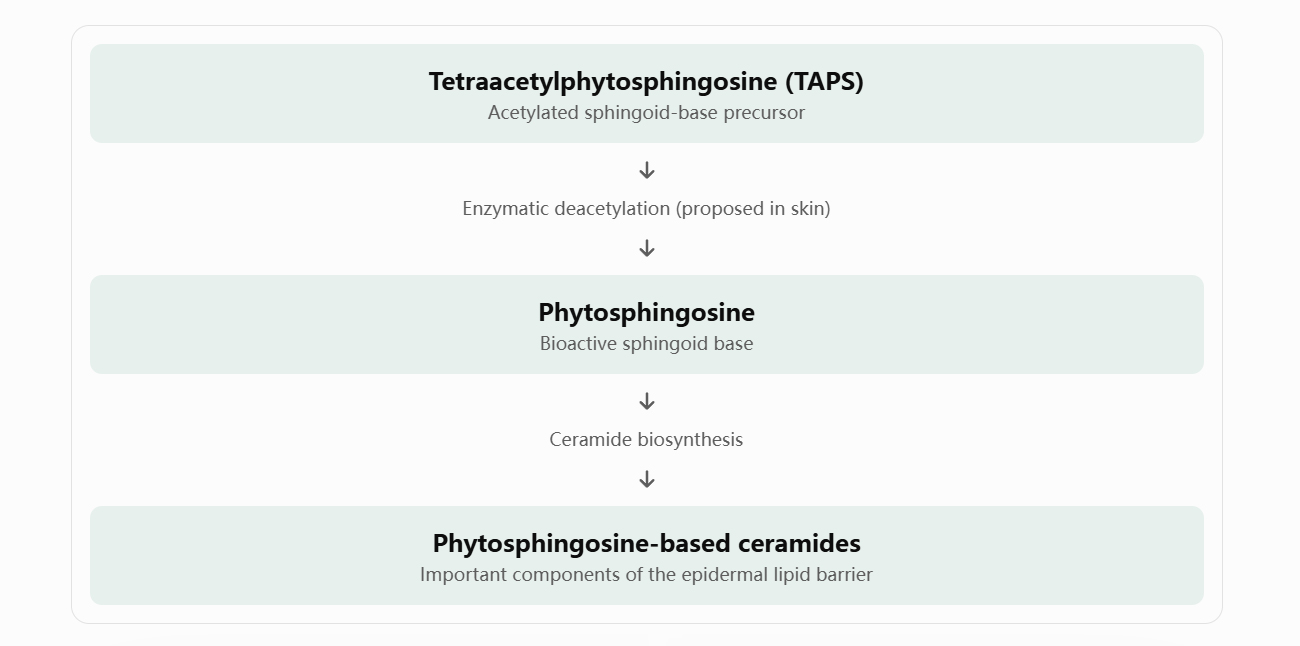
This conversion is important because phytosphingosine is a natural precursor for phytosphingosine-containing ceramides.
2. Promoting Ceramide Biosynthesis
One of the most important proposed functions of Tetraacetylphytosphingosine is supporting the formation of skin ceramides.
After conversion into phytosphingosine, the resulting sphingoid base can combine with suitable fatty acids through ceramide biosynthetic pathways.
The resulting phytosphingosine-based ceramides include:
- Ceramide NP: Non-hydroxy fatty acid linked to phytosphingosine.
- Ceramide AP: Alpha-hydroxy fatty acid linked to phytosphingosine.
- Ceramide EOP: Esterified omega-hydroxy fatty acid linked to phytosphingosine.
These ceramides contribute to the organization and integrity of the stratum corneum lipid matrix.
3. Strengthening the Skin Barrier
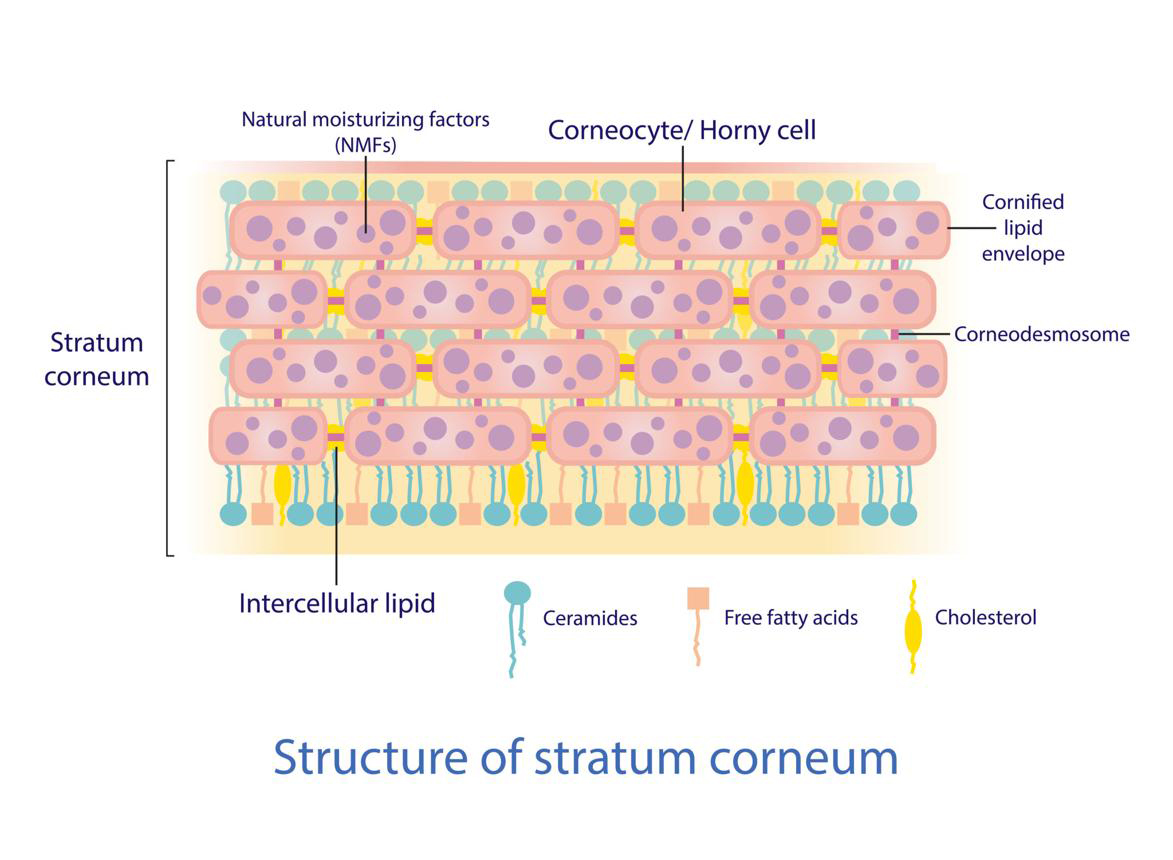
The stratum corneum is the outermost layer of the epidermis. Its structure resembles a brick-and-mortar wall:
- Corneocytes act as the bricks.
- Ceramides, cholesterol, and free fatty acids form the lipid mortar.
By supporting the availability of phytosphingosine for ceramide production, Tetraacetylphytosphingosine may help maintain this lipid structure.
Potential effects include:
(1) Improving the integrity of the skin barrier.
(2) Reducing excessive transepidermal water loss (TEWL).
(3) Improving resistance to external irritants.
(4) Supporting recovery of dry and compromised skin.
Importantly, these benefits are mechanistically plausible, but the extent to which topical Tetraacetylphytosphingosine produces them in human skin requires further clinical confirmation.
4. Improving Skin Hydration
Ceramides are essential for maintaining the skin’s water-retention capacity.
Tetraacetylphytosphingosine may indirectly improve skin hydration through its contribution to phytosphingosine-based ceramide formation.
The proposed process is:
- Tetraacetylphytosphingosine provides a precursor for phytosphingosine.
- Phytosphingosine supports ceramide biosynthesis.
- Ceramides help organize the intercellular lipid barrier.
- A better-organized barrier helps reduce water loss.
As a result, Tetraacetylphytosphingosine is potentially useful in moisturizing formulations targeting dry, rough, and dehydrated skin.
However, Tetraacetylphytosphingosine should not be considered a conventional humectant like glycerin or hyaluronic acid. Its proposed moisturizing effect is primarily associated with lipid-barrier support.
5. Supporting Keratinocyte Differentiation and Lipid Metabolism
Phytosphingosine is also involved in epidermal lipid metabolism and keratinocyte differentiation.
Research investigating sphingoid bases in cultured keratinocytes found that phytosphingosine could markedly increase phytoceramide pools.
This is relevant because keratinocyte differentiation is necessary for the formation and maintenance of a functional epidermal barrier.
The potential biological sequence is:
(1) Availability of phytosphingosine.
(2) Modulation of sphingolipid metabolism.
(3) Changes in phytoceramide production.
(4) Support for epidermal differentiation and lipid organization.
It is important to distinguish these findings from direct Tetraacetylphytosphingosine research: the cellular study investigated phytosphingosine rather than demonstrating the same effects after topical Tetraacetylphytosphingosine application.
6. Antioxidant and Skin-Protective Effects
Tetraacetylphytosphingosine has also been described in the literature as having antioxidant properties.
Its potential skin-protective functions are associated with:
- Supporting the skin’s lipid barrier.
- Potentially reducing oxidative damage to skin components.
- Supporting the maintenance of healthy skin conditions.
However, the antioxidant mechanism of Tetraacetylphytosphingosine is less clearly established than its role as a phytosphingosine precursor. Specific molecular targets and clinical antioxidant effects require further investigation.
7. Overall Mechanism of Action
The major proposed mechanisms can be summarized as follows:
| Mechanism | Potential skin benefit |
| Enzymatic deacetylation | Releases phytosphingosine |
| Ceramide biosynthesis | Supports epidermal lipid production |
| Lipid barrier maintenance | Improves barrier integrity |
| Reduced water loss | Helps maintain hydration |
| Sphingolipid metabolism | Supports epidermal lipid balance |
| Antioxidant activity | Potential skin protection |
8. Scientific Evidence and Research Limitations
The evidence supporting Tetraacetylphytosphingosine is mechanism comes from several research areas:
- Tetraacetylphytosphingosine biosynthesis research: Establishes TAPS as an acetylated precursor that can be deacetylated to produce phytosphingosine.
- Phytosphingosine research: Demonstrates its involvement in phytoceramide production and keratinocyte lipid metabolism.
- Ceramide research: Establishes the importance of phytosphingosine-based ceramides in skin barrier function.
- Cosmetic formulation research: Provides preliminary evidence supporting the use of Tetraacetylphytosphingosine as a ceramide precursor.
One important limitation is that evidence for phytosphingosine and ceramides cannot automatically be interpreted as proof of identical effects from topical Tetraacetylphytosphingosine.
Conclusion
Tetraacetylphytosphingosine primarily works as a potential precursor of phytosphingosine and phytosphingosine-based ceramides. Its most relevant cosmetic mechanism is supporting skin lipid metabolism and the epidermal barrier.
Its potential applications include:
(1) Skin barrier repair.
(2) Moisturizing and dryness reduction.
(3) Supporting ceramide production.
(4) Maintaining epidermal lipid balance.
(5) Skin protection and anti-aging formulations.
The strongest scientific rationale is its relationship with phytosphingosine and ceramide biosynthesis, while its direct clinical efficacy as a topical cosmetic ingredient remains an area for further research.