
Magnesium Acetyl Taurate (MgAT), based on chemical synthesis and lab preparation processes. I’ll cover both the chemical preparation (synthesis) and the experimental methods for evaluating its properties.
Materials of Magnesium Acetyl Taurate
To prepare or study Magnesium Acetyl Taurate, the following are commonly used:
1. Active chemical components:
- Magnesium source: Magnesium oxide (MgO), magnesium carbonate (MgCO₃), or magnesium hydroxide (Mg(OH)₂).
- Taurine derivative: Acetyl taurine (N-acetyltaurine) or taurine (2-aminoethanesulfonic acid), which can be acetylated.
- Solvents: Distilled water, ethanol, or methanol (depending on solubility and purification needs).
2. Reagents and chemicals:
- Acetic anhydride or acetyl chloride (for acetylation of taurine, if starting from taurine).
- pH adjusters: Hydrochloric acid (HCl) or sodium hydroxide (NaOH) to control pH during reaction.
- Optional chelating agents or buffers for stabilization.
3. Analytical chemicals:
- For characterization: HPLC solvents, deuterated solvents for NMR (D₂O), reagents for mass spectrometry, or UV-Vis for absorption studies.
Methods of Magnesium Acetyl Taurate
A. Synthesis of Magnesium Acetyl Taurate
A general method involves neutralization and complexation:
1. Acetylation of taurine (if not using pre-made acetyl taurine):
- Dissolve taurine in water or an alcohol solvent.
- Slowly add acetic anhydride under stirring at controlled temperature (0–5°C initially, then allow to rise to room temperature).
- Maintain pH around 7–8 using NaOH during the reaction.
- Purify acetyl taurine by recrystallization or solvent evaporation.
2. Complexation with magnesium:
- Dissolve magnesium source (MgO, MgCO₃, or Mg(OH)₂) in water under gentle heating.
- Slowly add acetyl taurine solution with stirring.
- Adjust pH to 7–8 to favor complex formation.
- Continue stirring at slightly elevated temperature (40–60°C) for several hours.
- Allow the solution to cool, and then precipitate the magnesium acetyl taurate if necessary.
- Filter, wash with cold water/ethanol, and dry under vacuum or in a low-temperature oven.
B. Characterization Methods
After synthesis, Magnesium Acetyl Taurate is usually analyzed by:
1. Spectroscopic methods:
- FTIR (Fourier-transform infrared spectroscopy): Confirms magnesium coordination and functional groups (sulfonate, acetyl, etc.).
- NMR (¹H and ¹³C): Verifies acetylation and taurine backbone.
2. Elemental analysis:
- Confirms magnesium, carbon, hydrogen, nitrogen, and sulfur content.
3. Physical characterization:
- Melting point / decomposition temperature.
- Solubility tests in water, ethanol, or other solvents.
4. Other methods:
- Mass spectrometry (MS) for molecular weight confirmation.
- X-ray diffraction (XRD) for crystalline structure, if needed.
C. Experimental Notes
- The ratio of magnesium to acetyl taurine typically ranges from 1:2 to 1:1 depending on desired stoichiometry.
- The reaction is usually done under mild heating and neutral pH to prevent decomposition.
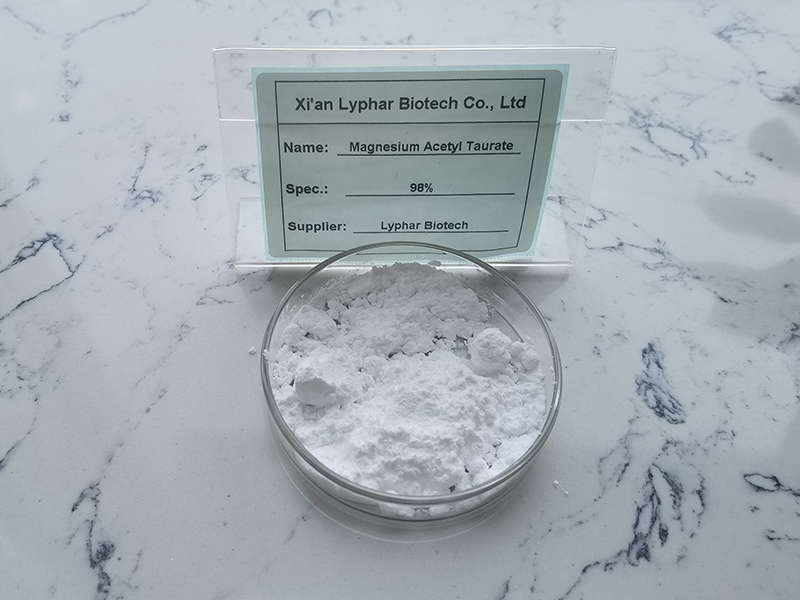
- Magnesium Acetyl Taurate is generally hygroscopic, so storage in airtight containers is recommended.
If you want, I can also make a step-by-step lab-style “Materials and Methods” protocol for Magnesium Acetyl Taurate that looks exactly like what you’d see in a journal article. It would be ready to use as a reference.