
Riboflavin Sodium Phosphate (RSP), also known as Riboflavin-5′-phosphate sodium (FMN sodium salt), is a phosphorylated form of Vitamin B2 (riboflavin). It is used as a nutritional fortifier in foods, beverages, and dietary supplements because it combines the biological benefits of riboflavin with improved water solubility, formulation flexibility, and stability.
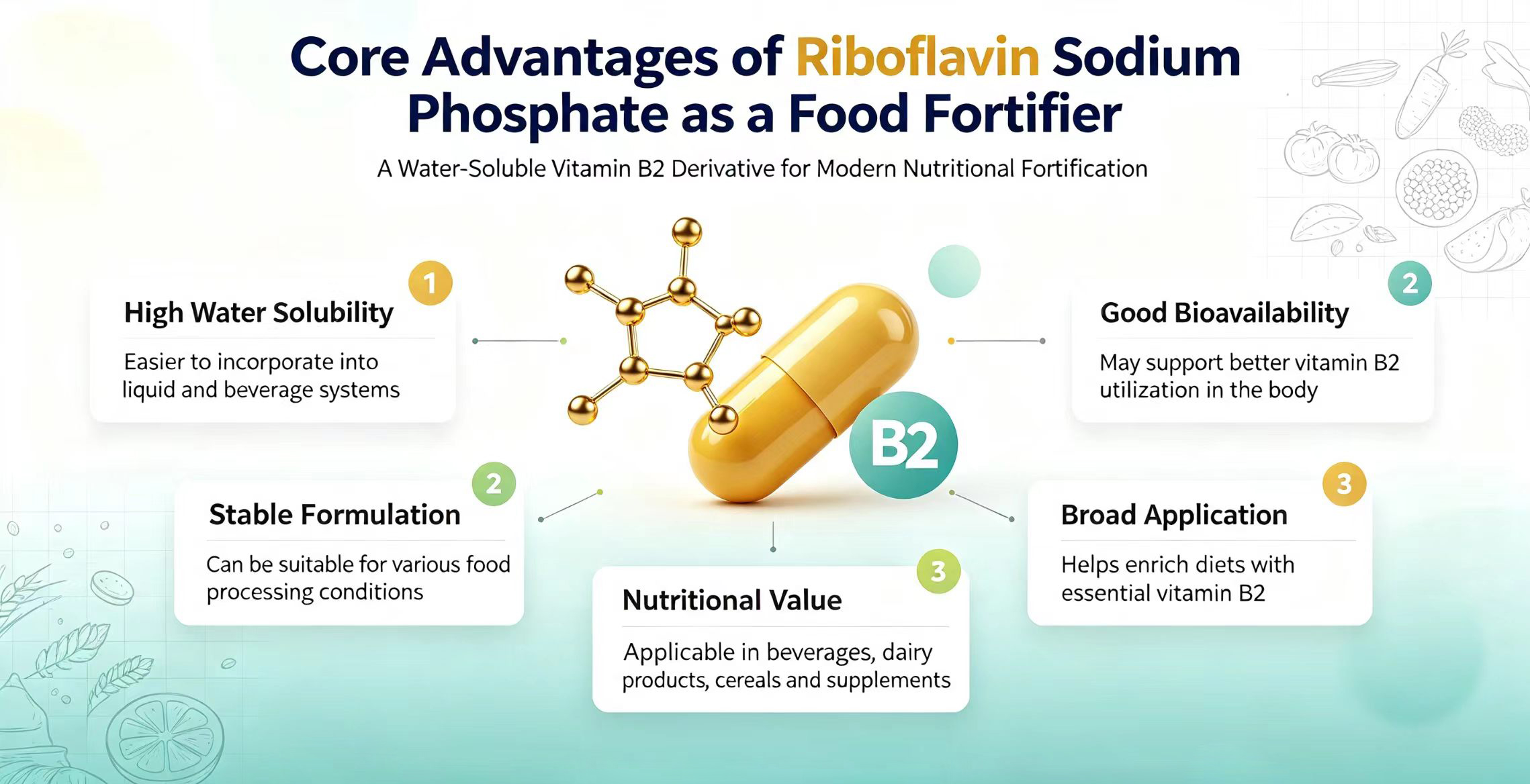
1. Superior Water Solubility
Key advantage:
Riboflavin Sodium Phosphate dissolves much more easily in water than standard riboflavin.
Riboflavin has:
- Very low water solubility
- Limited suitability for liquid foods
Riboflavin Sodium Phosphate has:
- Phosphate modification that increases polarity
- Better dispersion in aqueous systems
Food applications:
- Liquid nutritional drinks
- Infant formulas
- Sports beverages
- Fortified milk products
- Vitamin waters
Benefit for manufacturers:
- Easier mixing
- More uniform nutrient distribution
- Reduced sedimentation problems
2. Higher Bioavailability Potential
Riboflavin Sodium Phosphate is already a phosphorylated form of riboflavin and is closely related to the body’s active coenzyme:
Riboflavin → FMN → FAD
Riboflavin Sodium Phosphate provides:
- Flavin mononucleotide (FMN)
- A direct precursor for FAD formation
FMN and FAD are required for hundreds of enzymatic reactions.
Nutritional functions:
- Energy metabolism
- Fat metabolism
- Protein metabolism
- Cellular oxidation-reduction reactions
3. Better Stability in Liquid Food Systems
Compared with ordinary riboflavin, RSP offers improved formulation characteristics.
Advantages:
- Better water compatibility
- More stable in aqueous solutions
- Easier pH adjustment
- Less crystallization
Useful in:
- Ready-to-drink beverages
- Liquid supplements
- Nutritional solutions
4. Effective Vitamin B2 Fortification
Vitamin B2 is an essential nutrient involved in:
Energy production
FMN and FAD participate in:
- Mitochondrial electron transport
- ATP synthesis
- Carbohydrate oxidation
- Fatty acid metabolism
Adequate intake supports:
- Normal energy release from food
- Reduced fatigue related to deficiency
5. Improved Processing Compatibility
Food manufacturing involves:
- Heating
- Mixing
- Storage
- Packaging
Riboflavin Sodium Phosphate provides advantages in:
Formulation:
✔ Easier incorporation into premixes
✔ Better compatibility with water-based ingredients
✔ More consistent dosage control
It is particularly useful when precise vitamin delivery is required.
6. Suitable for Special Nutrition Products
Riboflavin Sodium Phosphate is valuable in products designed for:
Infant and child nutrition
Supports:
- Growth and development
- Energy metabolism
- Normal tissue maintenance
Medical nutrition
Used in:
- Nutritional supplements
- Enteral formulas
- Vitamin preparations
Elderly nutrition
Supports:
- Cellular energy metabolism
- Normal antioxidant systems
7. Supports Antioxidant Defense
Vitamin B2 is required for the activity of:
Glutathione reductase
This enzyme helps regenerate reduced glutathione (GSH), a major cellular antioxidant.
Potential benefits:
- Protection against oxidative stress
- Support of cellular defense systems
- Maintenance of normal redox balance
8. Better Choice for Transparent or Clear Beverages
A major challenge with riboflavin is its poor solubility.
Riboflavin Sodium Phosphate is preferred for:
- Clear nutritional drinks
- Liquid vitamin products
- Dissolved electrolyte beverages
because it reduces:
- Cloudiness
- Uneven distribution
- Nutrient precipitation
9. Lower Formulation Challenges
Compared with riboflavin:
| Property | Riboflavin | Riboflavin Sodium Phosphate |
| Water solubility | Low | High |
| Liquid formulation | Difficult | Easier |
| Dispersion | Poor | Good |
| Bioactive relationship | Precursor | FMN form |
| Nutrient stability | Moderate | Better |
| Manufacturing flexibility | Limited | High |
10. Clean Label and Regulatory Advantages
Riboflavin Sodium Phosphate is recognized as a nutritional form of Vitamin B2 in many food and supplement applications.
Advantages:
- Provides a recognized essential nutrient
- Suitable for vitamin premixes
- Compatible with fortified foods
- Allows accurate vitamin dosing
Main Food Applications
| Product Category | Purpose |
| Infant formula | Vitamin B2 enrichment |
| Dairy beverages | Nutritional enhancement |
| Sports drinks | Energy metabolism support |
| Meal replacement products | Micronutrient fortification |
| Cereals | Vitamin enrichment |
| Powdered supplements | Vitamin B2 delivery |
| Medical nutrition | Controlled nutrient supply |
Riboflavin Sodium Phosphate vs Riboflavin as Fortifiers
| Feature | Riboflavin | Riboflavin Sodium Phosphate |
| Nutritional activity | Excellent | Excellent |
| Solubility | Poor | Excellent |
| Liquid foods | Less suitable | Highly suitable |
| Powder foods | Suitable | Suitable |
| Processing flexibility | Moderate | Higher |
| Bioactive form relationship | Requires conversion | Closer to FMN |
Conclusion
The core advantages of Riboflavin Sodium Phosphate as a food nutrient fortifier are:
- Excellent water solubility → ideal for beverages and liquid nutrition products
- Efficient delivery of Vitamin B2 activity → supports FMN/FAD-dependent metabolism
- Better formulation stability → easier manufacturing and dosage control
- Improved compatibility with modern food systems → especially functional drinks and medical nutrition
- Supports energy metabolism, antioxidant defense, and normal cellular function
Overall, Riboflavin Sodium Phosphate is a high-performance Vitamin B2 fortification ingredient, especially valuable when manufacturers need a stable, water-compatible, and bioavailable riboflavin source.