
Tetraacetylphytosphingosine (TAPS) is an acetylated derivative of phytosphingosine, a naturally occurring sphingoid base involved in skin-barrier biology.
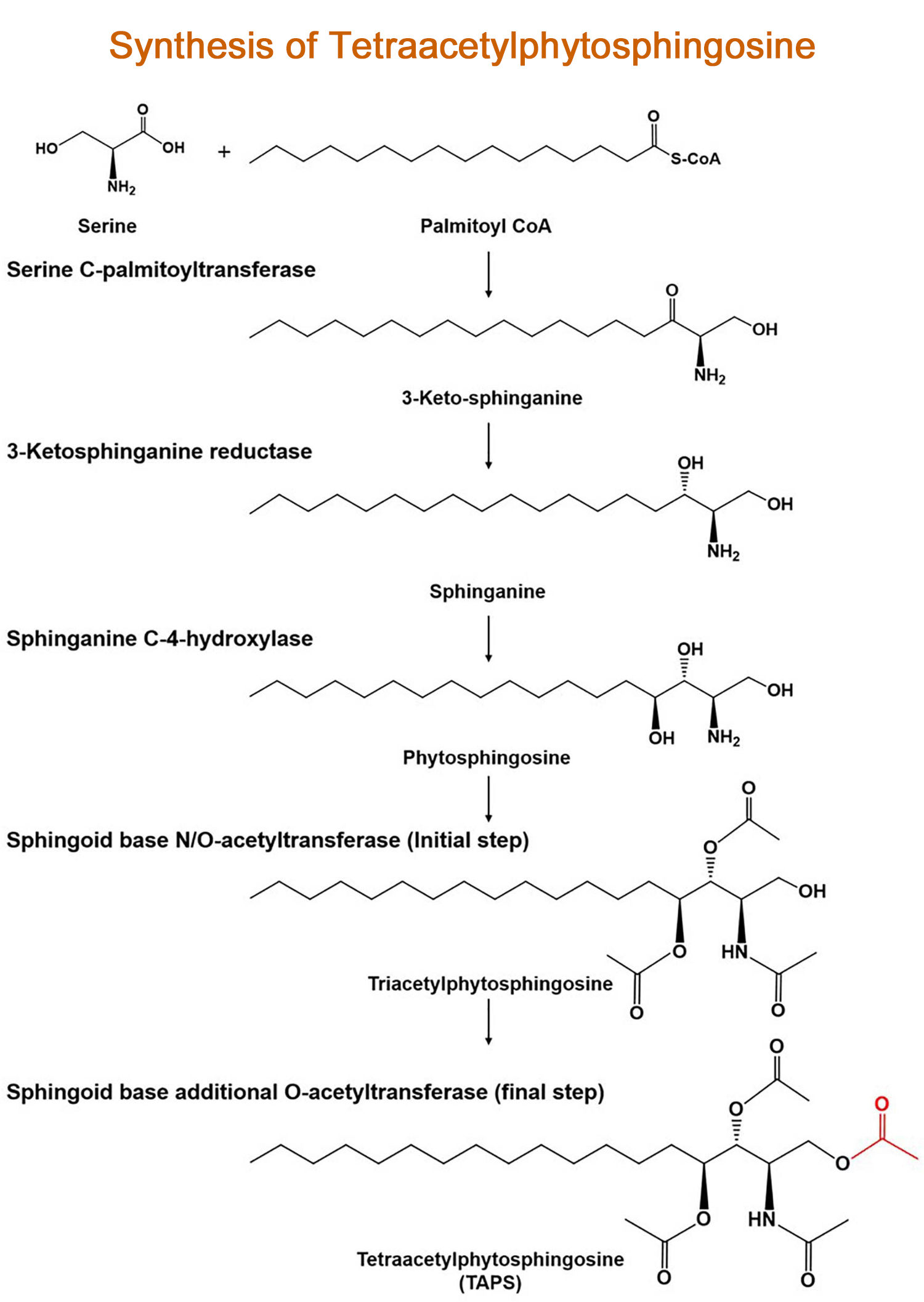
Tetraacetylphytosphingosine is produced through the chemical modification of phytosphingosine by introducing four acetyl groups into its molecular structure. This modification temporarily masks its hydroxyl and amino functional groups, changing its physicochemical properties and making it useful as a cosmetic ingredient and formulation intermediate.
The synthesis generally involves:
- Obtaining or preparing phytosphingosine.
- Protecting its amino and hydroxyl functional groups through acetylation.
- Purifying the resulting tetraacetylated compound.
- Confirming its chemical identity and purity.
- Evaluating its stability and suitability for cosmetic formulations.
The key chemical transformation is the conversion of phytosphingosine into its tetraacetylated derivative.
1. Chemical structure and reaction principle
Phytosphingosine contains four reactive functional-group hydrogens suitable for acetylation:
- One primary amino group (–NH₂).
- Three hydroxyl groups (–OH).
During complete acetylation:
- The amino group becomes an acetamide group (–NHCOCH₃).
- The three hydroxyl groups become acetate esters (–OCOCH₃).
Thus, Tetraacetylphytosphingosine contains three O-acetyl groups and one N-acetyl group.
Chemical identity of Tetraacetylphytosphingosine
| Property | Value |
| Chemical name | Tetraacetylphytosphingosine |
| CAS number | 13018-48-9 |
| Molecular formula | C₂₆H₄₇NO₇ |
| Molecular weight | Approximately 485.66 g/mol |
| Acetyl groups | 4 |
| Functional groups | 3 acetate esters and 1 acetamide |
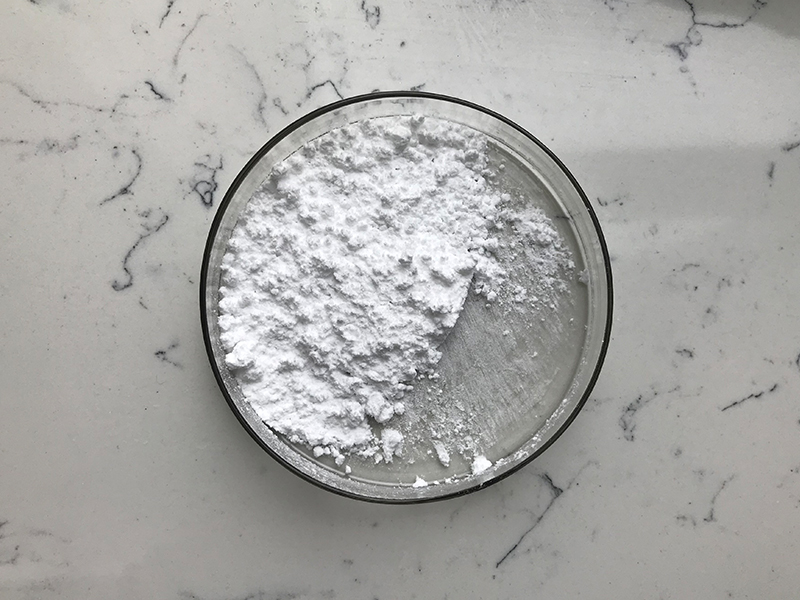
| Appearance | White to off-white solid |
2. Chemical synthesis method
One established preparation method involves the acetylation of phytosphingosine hydrochloride using acetic anhydride and triethylamine.
(1) Raw materials and reagents
| Material | Function |
| Phytosphingosine hydrochloride | Starting material |
| Acetic anhydride | Acetylating agent |
| Triethylamine | Acid-binding base |
| Chloroform | Organic reaction solvent |
| Sodium bicarbonate | Neutralization and washing |
| Magnesium sulfate | Drying agent |
| Silica gel | Chromatographic purification |
(2) Reaction process
Step 1: Preparation of the starting material
Phytosphingosine hydrochloride is dissolved in an appropriate organic solvent. Triethylamine is added to neutralize the hydrochloride salt and facilitate the acetylation reaction.
Step 2: Acetylation
Acetic anhydride is introduced as the acetylating reagent. The amino group and three hydroxyl groups undergo acetylation, producing tetraacetylphytosphingosine.
Step 3: Reaction completion
The reaction mixture is heated under reflux with continuous stirring. Reaction completion can be monitored using chromatographic methods.
Step 4: Neutralization and extraction
After cooling, the reaction mixture is washed with saturated sodium bicarbonate solution to remove residual acidic components. The organic phase is separated.
Step 5: Drying and concentration
The organic phase is dried over anhydrous magnesium sulfate, filtered, and concentrated under reduced pressure to remove the solvent.
Step 6: Purification
The crude product is purified by silica-gel column chromatography, using a dichloromethane–methanol solvent system.
Step 7: Product identification
The purified product is characterized using nuclear magnetic resonance (NMR), melting-point determination, and chromatographic purity analysis.
A published patent reports an approximately 80% yield and 96% purity for this preparation. The reported product was a white solid with a melting point of 41–43°C.
3. Alternative acetylation method
Another published laboratory procedure uses free phytosphingosine rather than its hydrochloride salt.
The reported conditions include:
- Phytosphingosine dissolved in pyridine.
- Acetic anhydride added as the acetylating reagent.
- Stirring at room temperature overnight.
- Concentration followed by flash chromatography.
The reported yield of tetraacetyl derivatives was approximately 75–80%.
This method offers a comparatively straightforward route when free phytosphingosine is available.
4. Industrial production through microbial fermentation
Chemical acetylation is not the only way to obtain Tetraacetylphytosphingosine. In fact, microbial fermentation is an important industrial production route.
The yeast Wickerhamomyces ciferrii (historically referred to as Pichia ciferrii) is particularly important because it naturally produces and secretes Tetraacetylphytosphingosine.
(1) Fermentation principle
The microorganism produces Tetraacetylphytosphingosine through its sphingolipid biosynthetic pathway.
The general process involves:
- Selecting a high-producing yeast strain.
- Preparing a suitable fermentation medium.
- Supplying carbon and nitrogen sources.
- Controlling temperature, pH, dissolved oxygen, and nutrient supply.
- Allowing microbial synthesis and accumulation of Tetraacetylphytosphingosine.
- Recovering Tetraacetylphytosphingosine from the fermentation broth.
Glycerol and L-serine have been investigated as important components of fermentation strategies.
(2) Strain improvement
Industrial research has focused on increasing Tetraacetylphytosphingosine productivity through:
- Mutagenesis and strain screening.
- Haploid breeding.
- Metabolic engineering.
- Optimization of fermentation conditions.
- Improvement of precursor supply and metabolic flux.
A 2025 review describes these approaches and identifies W. ciferrii as a particularly valuable microbial production platform
5. Extraction and purification of fermentation-derived Tetraacetylphytosphingosine
After fermentation, Tetraacetylphytosphingosine must be separated from microbial cells, culture-medium components, and other lipid impurities.
A typical downstream process includes:
- Fermentation broth collection: Collect the broth containing Tetraacetylphytosphingosine.
- Cell separation: Separate microbial biomass and supernatant through centrifugation or filtration.
- Lipid extraction: Extract Tetraacetylphytosphingosine using suitable organic solvents, such as ethyl acetate or methanol-containing solvent systems.
- Crude extract concentration: Remove extraction solvents under controlled conditions.
- Chromatographic purification: Use silica-gel chromatography or other suitable purification technologies.
- Crystallization: Apply appropriate crystallization conditions to obtain purified material.
- Drying: Remove residual moisture and solvents to obtain the finished product.
An earlier patent describes recovery through extraction of both the microbial cells and fermentation supernatant, followed by lipid extraction and silica-gel chromatography.
6. Comparison of production methods
| Comparison | Chemical acetylation | Microbial fermentation |
| Starting material | Phytosphingosine | Fermentation substrates |
| Production principle | Chemical acetylation | Biological biosynthesis |
| Main production system | Chemical reactor | Fermentation bioreactor |
| Main reagents | Acetic anhydride, base | Nutrients and carbon sources |
| Process complexity | Relatively straightforward reaction | Complex biological process |
| Production optimization | Reaction conditions | Strain and fermentation engineering |
| Main challenge | Reagent residues and purification | Productivity and downstream recovery |
| Industrial importance | Chemical preparation and intermediates | Important commercial production route |
Important distinction: Fermentation-derived Tetraacetylphytosphingosine is not necessarily produced by chemically acetylating extracted phytosphingosine. The microorganism can biosynthesize and secrete Tetraacetylphytosphingosine directly.
7. Quality control and analytical characterization
The quality of Tetraacetylphytosphingosine is important because impurities, incomplete acetylation, and residual solvents can affect its performance in subsequent cosmetic manufacturing.
The following analytical methods are useful:
| Analytical method | Quality-control purpose |
| HPLC | Purity and related substances |
| LC-MS | Molecular mass and impurity identification |
| NMR | Structural confirmation |
| FTIR | Functional-group identification |
| GC | Residual solvent analysis |
| Karl Fischer | Water content |
| Melting-point testing | Physical identity and consistency |
| Optical rotation | Stereochemical consistency |
Important quality indicators
- Chemical identity and molecular structure.
- Correct stereochemistry.
- High tetraacetylation completeness.
- Low levels of partially acetylated derivatives.
- Low residual solvent content.
- Controlled moisture and inorganic impurities.
- Consistent batch-to-batch purity.
For cosmetic-grade Tetraacetylphytosphingosine, additional specifications should address applicable cosmetic ingredient requirements and the manufacturer’s finished-material standards.
8. Applications of synthesized Tetraacetylphytosphingosine
Tetraacetylphytosphingosine is relevant to several areas of cosmetic and lipid research.
(1) Phytosphingosine preparation
Tetraacetylphytosphingosine can undergo deacetylation to produce phytosphingosine, which is useful as a starting material for sphingolipid research.
(2) Ceramide synthesis
Phytosphingosine and its derivatives can be combined with suitable fatty acids to produce ceramide structures.
(3) Skin-barrier research
Phytosphingosine-derived lipids are relevant to studying the composition and biological functions of the stratum corneum.
(4) Cosmetic ingredient development
Tetraacetylphytosphingosine serves as a precursor and intermediate in the development of phytosphingosine-related cosmetic ingredients.
(5) Pharmaceutical and biochemical research
Its derivatives are useful in studies involving sphingolipid metabolism, lipid synthesis, and biological activity.
9. Challenges in Tetraacetylphytosphingosine synthesis and production
Several challenges need to be considered during manufacturing:
- Incomplete acetylation: May generate mono-, di-, or triacetylated impurities.
- Stereochemical integrity: The natural stereochemical configuration must be preserved.
- Purification difficulties: Tetraacetylphytosphingosine and related lipid compounds can have similar physicochemical properties.
- Solvent management: Organic solvents require appropriate recovery and residual-solvent controls.
- Fermentation productivity: Microbial strains may have different production capabilities.
- Batch consistency: Fermentation and purification conditions must be carefully controlled.
10. Research developments and future prospects
Recent research increasingly emphasizes microbial biosynthesis rather than relying exclusively on conventional chemical synthesis.
A particularly relevant publication is:
Advances in the biosynthesis of tetraacetyl phytosphingosine, a key substrate of ceramides (2025).
The research reviews:
- Tetraacetylphytosphingosine biosynthetic pathways.
- The role of Wickerhamomyces ciferrii.
- Microbial strain improvement.
- Mutagenesis and breeding technologies.
- Metabolic engineering.
- Optimization of industrial fermentation.
These approaches may improve production efficiency and provide a more scalable supply of Tetraacetylphytosphingosine for ceramide manufacturing.
11. Conclusion
Tetraacetylphytosphingosine can be produced through two principal approaches:
- Chemical synthesis: Acetylation of phytosphingosine using acetic anhydride, followed by purification and quality testing.
- Microbial biosynthesis: Direct production of Tetraacetylphytosphingosine through fermentation using Wickerhamomyces ciferrii, followed by extraction and purification.
Chemical acetylation provides a relatively direct laboratory preparation method, while microbial fermentation is particularly important for industrial-scale production.
For commercial manufacturing, fermentation optimization, product recovery, purification efficiency, stereochemical integrity, and analytical quality control are important considerations.