
Tetraacetylphytosphingosine (TAPS) is a chemically modified derivative of phytosphingosine, a naturally occurring sphingoid base found in the lipid components of human skin and various biological organisms.
Tetraacetylphytosphingosine is primarily obtained through chemical synthesis rather than direct extraction from plants or animals. Its ultimate raw-material origin can nevertheless be natural, fermentation-derived, or petrochemical, depending on the phytosphingosine manufacturing route.
1. Primary source: Phytosphingosine
Phytosphingosine is the principal precursor used to manufacture Tetraacetylphytosphingosine.
- Natural occurrence: Present in human skin, particularly in the stratum corneum, where it is associated with ceramide-related lipids.
- Biological sources: Found in certain plants, fungi, yeasts, and other organisms.
- Industrial source: Can be obtained through chemical synthesis or biotechnological production.
- Chemical transformation: Phytosphingosine undergoes acetylation of its four hydroxyl and amino functional groups to produce tetraacetylphytosphingosine.
2. Microbial source: Wickerhamomyces ciferrii yeast
The most important industrial source of Tetraacetylphytosphingosine is the yeast Wickerhamomyces ciferrii.
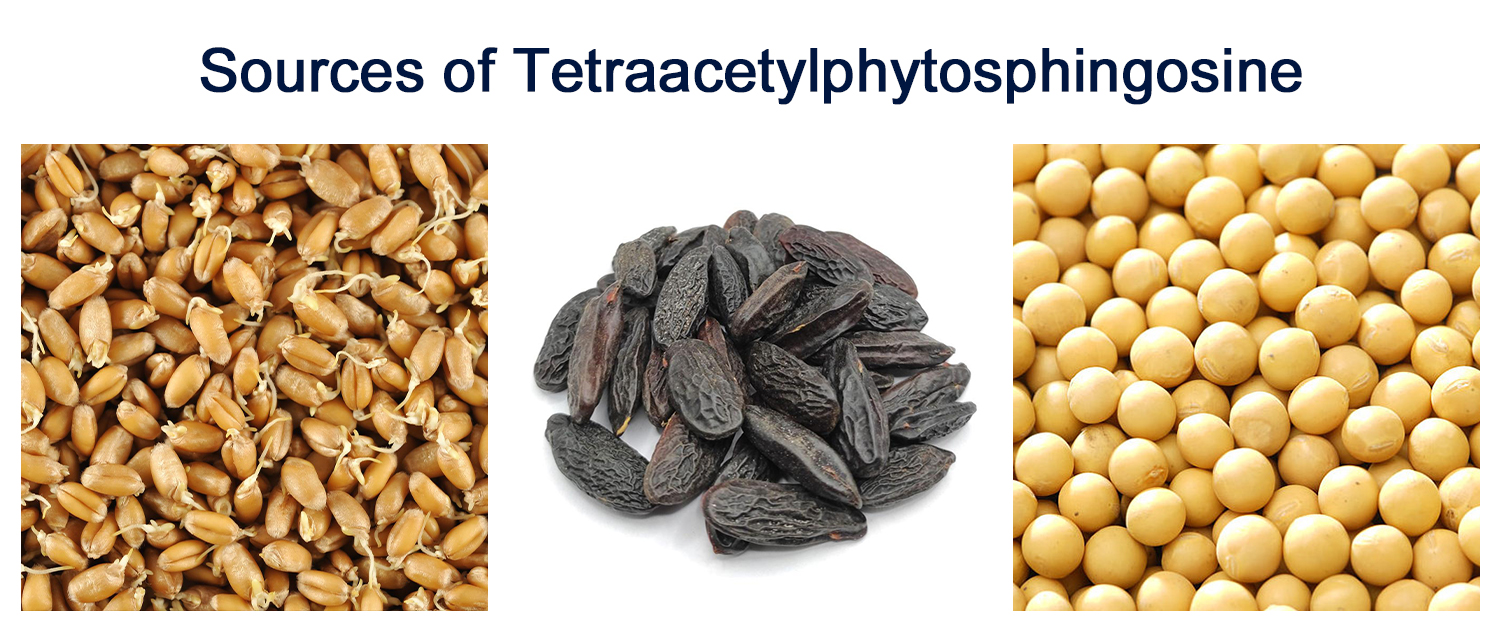
- Originally isolated from tonka bean pods (Dipteryx odorata).
- Naturally produces and secretes Tetraacetylphytosphingosine during fermentation.
- Can accumulate Tetraacetylphytosphingosine in the culture medium.
- Selected and genetically improved strains can produce higher quantities.
- Fermentation-derived Tetraacetylphytosphingosine can be recovered and purified for cosmetic applications.
This yeast is particularly valuable because it produces Tetraacetylphytosphingosine directly, reducing the need for complicated chemical synthesis.
3. Plant sources of phytosphingosine
Phytosphingosine and related sphingolipids occur naturally in several biological materials.
| Natural source | Relevance |
| Wheat and wheat germ | Sources of plant sphingolipids |
| Soybeans | Contain sphingolipid-related compounds |
| Tonka beans | Historically associated with the discovery of Tetraacetylphytosphingosine-producing yeast |
| Mushrooms | Contain phytosphingosine-related lipids |
| Other plant seeds | May contain small quantities of phytosphingosine |
Important: These materials are not necessarily direct commercial sources of Tetraacetylphytosphingosine. Plant extraction is generally inefficient because phytosphingosine concentrations are low.
4. Industrial production sources
Three production approaches are relevant:
| Production method | Description | Industrial relevance |
| Yeast fermentation | Tetraacetylphytosphingosine production using W. ciferrii | Established major production route |
| Engineered microbial fermentation | Modified yeast strains produce Tetraacetylphytosphingosine | Promising alternative |
| Chemical synthesis | Chemical preparation from suitable sphingoid precursors | Alternative manufacturing route |
Research has also demonstrated Tetraacetylphytosphingosine production using engineered Yarrowia lipolytica, although its production performance has historically been lower than that of established W. ciferrii strains.
5. How the source is converted into Tetraacetylphytosphingosine
The microbial biosynthesis pathway can be summarized as follows:
- Serine + palmitoyl-CoA: Initial sphingolipid precursor formation.
- 3-Ketosphinganine: Produced through serine palmitoyltransferase.
- Sphinganine: Formed through reduction.
- Phytosphingosine: Produced through hydroxylation.
- Tetraacetylphytosphingosine: Formed through acetylation reactions.
The resulting Tetraacetylphytosphingosine is recovered from the fermentation broth, separated, and purified.
6. Which source is best for cosmetic-grade Tetraacetylphytosphingosine?
Fermentation-derived Tetraacetylphytosphingosine from Wickerhamomyces ciferrii.
Its advantages include:
- Biological production origin.
- Potentially lower dependence on plant extraction.
- Production scalability through fermentation.
- Consistent molecular structure when properly controlled.
- Suitability as a precursor for phytosphingosine and ceramide production.
For cosmetic raw-material purchasing, manufacturers should verify:
- Tetraacetylphytosphingosine identity and assay/purity.
- Residual phytosphingosine and partially acetylated intermediates.
- Residual solvents and processing chemicals.
- Microbial limits and contamination.
- Heavy metals.
- Batch-to-batch consistency.
- Stability and storage conditions.
7. Scientific references
- Zhang et al. (2025). Advances in the biosynthesis of tetraacetyl phytosphingosine, a key substrate of ceramides. Synthetic and Systems Biotechnology. Read full research article.
- Cui et al. (2023). Fermentative production of tetraacetyl phytosphingosine: a review. Chinese Journal of Biotechnology. Read research abstract.
- Differences in the Fatty Acid Profile, Morphology, and Tetraacetylphytosphingosine-Forming Capability Between Wild-Type and Mutant Wickerhamomyces ciferrii. Read research article.
Conclusion: The primary commercial source of Tetraacetylphytosphingosine is microbial fermentation using Wickerhamomyces ciferrii. Although its biological precursor, phytosphingosine, occurs in plants, fungi, and animal tissues, direct plant extraction is not the preferred industrial route. Fermentation provides a more practical approach for producing cosmetic-grade Tetraacetylphytosphingosine at scale.