
Tetraacetylphytosphingosine (TAPS) is a chemically modified derivative of phytosphingosine. It is mainly investigated and used as a cosmetic skin-conditioning and barrier-support ingredient, particularly where improved stability and formulation compatibility are desired.
1. Skin-barrier care
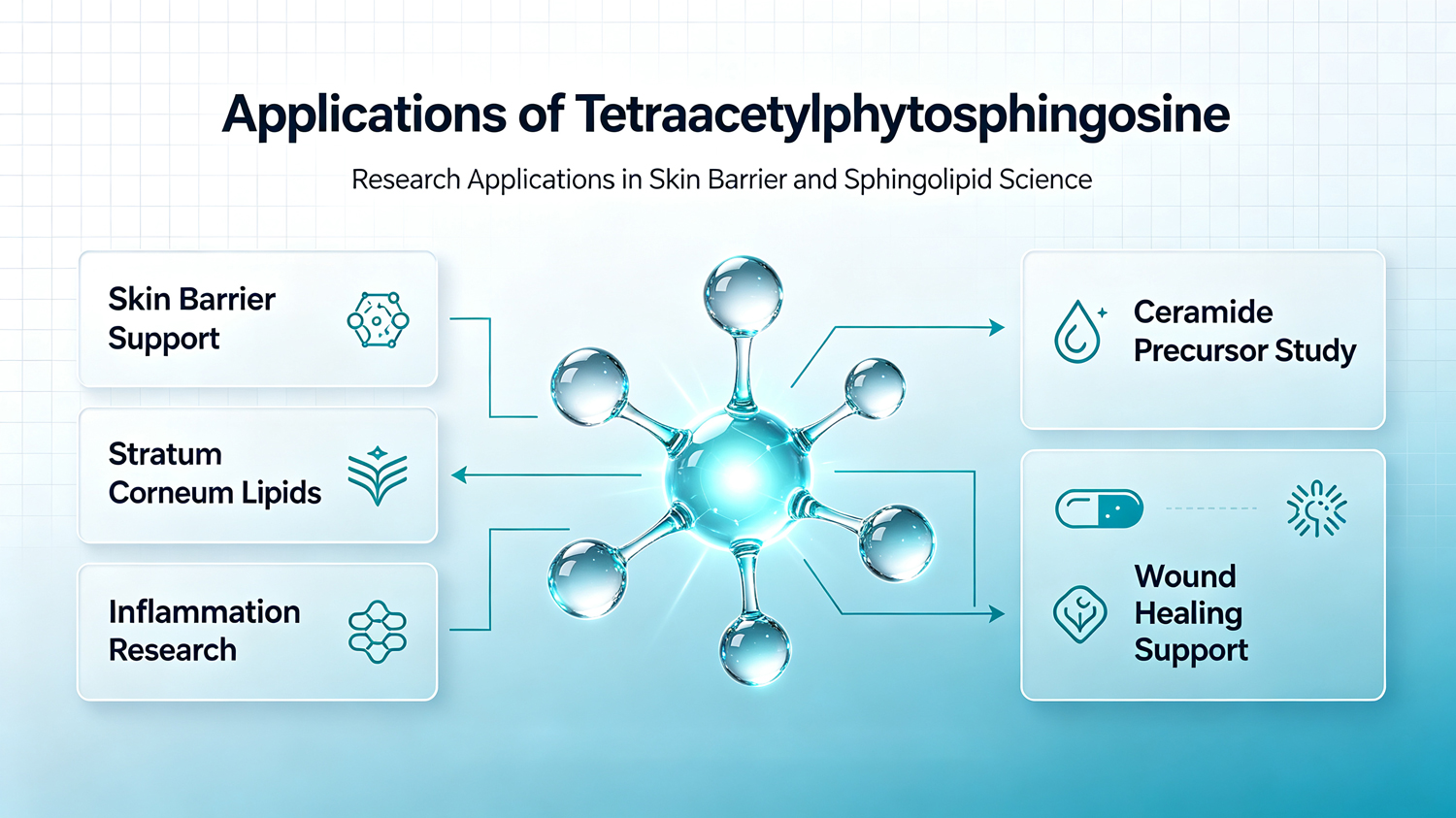
Tetraacetylphytosphingosine is used in formulations intended to support the skin barrier. As a phytosphingosine-derived molecule, it is relevant to the sphingolipid/ceramide system of the stratum corneum.
Potential applications include:
- Barrier-support creams and lotions
- Dry and rough-skin products
- Moisturizers
- Skin-repair/conditioning formulations
- Products designed for compromised or stressed skin
2. Moisturizing and hydration products
Tetraacetylphytosphingosine can be incorporated into products aimed at maintaining skin hydration by supporting the lipid environment of the stratum corneum.
Typical product categories:
- Facial moisturizers
- Body lotions
- Hand creams
- Intensive moisturizing creams
- Overnight repair products
3. Anti-aging skincare
Because skin-barrier integrity and epidermal lipid organization are important for maintaining healthy-looking skin, Tetraacetylphytosphingosine may be incorporated into anti-aging formulations as a supporting active.
It may be used in products targeting:
- Dryness-associated fine lines
- Loss of smoothness
- Rough texture
- Reduced skin resilience
- Mature-skin barrier deterioration
It is better regarded as a barrier/skin-conditioning active than as a direct collagen-stimulating anti-aging ingredient.
4. Sensitive-skin formulations
Phytosphingosine-related ingredients are of interest in formulations for sensitive or easily stressed skin. Tetraacetylphytosphingosine can therefore be used in:
- Sensitive-skin moisturizers
- Barrier creams
- Post-environmental-stress skincare
- Gentle facial-care products
The actual suitability depends strongly on the finished formulation and concentration.
5. Acne-prone and blemish-oriented skincare
Phytosphingosine has biological relevance to epidermal sphingolipids and has been investigated for effects associated with microbial balance and inflammation. Consequently, phytosphingosine derivatives can be of interest in formulations for blemish-prone skin.
However, evidence for Tetraacetylphytosphingosine specifically should not automatically be equated with evidence for free phytosphingosine.
6. Hair and scalp care
Tetraacetylphytosphingosine can also be considered for scalp and hair-conditioning applications, particularly products focused on the scalp barrier.
Potential uses include:
- Scalp moisturizers
- Sensitive-scalp products
- Scalp-barrier treatments
- Conditioning formulations
- Dry-scalp products
7. Lip and protective-care products
Because lips have a relatively weak barrier and are prone to dehydration, sphingolipid-related ingredients may be incorporated into:
- Lip balms
- Lip repair products
- Protective creams
- Dry/chapped-skin products
8. Formulation and delivery applications
An important reason for acetylating phytosphingosine is chemical modification. Acetyl groups can alter properties such as lipophilicity, stability, and formulation behavior. This makes Tetraacetylphytosphingosine potentially useful where the formulator wants a phytosphingosine-derived material with different handling characteristics from free phytosphingosine.
Summary
| Application | Main purpose |
| Facial skincare | Barrier support and conditioning |
| Moisturizers | Hydration/barrier maintenance |
| Anti-aging | Smoothness and barrier-related skin quality |
| Sensitive skin | Barrier-support formulations |
| Blemish-prone skin | Supporting healthy skin environment |
| Scalp care | Scalp conditioning and barrier support |
| Hair care | Conditioning/protective formulations |
| Lip care | Protective and moisturizing products |
Key point: Tetraacetylphytosphingosine is primarily interesting as a phytosphingosine-derived cosmetic active for skin-barrier and conditioning applications. Claims such as anti-acne, anti-inflammatory, or anti-aging should be evaluated specifically for Tetraacetylphytosphingosine rather than inferred solely from research on phytosphingosine or ceramides.