
Polydeoxyribonucleotide (PDRN) improves a “damaged cuticle” (usually referring in cosmetic science to the hair cuticle or sometimes the skin barrier stratum corneum) not by directly “patching” it, but by activating cellular repair pathways in the underlying living cells that rebuild the structure over time.
Below is the mechanism broken down clearly.
1. First clarification: what “cuticle repair” actually means
A cuticle layer (hair or skin) is not living tissue:
- Hair cuticle = dead keratinized cells
- Skin stratum corneum = dead corneocytes
So PDRN does NOT repair these layers directly.
Instead, it acts on:
- Hair follicle cells (living)
- Dermal fibroblasts (living)
- Basal keratinocytes (living)
These cells generate new keratin or barrier lipids, which replace damaged cuticle over time.
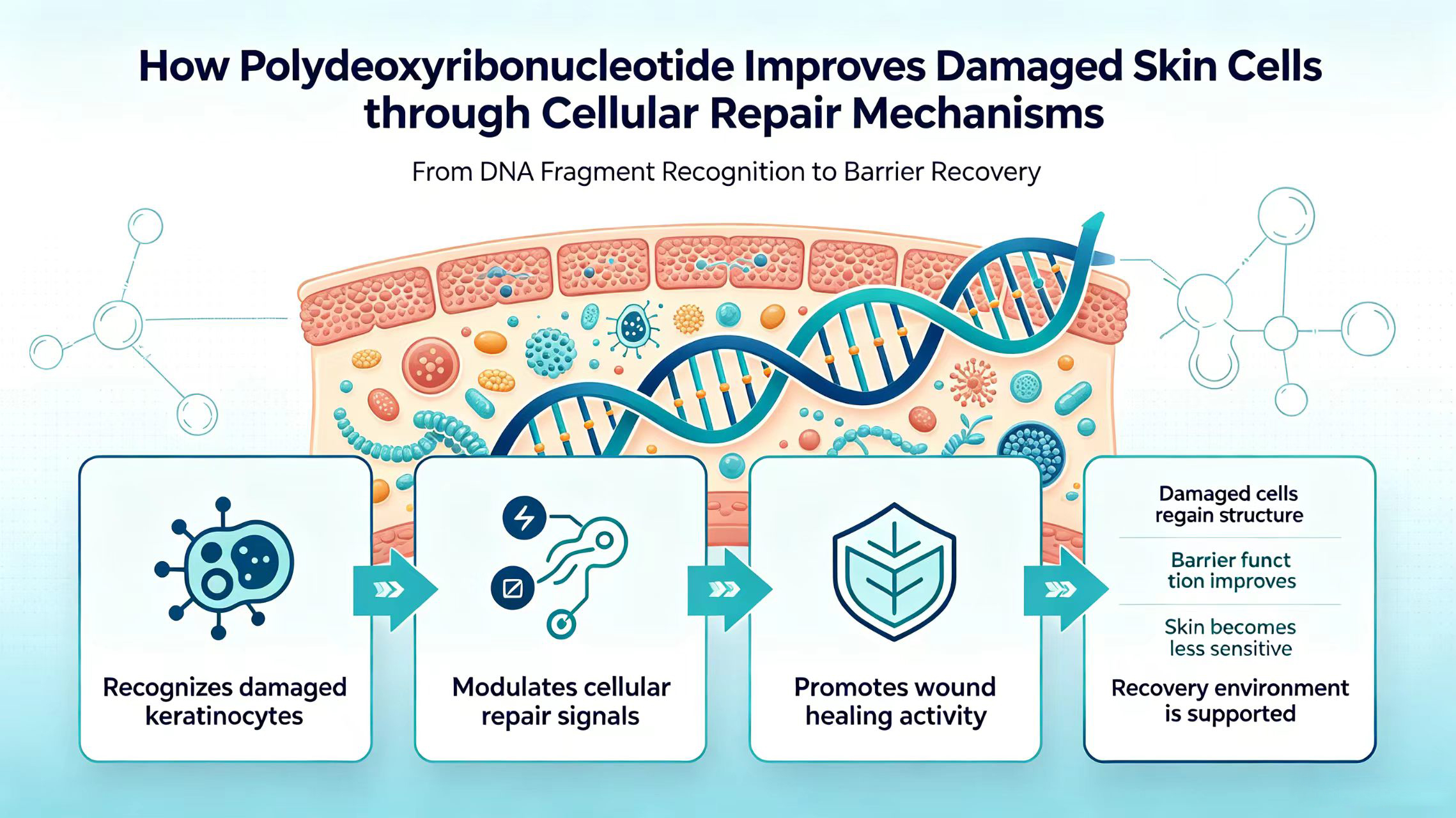
2. Core mechanism: Adenosine A2A–driven cellular repair
After application/injection, Polydeoxyribonucleotide (PDRN) is broken down into nucleotides that increase extracellular adenosine signaling.
This activates:
Adenosine A2A receptor
In target skin or follicle cells:
- ↑ cAMP signaling
- ↑ cell proliferation
- ↑ tissue remodeling genes
3. How this translates to “cuticle repair”
A) In skin (stratum corneum barrier restoration)
Polydeoxyribonucleotide (PDRN) acts on basal keratinocytes → leads to:
- ↑ keratinocyte proliferation
- ↑ differentiation control (normalized turnover)
- ↑ lipid barrier enzyme activity (indirectly via repair signaling)
Result:
- Faster replacement of damaged surface cells
- Improved barrier smoothness
- Reduced rough, flaky “cuticle damage” appearance
B) In hair (hair cuticle integrity improvement)
At the follicle level:
Polydeoxyribonucleotide (PDRN) → dermal papilla activation → follicular signaling changes:
- ↑ VEGF (vascular supply to follicle)
- ↑ fibroblast activity around follicle sheath
- ↑ growth factor environment (IGF-1, FGF signaling indirectly supported)
- ↓ oxidative stress and inflammation
Result:
New hair shaft formed has:
- more uniform cuticle layering
- smoother scale alignment
- reduced fragility and split-prone structure
Important: it improves new growth quality, not repairing already-keratinized hair shafts.
4. Anti-inflammatory protection of the “repair environment”
Damaged cuticle environments usually involve:
- oxidative stress
- UV damage
- micro-inflammation
Polydeoxyribonucleotide (PDRN) reduces this through:
- ↓ TNF-α, IL-6, IL-1β
- ↓ NF-κB activation
- ↑ IL-10 (repair cytokine)
This prevents further degradation while repair occurs.
5. Microcirculation improvement (nutrient delivery support)
Polydeoxyribonucleotide (PDRN) increases:
- VEGF → angiogenesis
- capillary perfusion in dermis
Effect:
- better oxygen delivery
- better amino acid and lipid supply
- faster keratin synthesis in follicles and epidermis
6. Structural outcome: why cuticle looks smoother
Even though Polydeoxyribonucleotide (PDRN) doesn’t “coat” the surface, it produces visible improvement via:
Skin:
- thicker epidermis
- more organized stratum corneum turnover
- improved lipid barrier → smoother surface reflection
Hair:
- stronger follicular output
- improved keratin packing → flatter cuticle scales
- less oxidative damage during formation
7. Key concept: “indirect regeneration model”
Polydeoxyribonucleotide (PDRN) works like this:
Signal repair in living cells → those cells rebuild better keratinized structures → improved cuticle quality appears over time
It is not a surface repair agent, but a biological remodeling stimulant.
8. Limitations (important)
- Does NOT repair already split or lifted hair cuticles
- Does NOT instantly smooth damaged hair shafts
- Effects depend on follicle/skin health
- Works best with repeated treatments or post-injury recovery states
9. One-line mechanism summary
Polydeoxyribonucleotide (PDRN) improves cuticle appearance by activating adenosine A2A–mediated cellular repair in keratinocytes and follicular cells, leading to enhanced regeneration of structurally healthier keratinized layers rather than direct surface repair.