
Sialic acid, most commonly N-acetylneuraminic acid (Neu5Ac), is a nine-carbon acidic monosaccharide derivative found mainly at the terminal positions of glycoconjugates such as glycoproteins and glycolipids. In humans, Neu5Ac is the predominant sialic acid and participates in cell recognition, receptor interactions, immune regulation, and the stability and lifetime of circulating glycoproteins.
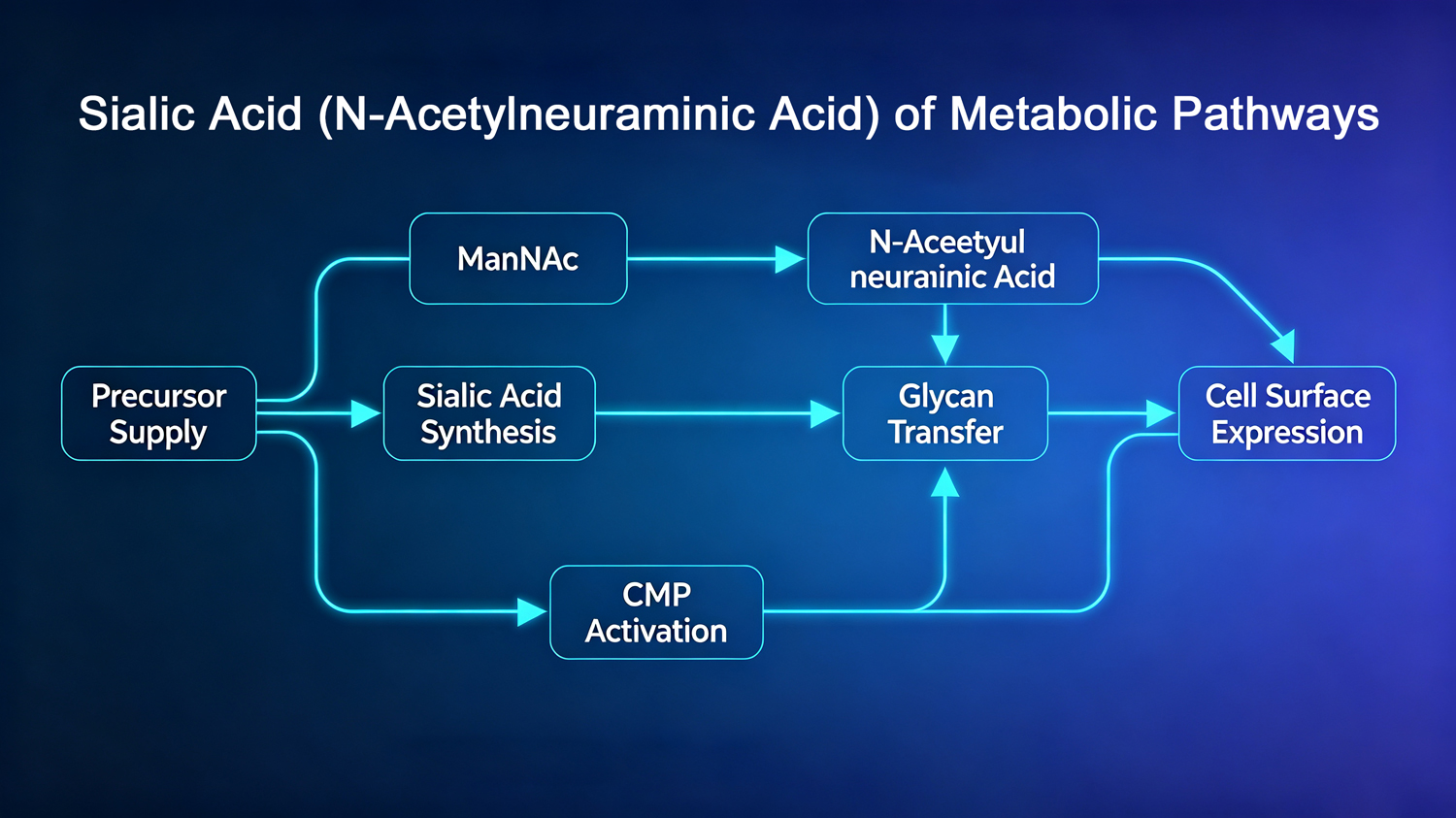
1. Overview of Neu5Ac metabolism
Neu5Ac metabolism can be divided into four major processes:
- De novo synthesis
- Activation to CMP-Neu5Ac
- Incorporation into glycoconjugates
- Removal and salvage/degradation
A simplified pathway is:
UDP-GlcNAc → ManNAc → Neu5Ac → CMP-Neu5Ac → sialylated glycoconjugates
When sialic acid is removed from glycoconjugates:
Sialylated glycoconjugate → free Neu5Ac → ManNAc → GlcNAc → metabolic pathways
2. De novo synthesis of Neu5Ac
The principal human biosynthetic pathway begins with UDP-N-acetylglucosamine (UDP-GlcNAc).
Step 1: UDP-GlcNAc → ManNAc
UDP-GlcNAc is converted to N-acetylmannosamine (ManNAc) by the bifunctional enzyme UDP-N-acetylglucosamine 2-epimerase/N-acetylmannosamine kinase (GNE).
The GNE enzyme has two activities:
- UDP-GlcNAc 2-epimerase
- ManNAc kinase
This is the major rate-controlling step in sialic acid biosynthesis.
Step 2: ManNAc → ManNAc-6-phosphate
ManNAc is phosphorylated by the kinase domain of GNE:
ManNAc + ATP → ManNAc-6-P + ADP
Step 3: ManNAc-6-P + phosphoenolpyruvate → Neu5Ac-9-P
ManNAc-6-phosphate condenses with phosphoenolpyruvate (PEP) through the action of N-acetylneuraminic acid-9-phosphate synthase (NANS).
This generates Neu5Ac-9-phosphate.
Step 4: Neu5Ac-9-P → Neu5Ac
Neu5Ac-9-phosphate is dephosphorylated by N-acetylneuraminic acid-9-phosphate phosphatase (NANP), producing free Neu5Ac.
So, in simplified form:
UDP-GlcNAc → ManNAc → ManNAc-6-P → Neu5Ac-9-P → Neu5Ac
3. Activation of Neu5Ac
Free Sialic acid must be activated before it can be transferred to glycoconjugates.
Neu5Ac is converted to CMP-Neu5Ac (CMP-sialic acid) by CMP-N-acetylneuraminic acid synthetase (CMAS).
Neu5Ac + CTP → CMP-Neu5Ac + PPi
CMP-Neu5Ac is the activated donor of sialic acid used by sialyltransferases.
Unlike many nucleotide sugars, CMP-Neu5Ac is produced in the nucleus in mammalian cells and subsequently transported to the Golgi apparatus.
4. Incorporation into glycoconjugates
CMP-Neu5Ac is transported into the Golgi apparatus, where different sialyltransferases transfer Neu5Ac to the terminal positions of carbohydrate chains.
The major products include:
- Sialylated glycoproteins
- Sialylated glycolipids
- Gangliosides
- Other specialized glycoconjugates
Common linkages include:
- α2-3
- α2-6
- α2-8
These linkages have different biological functions and occur on different glycoconjugates.
5. Sialic acid salvage pathway
Cells can also recover Neu5Ac from degraded glycoconjugates.
A simplified salvage pathway is:
Sialylated glycoconjugate → free Neu5Ac → ManNAc → ManNAc-6-P → Neu5Ac
Free Neu5Ac can be converted back toward the biosynthetic pathway, reducing the need to synthesize it entirely from UDP-GlcNAc.
This pathway is metabolically advantageous because recycling an existing sialic-acid molecule requires fewer biosynthetic resources than producing it de novo.
6. Degradation of sialic acid
Sialylated glycoconjugates are continuously turned over.
Neuraminidases/sialidases cleave terminal Neu5Ac residues from glycoconjugates.
In lysosomes, released sialic acid can enter catabolic pathways. In humans, the degradation pathway ultimately converts Neu5Ac through several intermediates, including N-acetylmannosamine-6-phosphate and N-acetylglucosamine-6-phosphate.
A simplified representation is:
Neu5Ac → ManNAc → ManNAc-6-P → GlcNAc-6-P → central carbohydrate metabolism
The exact downstream fate involves additional enzymatic steps.
7. Relationship to central metabolism
Sialic acid metabolism is connected to several major metabolic pathways.
| Metabolic pathway | Relationship to Neu5Ac |
| Glucose metabolism | Provides carbon precursors for UDP-GlcNAc |
| Hexosamine biosynthetic pathway | Produces UDP-GlcNAc, an important precursor |
| Glycolysis | Provides intermediates such as PEP used during Neu5Ac synthesis |
| Nucleotide metabolism | CTP is required to form CMP-Neu5Ac |
| Glycoprotein metabolism | Neu5Ac is incorporated into glycoproteins |
| Glycolipid metabolism | Neu5Ac is incorporated into gangliosides and other glycolipids |
| Lysosomal degradation | Removes and recycles sialic acid from glycoconjugates |
8. Metabolic regulation
The GNE enzyme is particularly important for regulating Neu5Ac production. CMP-Neu5Ac can provide feedback inhibition of GNE, helping prevent excessive synthesis.
Conceptually:
High CMP-Neu5Ac → inhibition of GNE → reduced Neu5Ac synthesis
Low CMP-Neu5Ac → increased GNE activity → increased Neu5Ac production
This feedback mechanism helps maintain appropriate intracellular sialic-acid levels.
9. Energy requirements
Sialic acid metabolism is not primarily an energy-producing pathway. Instead, it is mainly a biosynthetic and recycling pathway.
Energy and nucleotide resources are nevertheless required:
- ATP is consumed during phosphorylation of ManNAc.
- CTP is consumed during formation of CMP-Neu5Ac.
- PEP provides a three-carbon substrate for Neu5Ac formation.
- Recycling through salvage pathways can reduce the metabolic cost of producing new Neu5Ac.
Therefore, the salvage pathway contributes to metabolic efficiency, although it should not be described as a major pathway for generating ATP.
10. Physiological significance
Sialic acid metabolism is important because sialylation influences:
- Cell–cell recognition
- Cell adhesion
- Immune-cell interactions
- Protein stability and circulating half-life
- Receptor activity
- Cell-surface charge
- Pathogen recognition and infection
- Development of the nervous system
- Ganglioside formation in neural tissues
The amount and linkage of sialic acid on cell-surface glycans are tightly regulated because changes in sialylation can alter cellular signaling and recognition.
Overall pathway
Glucose
↓
UDP-GlcNAc
↓ GNE
ManNAc
↓
ManNAc-6-P
↓ NANS + PEP
Neu5Ac-9-P
↓
Neu5Ac
↓ CMAS + CTP
CMP-Neu5Ac
↓ Golgi sialyltransferases
Sialylated glycoproteins / glycolipids
And during turnover:
Sialylated glycoconjugates
↓ sialidases
Neu5Ac
↓
Salvage/degradation pathways
In short: Neu5Ac sits at the intersection of carbohydrate metabolism and glycoconjugate biosynthesis. Its metabolism consists of de novo production from UDP-GlcNAc, activation as CMP-Neu5Ac, transfer to glycoconjugates, and subsequent removal and recycling/degradation.