
Sialic acid (N-acetylneuraminic acid, Neu5Ac) is best classified as a modified monosaccharide / acidic amino sugar derivative, more specifically a 9-carbon nonulosonic acid (keto-deoxy sugar).
Classification
| Level | Classification of Sialic Acid |
| Broad class | Carbohydrate derivative |
| Sugar type | Modified monosaccharide |
| More specific class | Nonulosonic acid |
| Structural type | 9-carbon α-keto acid (2-ketoaldonic acid) |
| Derivative features | N-acetylated + deoxygenated sugar |
| Common example | N-Acetylneuraminic acid (Neu5Ac) |
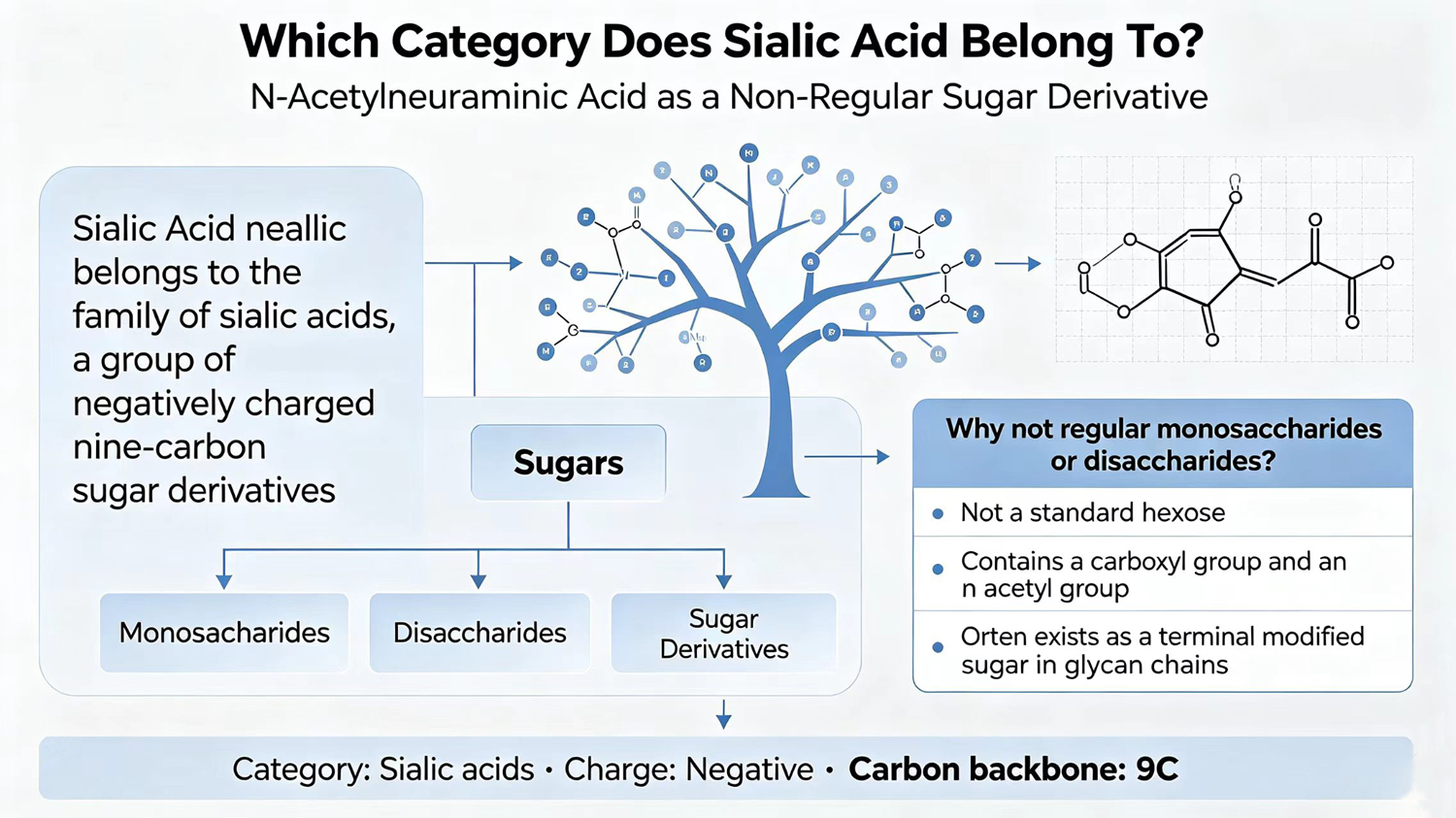
Why is it considered a sugar derivative?
Sialic acid has a carbohydrate-like backbone, but it is structurally modified compared with simple sugars.
Its structure contains:
- 9 carbon atoms, rather than the 3–7 carbons typical of common monosaccharides.
- A carboxylic acid group (–COOH), which gives it acidic properties.
- A keto group (C=O) at C-2.
- An N-acetylamino group (–NHCOCH₃).
- A deoxy modification, meaning it lacks an oxygen atom that would occur in the corresponding parent sugar.
- It commonly exists in a cyclic α-keto form in biological systems.
Therefore, it is not simply an unmodified aldose or ketose such as glucose or fructose.
Why isn’t it a regular monosaccharide?
There is an important distinction here: Sialic acid is technically a monosaccharide, because it is a single sugar unit and is not formed by linking two sugar molecules.
However, it is not a “regular” or simple monosaccharide such as glucose, galactose, or fructose. It is a specialized modified monosaccharide.
Its unusual 9-carbon structure and carboxylic-acid functionality place it in the nonulosonic acid/sialic acid family.
So the most accurate statement is:
Sialic acid is a monosaccharide in the broad structural sense, but it is classified more specifically as a modified monosaccharide (a 9-carbon nonulosonic acid) rather than a conventional simple monosaccharide.
Why isn’t it a disaccharide?
A disaccharide contains two monosaccharide units joined by a glycosidic bond.
Examples:
- Glucose + fructose → sucrose
- Glucose + galactose → lactose
- Glucose + glucose → maltose
Sialic acid is one molecular sugar unit, not two sugar residues joined together. Therefore, it is not a disaccharide.
Importantly, sialic acid can occur as a terminal residue attached to other sugars in oligosaccharides and glycoproteins. In that situation, the larger molecule may be an oligosaccharide or glycan, but the Neu5Ac residue itself remains a single modified monosaccharide.
Simple classification hierarchy
Carbohydrates
→ Monosaccharides
→ Modified monosaccharides / sugar derivatives
→ Nonulosonic acids
→ Sialic acids
→ N-Acetylneuraminic acid (Neu5Ac)
Thus, if you are preparing a classification table for carbohydrate derivatives, the best category is:
Sialic acid (N-acetylneuraminic acid) → acidic amino sugar derivative / modified monosaccharide → nonulosonic acid.