
Sepiwhite MSH and tranexamic acid (TXA) are both skin-brightening agents, but they target pigmentation through different biological pathways. For general cosmetic hyperpigmentation, Sepiwhite is a melanocyte-signaling inhibitor; for melasma and inflammation/vascular-associated pigmentation, topical TXA has a stronger clinical evidence base.
| Feature | Sepiwhite MSH | Tranexamic Acid |
| INCI/chemical name | Undecylenoyl Phenylalanine | Tranexamic Acid |
| Type | Lipoamino-acid cosmetic active | Synthetic lysine analogue/antifibrinolytic |
| Main target | α-MSH signaling → melanogenesis | Plasmin/plasminogen pathway → melanocyte stimulation |
| Effect on tyrosinase | Indirectly reduces its metabolic activation | Indirectly suppresses melanogenic signaling |
| Best suited for | Dark spots, uneven tone, tanning, general hyperpigmentation | Melasma, PIH and UV/inflammation-associated pigmentation |
| Evidence | Good cosmetic/ingredient studies; some clinical data | More clinical studies specifically in melasma |
| Typical topical level | Seppic recommends 2% for Sepiwhite MSH | Common cosmetic formulations: ~2–5% |
| Irritation | Generally well tolerated | Usually well tolerated topically, but irritation/erythema can occur |
| Oral/systemic use | No | Tranexamic Acid is also a systemic drug, but oral use for melasma requires medical supervision |
| Main advantage | Directly targets the α-MSH pigmentation pathway | Stronger evidence for melasma-related pigmentation pathways |
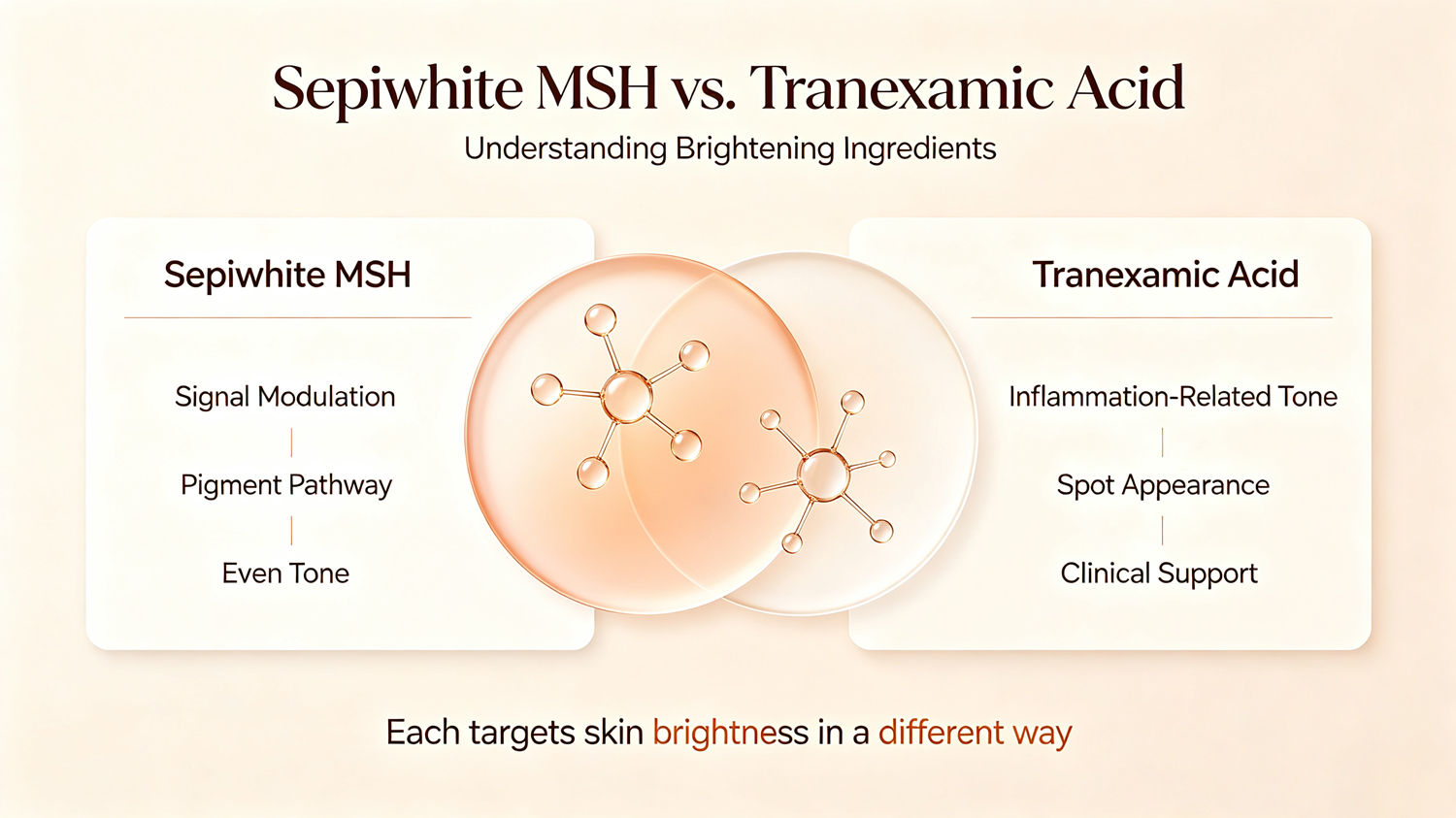
1. Mechanism: Sepiwhite MSH
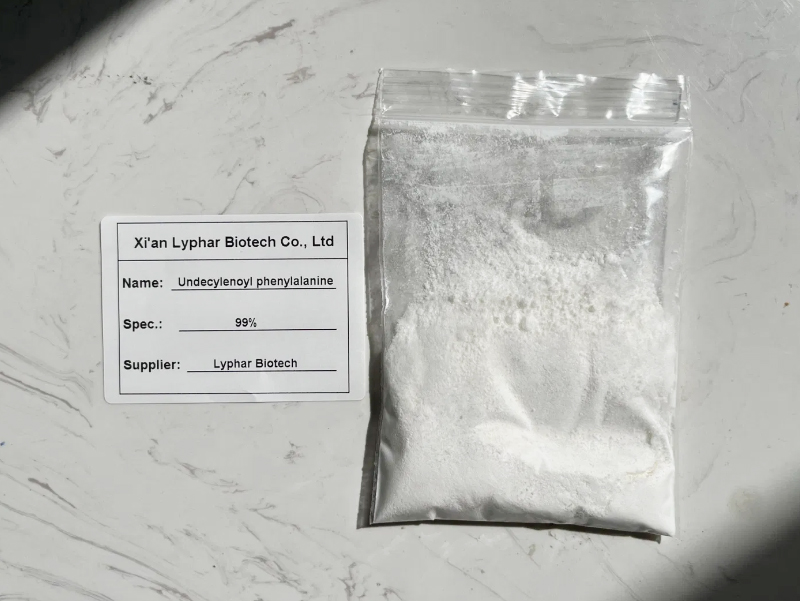
Sepiwhite MSH is undecylenoyl phenylalanine. The manufacturer describes it as an α-MSH-pathway modulator that inhibits the metabolic activation of tyrosinase.
The simplified pathway is:
UV/inflammatory stimulus → α-MSH signaling → melanocyte activation → tyrosinase activation → melanin synthesis
Sepiwhite interferes with the α-MSH portion of this pathway, thereby reducing melanogenic activity.
There is also clinical evidence for undecylenoyl phenylalanine in combination with niacinamide: a double-blind split-face study found that 1% undecylenoyl phenylalanine + 5% niacinamide reduced facial hyperpigmentation more effectively than niacinamide alone after 8 weeks.
2. Mechanism: Tranexamic acid
Tranexamic Acid works differently. It inhibits plasmin/plasminogen activity, which can reduce downstream inflammatory and melanogenic signaling in the skin.
One proposed pathway is:
UV/inflammation → uPA/plasminogen → plasmin → inflammatory mediators/PGE₂/α-MSH-related signaling → melanocyte activation → melanin
By interfering with this system, Tranexamic Acid can reduce melanocyte stimulation. Reviews also describe effects involving inflammatory mediators, prostaglandins and endothelin-1.
Importantly, a 12-week study of 2% topical Tranexamic Acid in 23 people with melasma found significant improvement in mMASI in 22 participants and reduced epidermal melanin; endothelin-1 was also downregulated.
Which is better for different pigmentation?
For melasma → Tranexamic acid has the edge.
There are multiple clinical studies specifically evaluating topical Tranexamic Acid for melasma, including randomized trials. However, results aren’t uniformly positive: one 5% topical Tranexamic Acid trial found pigmentation improvement but no significant superiority over vehicle, illustrating that formulation and patient population matter.
For ordinary dark spots/uneven tone → Sepiwhite MSH is a very reasonable cosmetic active.
Its mechanism is particularly attractive when the formulation is designed around reducing α-MSH-driven melanogenesis. Seppic currently recommends 2% use for its standard Sepiwhite MSH material.
For post-inflammatory hyperpigmentation → Tranexamic Acid may have an advantage, because its mechanism addresses inflammatory signaling in addition to melanogenesis.
For tanning/UV-induced pigmentation → either can be useful, but rigorous photoprotection is more important than choosing between the two.
Can they be combined?
Yes, they are mechanistically complementary.
A formulation could theoretically attack pigmentation at two different levels:
→ ↓ α-MSH signaling
→ ↓ tyrosinase activation
→ ↓ melanin production
Tranexamic Acid
→ ↓ plasmin pathway
→ ↓ inflammatory/melanogenic mediators
→ ↓ melanocyte stimulation
So a Sepiwhite MSH + Tranexamic Acid + niacinamide formulation is scientifically plausible, although the evidence for the specific three-ingredient combination is not equivalent to evidence for each ingredient individually.
Bottom line
If I were ranking them specifically for hyperpigmentation:
Melasma:
Tranexamic Acid ⭐⭐⭐⭐⭐ > Sepiwhite MSH ⭐⭐⭐⭐
Post-inflammatory hyperpigmentation:
Tranexamic Acid ⭐⭐⭐⭐⭐ > Sepiwhite MSH ⭐⭐⭐⭐
General dark spots/uneven complexion:
Sepiwhite MSH ⭐⭐⭐⭐½ ≈Tranexamic Acid ⭐⭐⭐⭐½
α-MSH/tyrosinase-targeted cosmetic formulation:
Sepiwhite MSH ⭐⭐⭐⭐⭐
Clinical evidence specifically for melasma:
TXA has the stronger evidence base.
And neither should be viewed as a substitute for broad-spectrum sunscreen, because UV exposure can continually reactivate pigmentation pathways.
If you’re comparing them for formulation development, the most interesting next comparison would be Sepiwhite MSH vs Tranexamic Acid vs Alpha-Arbutin vs Kojic Acid vs Niacinamide, including mechanism, effective concentration, stability, pH, compatibility, evidence strength, and expected brightening power.