
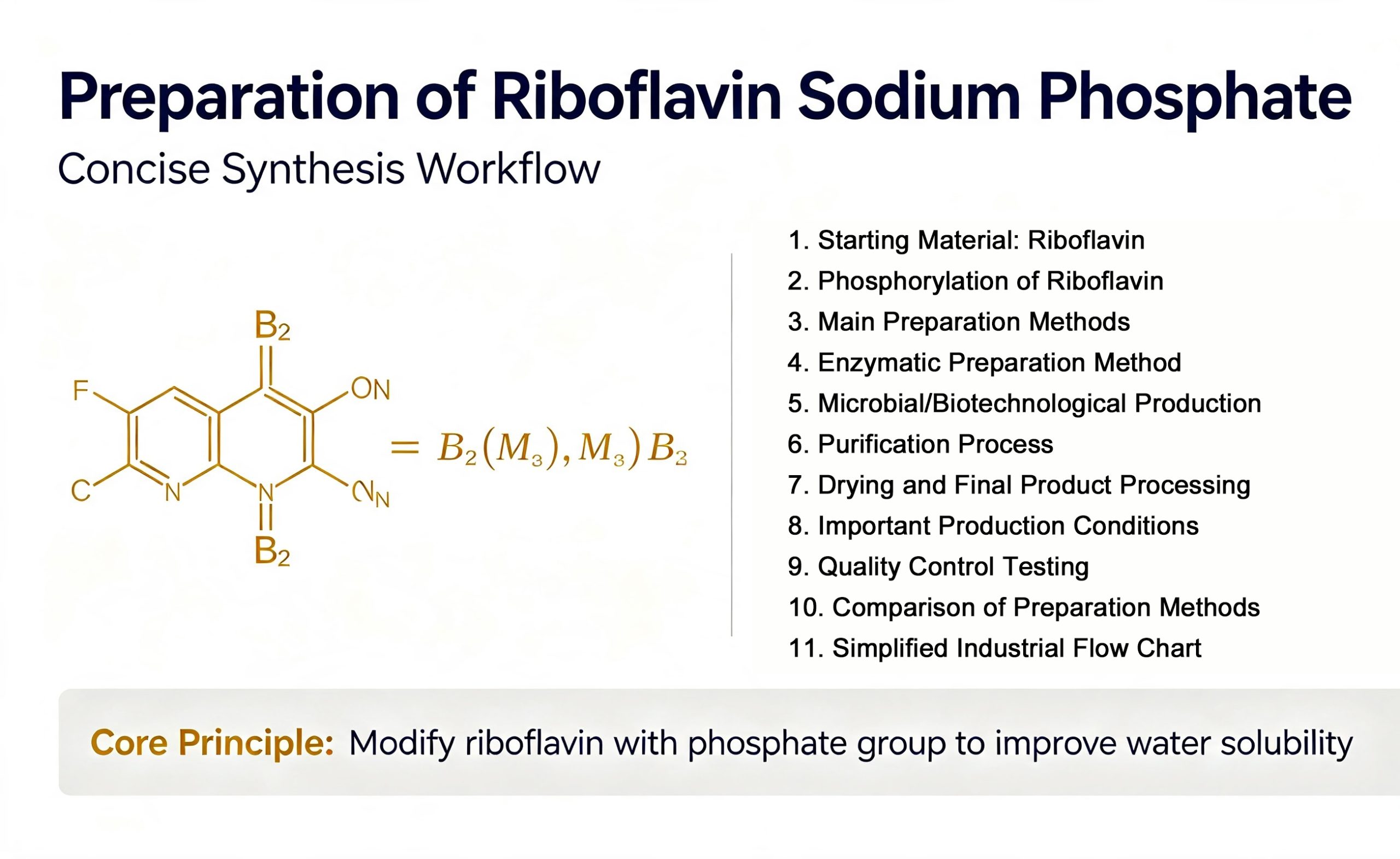
Riboflavin Sodium Phosphate (RSP), also known as Riboflavin-5′-phosphate sodium, FMN sodium salt, or flavin mononucleotide sodium, is prepared by converting riboflavin (Vitamin B2) into its phosphorylated coenzyme form and then forming the sodium salt.
The overall process is:
Riboflavin → Phosphorylation → Riboflavin-5′-phosphate → Sodium salt formation → Purification → Drying
1. Starting Material: Riboflavin
The starting compound is purified riboflavin, which may be obtained from:
- Chemical synthesis
- Microbial fermentation (common industrial source)
Common production microorganisms include:
- Ashbya gossypii
- Bacillus subtilis
- Engineered microbial strains
The riboflavin is purified before phosphorylation.
2. Phosphorylation of Riboflavin
The key reaction introduces a phosphate group onto the 5′-hydroxyl group of the ribityl side chain.
Reaction:
Riboflavin+Phosphate donor→Riboflavin-5′-phosphate
The product is FMN (flavin mononucleotide).
3. Main Preparation Methods
Method 1: Chemical Phosphorylation
This is the traditional industrial method.
Step 1: Phosphate Ester Formation
Riboflavin reacts with a phosphorylating reagent.
Common reagents:
- Phosphorus oxychloride (POCl₃)
- Phosphoric acid
- Polyphosphoric acid
- Phosphate anhydrides
Example:
Riboflavin+POCl3→Riboflavin-5′-phosphate
The reaction is controlled to favor phosphorylation at the 5′ position.
Step 2: Hydrolysis
Excess phosphorylating reagent is removed by hydrolysis:
POCl3+H2O→H3PO4+HCl
The reaction mixture is treated to remove unwanted acidic components.
Step 3: Neutralization
The acidic riboflavin phosphate is converted into sodium salt.
Reaction:
FMN-H+NaOH→FMN-Na+H2O
The pH is adjusted to obtain:
Riboflavin-5′-phosphate sodium
4. Enzymatic Preparation Method
A more selective modern method uses enzymes.
Enzyme:
Riboflavin kinase
Reaction:
Riboflavin+ATP→FMN+ADP
The enzyme transfers a phosphate group from ATP to riboflavin.
Advantages:
- High selectivity
- Fewer by-products
- Mild reaction conditions
- Environmentally friendly
Disadvantages:
- Higher production cost
- More complex bioprocess control
5. Microbial/Biotechnological Production
Some microorganisms naturally produce FMN during vitamin B2 metabolism.
Pathway:
Glucose
↓
Riboflavin
↓ (riboflavin kinase)
FMN
↓ (FMN adenylyltransferase)
FAD
Industrial approaches may combine:
- Fermentation production of riboflavin
- Enzymatic conversion to FMN
- Sodium salt formation
6. Purification Process
After phosphorylation, the reaction mixture contains:
- Riboflavin
- FMN
- Unreacted phosphate compounds
- Side products
Purification steps include:
Filtration
Removes insoluble materials.
Ion exchange purification
Separates:
- FMN
- Riboflavin
- Ionic impurities
Adsorption purification
Uses resins to selectively capture flavin compounds.
Crystallization
Produces purified riboflavin sodium phosphate crystals.
7. Drying and Final Product Processing
Purified Riboflavin Sodium Phosphate is dried by:
- Vacuum drying
- Spray drying
- Freeze drying
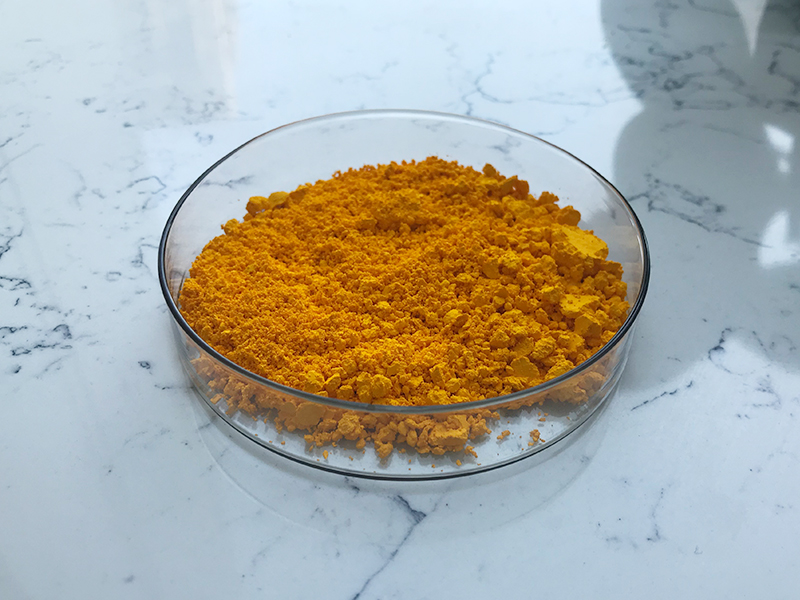
The final product is commonly supplied as:
- Riboflavin-5′-phosphate sodium dihydrate
- Yellow-orange crystalline powder
8. Important Production Conditions
Because riboflavin compounds are sensitive, manufacturers control:
Light exposure
Riboflavin is photosensitive.
Protection:
- Dark reaction vessels
- Amber containers
- Reduced UV exposure
Temperature
Excessive heat may cause degradation.
Controlled temperatures help prevent:
- Lumichrome formation
- Lumiflavin formation
pH
pH control is important because:
- Strong acidity may degrade flavins
- Strong alkalinity may affect stability
9. Quality Control Testing
Pharmaceutical and food-grade Riboflavin Sodium Phosphate is tested for:
Identity
- HPLC
- UV-visible spectroscopy
- FTIR
- NMR
Purity
- Riboflavin content
- Related flavin compounds
- Residual solvents
- Heavy metals
Physical properties
- Water content
- Particle size
- Solubility
- Color
10. Comparison of Preparation Methods
| Method | Advantages | Limitations |
| Chemical phosphorylation | Mature, scalable, economical | More purification required |
| Enzymatic phosphorylation | High selectivity, cleaner product | Higher cost |
| Fermentation-based route | Sustainable, renewable | Requires biological optimization |
11. Simplified Industrial Flow Chart
Riboflavin raw material
↓
Phosphorylation reaction
↓
FMN formation
↓
Neutralization with sodium hydroxide/sodium salt formation
↓
Purification
↓
Concentration
↓
Crystallization
↓
Drying
↓
Riboflavin Sodium Phosphate powder
Summary
The preparation of Riboflavin Sodium Phosphate involves the conversion of riboflavin into its phosphorylated active coenzyme form:
Riboflavin + phosphate donor → Riboflavin-5′-phosphate → Sodium salt
The most important production goals are:
- High phosphorylation efficiency
- High purity
- Protection from light and oxidation
- Stable sodium salt formation
Because of its superior water solubility and formulation properties, Riboflavin Sodium Phosphate is widely used in food fortification, nutritional supplements, pharmaceutical preparations, and specialized medical formulations.