
BAM-15 is a mitochondrial uncoupler that has been studied for its effects on metabolism, obesity, and insulin sensitivity. Its mechanism on insulin sensitivity and glucose regulation can be explained through several interconnected pathways:
1. Mitochondrial Uncoupling
- BAM-15 disrupts the proton gradient across the inner mitochondrial membrane, allowing protons to flow back into the mitochondrial matrix without generating ATP.
- This increases energy expenditure because cells need to burn more substrates (like glucose and fatty acids) to maintain ATP levels.
- The resulting metabolic shift reduces lipid accumulation in tissues such as liver and muscle, which is a major contributor to insulin resistance.
2. Reduction of Lipotoxicity
- Excess fatty acids in liver and muscle interfere with insulin signaling by activating stress kinases (e.g., JNK, PKC) that inhibit the insulin receptor pathway.
- BAM-15 promotes fat oxidation and reduces ectopic lipid storage, thereby restoring insulin signaling in peripheral tissues.
3. Improved Insulin Signaling
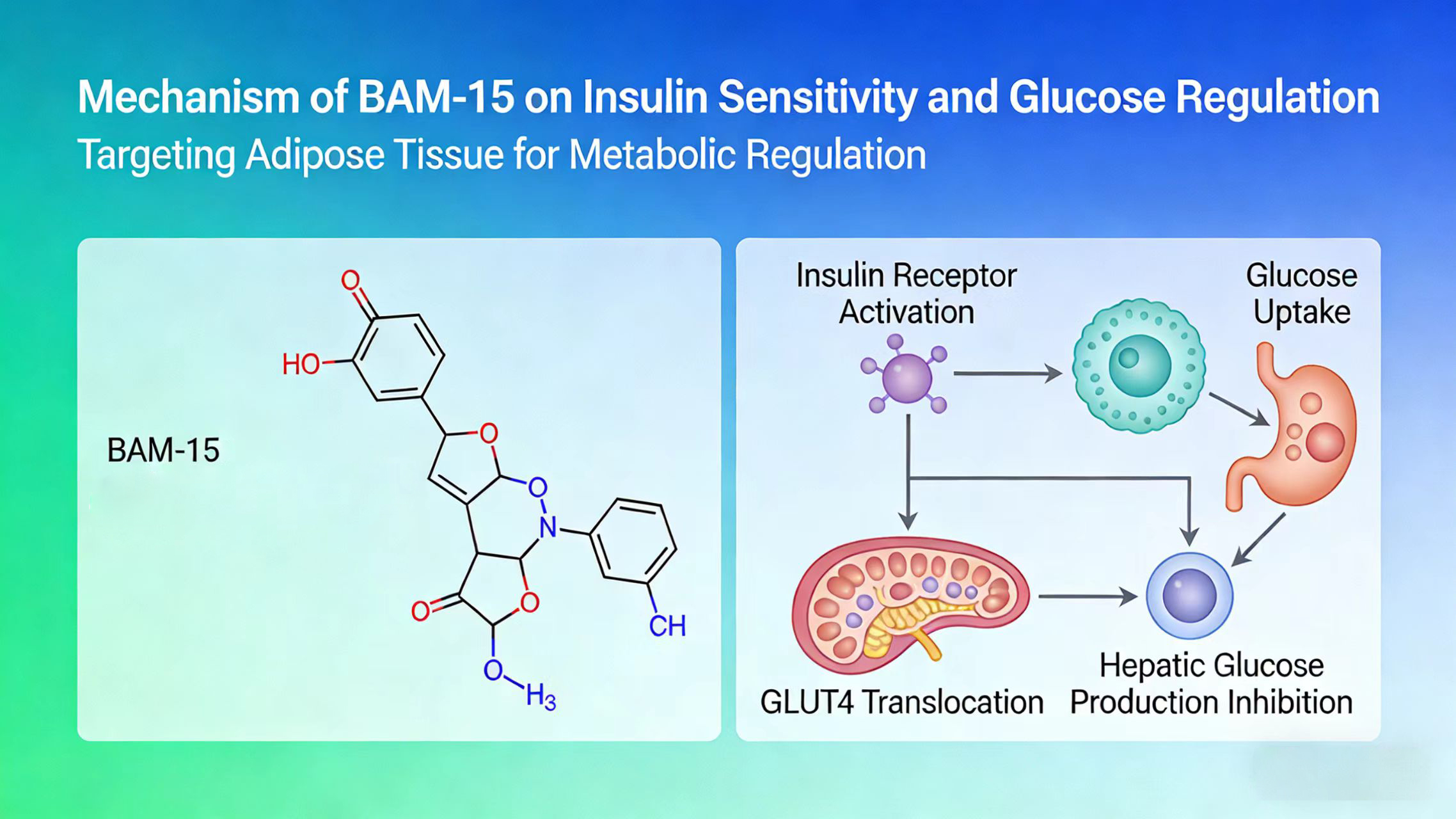
Studies in obese or high-fat diet animal models have shown that BAM-15 increases phosphorylation of key insulin signaling proteins, such as:
- AKT (protein kinase B) – enhances glucose uptake in muscle and adipose tissue.
- IRS-1 (insulin receptor substrate-1) – facilitates effective insulin receptor signaling.
By improving the insulin cascade, BAM-15 enhances glucose uptake in insulin-sensitive tissues.
4. Enhanced Glucose Homeostasis
- BAM-15 is uncoupling effect increases basal metabolic rate, leading to higher glucose utilization.
- Lower intracellular lipid levels and improved mitochondrial function also reduce hepatic gluconeogenesis (glucose production by the liver).
- The combined effect is lower blood glucose levels and improved glycemic control.
5. Anti-Inflammatory Effects
- Chronic inflammation contributes to insulin resistance by impairing insulin signaling.
- BAM-15 reduces reactive oxygen species (ROS) production and inflammation in metabolic tissues, indirectly supporting better insulin sensitivity.
Summary
In essence, BAM-15 improves insulin sensitivity and glucose regulation by:
- Increasing energy expenditure via mitochondrial uncoupling.
- Reducing lipid accumulation in liver and muscle.
- Restoring insulin signaling pathways.
- Enhancing glucose uptake and utilization.
- Reducing inflammation and oxidative stress.
If you want, I can also draw a mechanistic diagram showing BAM-15 is effect on mitochondria, fat metabolism, and insulin signaling, which makes this much clearer visually.
Do you want me to make that diagram?